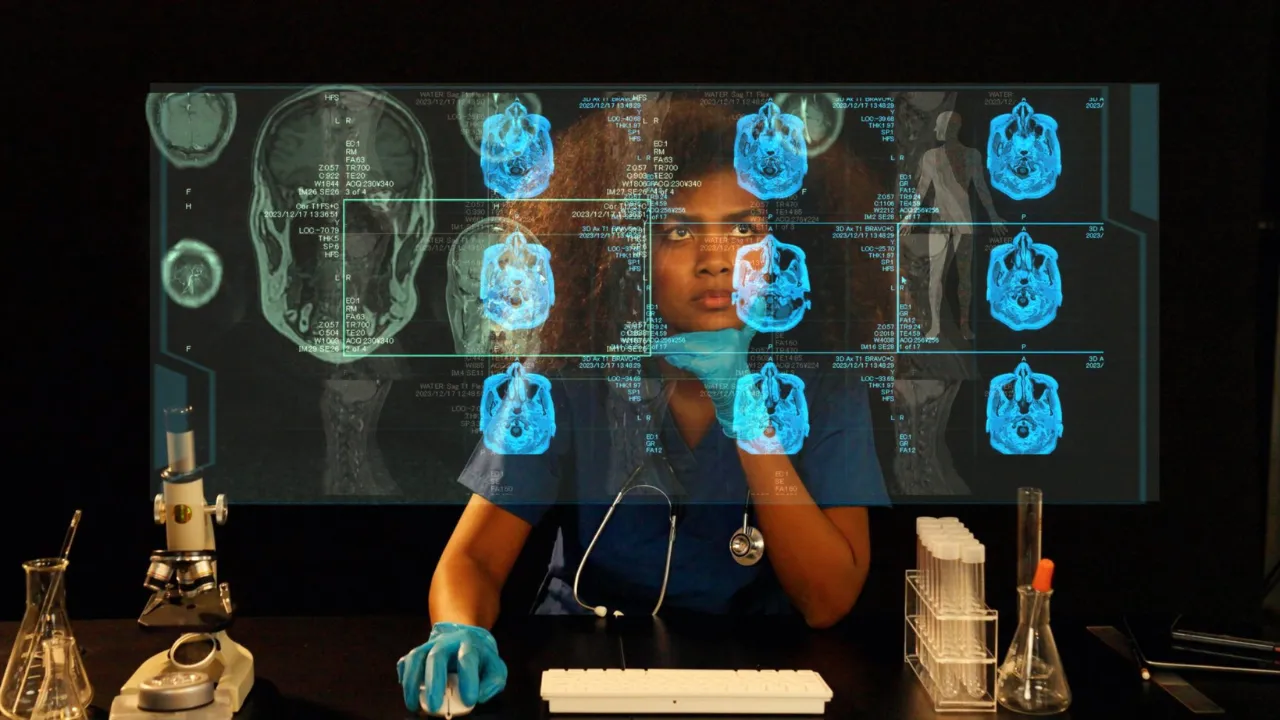
When a patient expects surgery and a surgeon decides not to operate, something uncomfortable happens. The patient feels abandoned. The family wants answers. The institution wants action. Every signal in the room says: do something.
Co-author Dr. James Naples faced exactly this with a patient who had a serious infection and clear expectations of a surgical fix. Naples considered the substantial risks and chose to wait. He slow-played the decision, monitored regularly, resisted the pull toward intervention. The patient recovered without surgery.

While that story sounds simple, it isn’t. Patients, boards, markets, and peers all exert pressure to act to address uncertainty, triggering one of the most powerful and least examined forces in high-stakes decision-making. In both the operating room and the boardroom, seeking certainty prematurely is often what causes the most damage. This is what we call the uncertainty paradox: we only achieve greater certainty from sitting long enough with our uncertainty.
The surgical field offers an unusually clear window into this uncertainty paradox because the stakes are unambiguous. Three practices drawn from surgery and the leadership experiences of executives who’ve applied them illuminate how the best decision-makers paradoxically reduce uncertainty by inducing it.

Consider the cochlear implant. The surgical procedure involves implanting a complex, electrical device that allows deaf children and adults to hear. Resistance was fierce across stakeholders. Doctors were worried about the results. Patients did not want to be human experiments. The public thought it was the first step towards bionic humans. The reactions were so fierce that an early implant recipient described how her parents had tomatoes thrown at them as they exited the hospital.
Surgeons who pushed forward anyway did so against every institutional signal telling them to stop. The pressure to retreat to certainty was social, political and visceral. By embracing that uncertainty anyway, these brave surgeons produced an innovative implant that is now widely accepted. Cochlear implant recipients did not become bionic. They became more human, by advancing their hearing, learning to speak and entering a society once closed off to them.
Lesson 1: Steer Into the Skid
Certainty isn’t safe, but rather familiar. Futurist Amy Webb uses the metaphor of driving on ice. When you slam on your brakes and start to skid, your instinct is to turn the wheel in the opposite direction. That instinct accelerates the crash. In contrast, effectively navigating ice requires steering into the skid.
Pioneering neurosurgeon Harvey Cushing steered into the skid when he decided to approach tumors of the pituitary gland through the nose. Every established surgeon around him had a practiced, accepted method that killed more patients than Cushing’s unorthodox route did. Despite the uncertainty and unorthodox nature of Cushing’s approach, it minimized mortality and established a new standard.

Zita Cobb ran the same calculation when she was seeking to support rural community development. After rising to become the third highest-paid female executive in Canada as COO of JDS Uniphase, she walked away from corporate predictability to confront one of the most disorienting consequences of globalization: the erosion of local knowledge, culture, and economic resilience. Cobb returned to her tiny home of Fogo Island, off the remote coast of Newfoundland, and embraced an audacious, improbable idea of building a luxury inn for the global elite in one of the most isolated communities in the country.
She knew the global attention she was courting could destroy the very culture she was trying to preserve. Local residents resisted. The idea looked absurd from the outside. By leaning into uncertainty, Cobb continually negotiated the challenges of connecting global elites with local knowledge and culture and developed a host of innovative solutions. The Inn not only redeveloped the economy on Fogo Island and valued distinct local knowledge and skills, it has been a model for rural community building across the globe.
Lesson 2: Walk the Tightrope
In every surgery, a complex decision arises: “Should I keep going, or should I stop?” To keep going means a chance of bleeding, complication, injury, or death. A better outcome is being cancer- or disease-free. Stopping limits downside but also limits upside.
Co-author Wendy Smith calls this “tightrope walking”; not balance, which implies stasis, but constant recalibration against a live tension.
Gord Lambert ran this dynamic explicitly while constructing Canadian Oil Sands Innovation Alliance (COSIA). Lambert knew that the industry needed to clean up its environmental practices in the face of extreme environmentalist pressure. He pushed industry leaders toward bold, collective experimentation, sharing intellectual property, pooling research, and jointly investing in environmental innovations that no company could achieve alone. But he knew that if he pushed too hard, the highly competitive CEOs would all reject the idea.
The tightrope was live: too much pressure and the CEOs walked; too little and the environmental commitment collapsed into PR. Lambert’s leadership exemplifies the tightrope: advancing into uncertainty with courage, while maintaining the structure needed to protect trust and shared purpose.
Lesson 3: Freeze the Frame
The most counterintuitive surgical move isn’t a new technique. It’s choosing not to operate when the room expects you to.
When Naples slow-played his decision on the infected patient by monitoring instead of cutting, he was working against every social signal in the room. Patients prefer action, and families want plans.
“Deliberate inaction” is like a CEO telling a board to stay the course as sales drop. Nobody wants to hear it.
Alfred Sloan, ex-CEO of General Motors, allegedly asked at the beginning of a board meeting whether everyone agreed. When everyone said yes, he responded: “Then I propose we give ourselves time to develop disagreement and perhaps gain some understanding of what the decision is all about.”
The data backs this instinct. An in-depth analysis of how more than 100 German chief executives responded to the EU’s 2004 enlargement found that CEOs who paused and approached the situation with detached curiosity significantly outperformed more action-oriented peers. They “considered a wider range of responses; included more diverse voices in decision making; and responded with more novel and resourceful measures.”
The common thread across all three practices is not a tolerance for uncertainty, but rather a resistance to institutional gravity that demands premature resolution. In surgery, that gravity gets people killed. In business, it just looks like everyone making the same confident mistake at the same time. Embracing the uncertainty paradox requires courage but ultimately enables better outcomes.
Written by James G. Naples, Wendy K. Smith, and Scott D. Anthony for Fortune as “The uncertainty paradox: believe it or not, today’s massive uncertainty creates the best conditions for disruptive growth” and republished with permission. Dr. James G. Naples is an Assistant Professor at Harvard Medical School and a surgeon at Beth Israel Deaconess Medical Center, Wendy K. Smith is a Professor at the University of Delaware and the author of Both/And Thinking, and Scott. D. Anthony is a Clinical Professor at the Tuck School of Business at Dartmouth College and the author of Epic Disruptions.