




GUAYNABO, PR, September 16, 2026 — Gen Z is entering a very different labor market than Millennials did nearly two decades ago. Young Gen Z adults are less likely to participate in the labor force or be employed, but those who enter the workforce face lower unemployment, and those working full time earn more in real terms.
Zety®, a leading resume builder, released its Early-Career Labor Market Report, analyzing U.S. Bureau of Labor Statistics data for adults ages 20–24 during two comparable early-career periods: Millennials from 2005–2008 and Gen Z from 2021–2024.

The comparison looks at labor force participation, employment, unemployment, and inflation-adjusted weekly earnings to show how the early-career labor market has changed across generations.
Key Findings
- Gen Z is less present in the labor force: Gen Z adults have an average labor force participation rate of 71.1%, representing those working or actively looking for work, versus 74.5% for Millennials at the same age.
- A smaller share of Gen Z is employed: Gen Z’s employment-population ratio averaged 65.8%, below the Millennial average of 67.9%.
- Gen Z labor-force participants experienced lower unemployment: The unemployment rate averaged 7.5% for Gen Z, compared with 8.9% for Millennials.
- Full-time Gen Z workers outpace Millennials on pay: Inflation-adjusted median weekly earnings averaged approximately $756 for Gen Z and $674 for Millennials.
Gen Z Has a Weaker Connection to the Labor Force
The share of young adults participating in the labor force was consistently lower during the Gen Z period.

From 2021 through 2024, labor-force participation among adults ages 20–24 averaged 71.1%. When Millennials were the same age from 2005 through 2008, the rate averaged 74.5%.
That 3.4-percentage-point difference means a greater share of Gen Z adults are outside the labor force entirely, neither working nor actively looking for work.
A similar, although narrower, difference appears in employment. Gen Z’s employment-population ratio averaged 65.8%, compared with 67.9% for Millennials. In other words, a smaller percentage of Gen Z adults ages 20–24 held jobs during the period studied.
| Early-career metric
|
Millennials Ages 20-24 (2005–2008)
|
Gen Z Ages 20-24 (2021–2024)
|
Gen Z Difference
|
| Labor force participation
|
74.5%
|
71.1%
|
−3.4 pp
|
| Employment-population ratio
|
67.9%
|
65.8%
|
−2.1 pp
|
| Unemployment rate
|
8.9%
|
7.5%
|
−1.4 pp
|
Source: U.S. Bureau of Labor Statistics Current Population Survey, Table 3, annual averages.

Gen Z’s Lower Unemployment Rate Tells a Different Story
Despite having lower participation and employment rates, Gen Z did not experience higher unemployment.
The unemployment rate averaged 7.5% during the Gen Z period, compared with 8.9% during the Millennial period. That represents a 1.4-percentage-point advantage for Gen Z.
The distinction is important. The unemployment rate measures the percentage of labor-force participants who are jobless, available to work, and actively looking for a job. It does not include people who are outside the labor force.
In other words, Gen Z adults are less likely to participate in the labor market overall, but those who do participate are less likely to be unemployed than Millennials were at the same age.
Full-Time Gen Z Workers Earn 12% More
Gen Z also has an earnings advantage.
Inflation-adjusted median weekly earnings for full-time wage and salary workers ages 20–24 averaged $756.25 from 2021 through 2024. For Millennials in the same age group from 2005 through 2008, the average was $673.50.
That amounts to approximately $83 more per week, or a 12.3% difference in Gen Z’s favor. 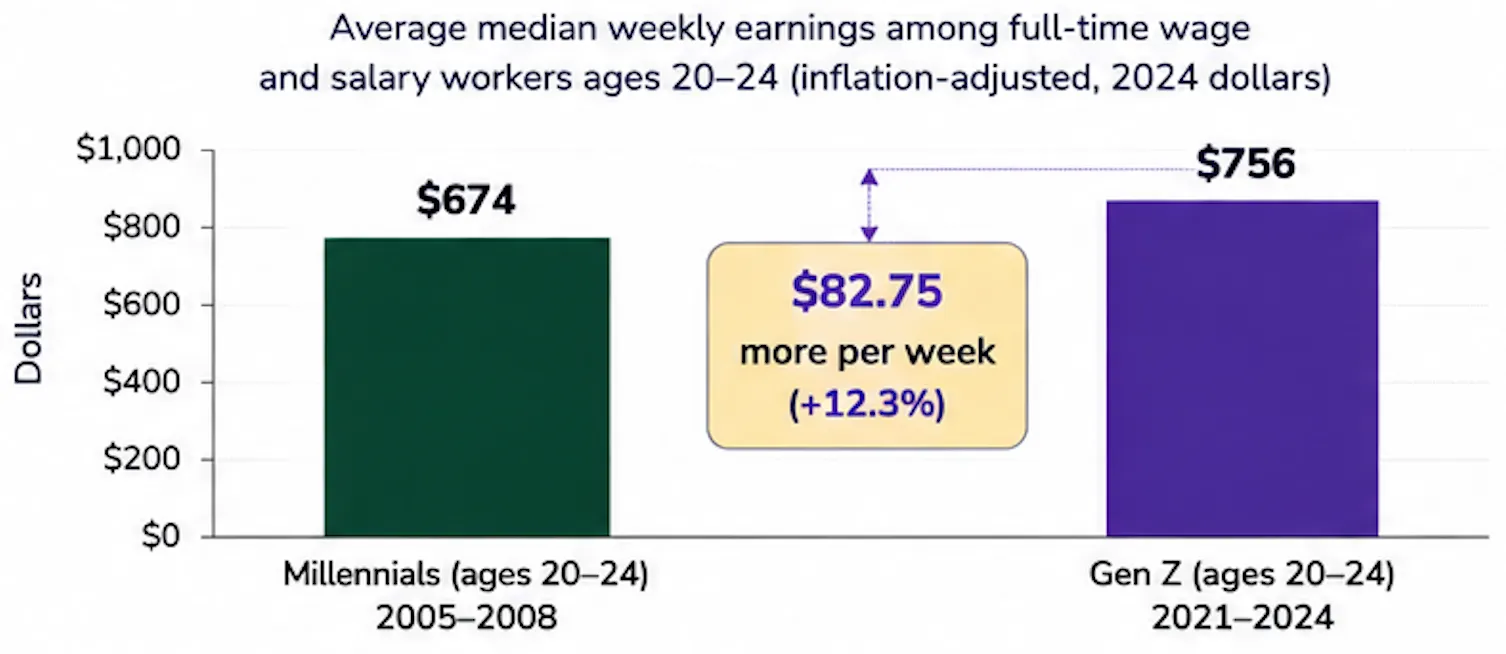
Source: U.S. Bureau of Labor Statistics Current Population Survey, Table 17, annual averages.
On an annualized basis, these weekly earnings equate to approximately $39,300 for Gen Z and $35,000 for Millennials, a difference of roughly $4,300 per year. Because the comparison is expressed in 2024 dollars and adjusted for inflation, the difference reflects higher inflation-adjusted weekly earnings rather than simply the effect of rising wages and prices over time.
A Mixed Early-Career Picture
Taken together, there is no clear indication that either generation had a stronger start overall.
Millennials were more likely to participate in the labor force and more likely to be employed at ages 20–24. Gen Z labor-force participants, however, experienced lower unemployment, while full-time Gen Z workers received higher inflation-adjusted weekly pay.
The result is a divide between access and outcomes. A smaller share of Gen Z has established a place in the workforce, but those working full time are earning more than Millennials did at the same age.

The comparison does not establish why Gen Z participation is lower. Factors such as school enrollment, economic conditions, caregiving responsibilities, delayed workforce entry, and decisions about whether to look for work may all affect whether young adults participate in the labor force.
For detailed insights on the Early-Career Labor Market Report, access the full study at https://zety.com/blog/early-career-labor-market-report or contact Skyler Acevedo, at [email protected].
Methodology
This analysis compares labor-market outcomes and median weekly earnings for Millennials and Gen Z at the same early-career age using data from the U.S. Bureau of Labor Statistics’ Current Population Survey (CPS).
To clarify how the labor-market measures are calculated, BLS defines employment status as follows:
- Employed: People who have jobs.
- Unemployed: People who are jobless, but are looking for work and available to work.
- Labor force: The combined group of employed and unemployed people.
Based on Pew Research Center’s commonly used generational boundaries, Millennials are defined as people born from 1981 through 1996, while Gen Z begins with those born in 1997.
To create an age-consistent comparison, the analysis examines Americans ages 20–24 during four-year periods in which the entire age group falls within each generation. The Millennial comparison covers 2005–2008, when Americans ages 20–24 were born between 1981 and 1989. The Gen Z comparison covers 2021–2024, when Americans ages 20–24 were born between 1997 and 2005.
Due to the 2025 federal government shutdown, BLS did not collect CPS data for October 2025. As a result, BLS annual estimates for 2025 are based on 11 monthly observations rather than 12, and were excluded from this analysis. As a robustness check, results were tested using five-year periods ending in 2009 and 2025, including the 2025 CPS annual estimates. The directional findings were unchanged: Gen Z had lower labor-force participation and employment-population rates, while Millennials had higher unemployment.
Limitations
This comparison reflects outcomes during two different four-year economic periods, including the onset of the Great Recession in 2008 and the pandemic-era labor market recovery beginning in 2021. The results describe the experiences of each generation during the periods studied and do not establish that generational differences caused the outcomes.
About Zety
Zety’s Resume Builder is a premier platform that leverages advanced AI tools to help job seekers stand out and land interviews effortlessly. Offering step-by-step guidance, curated content suggestions, and 100s of professional, ATS-friendly resume templates, it allows users to feel confident crafting tailored applications. Millions of professionals rely on Zety’s interactive suite—which also features an easy-to-use Cover Letter Generator—to produce high-quality documents that are free to create and ready to download. Since 2016, Zety’s career blog has provided free data-driven insights aimed at empowering professionals at every stage of their journey. The editorial team includes Certified Professional Resume Writers, with the best career advice and evidence-based findings featured in Business Insider, CNBC, and Forbes, among others. Stay connected with Zety on LinkedIn, Facebook, Instagram, and YouTube for free expert career tips and updates. Follow Zety as a preferred source in Google to receive more workforce trends, career insights, and labor market research in your personalized search experience.