
Advertisements
Your Brand Deserves The Spotlight - Advertise With Us - Allwork.Space
  • Marketplace
  • Resources
  • Business Directory
  • Events
  • Advertise
  • Publish a Press Release
  • Submit Your Story | Get Featured
  • Get the Newsletter
  • Contact
  • About Us
The FUTURE OF WORK® since 2003
Allwork.Space
No Result
View All Result
Subscribe
  • Submit Your StoryNew
  • More
    • Columnists
      • Dr. Gleb Tsipursky – The Office Whisperer
      • Nirit Cohen – WorkFutures
      • Angela Howard – Culture Expert
      • Drew Jones – Design & Innovation
      • Jonathan Price – CRE & Flex Expert
    • Get the Newsletter
    • Events
    • Advertise With Us
    • Publish a Press Release
    • Brand PulseNew
    • Partner Portal
  • Latest News
  • Business
  • Leadership
  • Work-life
  • Career Growth
  • Tech
  • Design
  • Workforce
  • Coworking
  • CRE
  • Podcast
  • Submit Your StoryNew
  • More
    • Columnists
      • Dr. Gleb Tsipursky – The Office Whisperer
      • Nirit Cohen – WorkFutures
      • Angela Howard – Culture Expert
      • Drew Jones – Design & Innovation
      • Jonathan Price – CRE & Flex Expert
    • Get the Newsletter
    • Events
    • Advertise With Us
    • Publish a Press Release
    • Brand PulseNew
    • Partner Portal
  • Latest News
  • Business
  • Leadership
  • Work-life
  • Career Growth
  • Tech
  • Design
  • Workforce
  • Coworking
  • CRE
  • Podcast
No Result
View All Result
Subscribe
Allwork.Space
No Result
View All Result
Advertisements
UltraSoftBIS Work Smarter, Not Harder
Home News

Microsoft Claims Quantum Computing Is “Years, Not Decades” Away

Microsoft unveiled the new Majorana 1 chip that accelerates quantum computing, promising breakthroughs in medicine, chemistry, and how we work.

Emma AscottbyEmma Ascott
February 19, 2025
in News
Reading Time: 3 mins read
A A
Microsoft Claims Quantum Computing Is “Years, Not Decades” Away

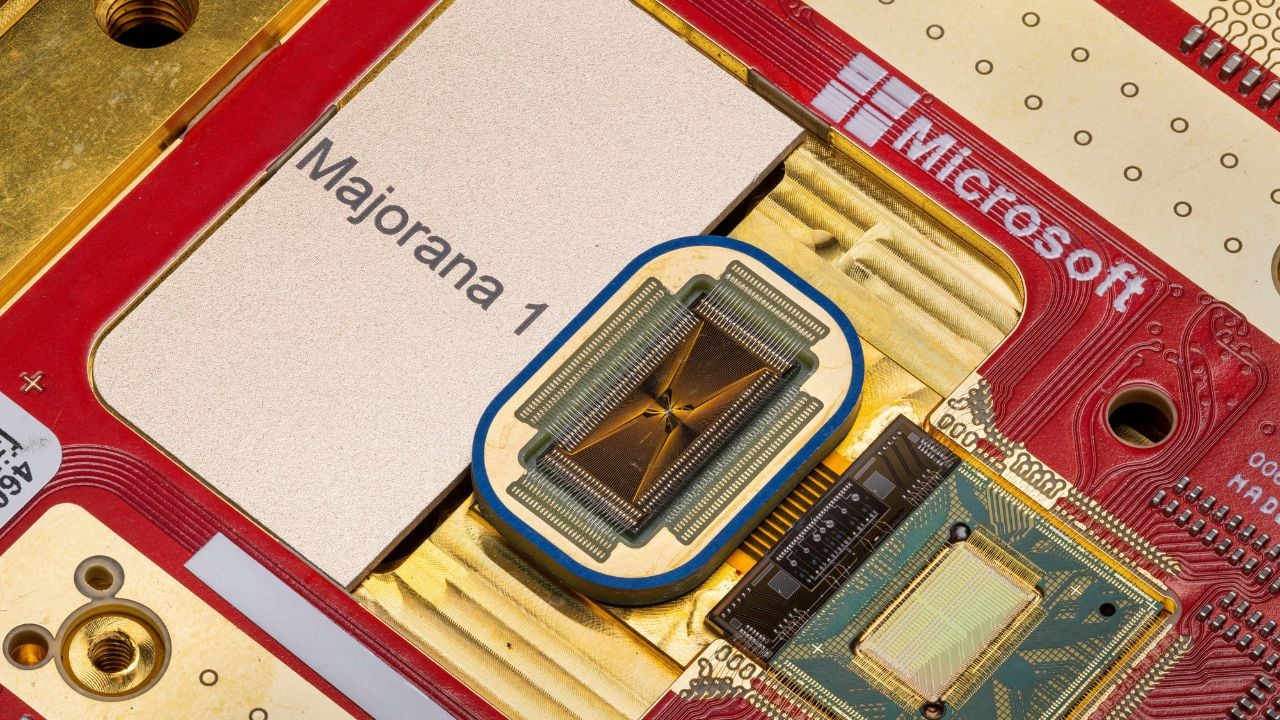
Microsoft's Majorana 1 quantum computing chip is pictured in this undated handout photo obtained by Reuters on February 19, 2025. Courtesy of Microsoft/Handout via REUTERS

Microsoft on Wednesday unveiled a new chip that it said showed quantum computing is “years, not decades” away, joining Google and IBM in predicting that a fundamental change in computing technology is much closer than recently believed.

Quantum computing holds the promise of carrying out calculations that would take today’s systems millions of years and could unlock discoveries in medicine, chemistry and many other fields where near-infinite seas of possible combinations of molecules confound classical computers.

Advertisements
UltraSoftBIS Work Smarter, Not Harder

Quantum computers also hold the danger of upending today’s cybersecurity systems, where most encryption relies on the assumption that it would take too long to brute force gain access.

The biggest challenge of quantum computers is that a fundamental building block called a qubit, which is similar to a bit in classical computing, is incredibly fast but also extremely difficult to control and prone to errors.

Advertisements
Yardi Kube automates flex & coworking operations

Microsoft’s Majorana 1 Chip: A Leap Toward Practical Quantum Computing

Microsoft said the Majorana 1 chip it has developed is less prone to those errors than rivals and provided as evidence a scientific paper set to be published in academic journal Nature.

When useful quantum computers will arrive has become a topic of debate in the upper echelons of the tech industry. Nvidia CEO Jensen Huang said last month that the technology was two decades away from overtaking his company’s chips, the workhorses of artificial intelligence, reflecting broad skepticism.

Those remarks prompted Google, which last year showed off its own new quantum chip, to say that commercial quantum computing applications are only five years away. IBM has said large-scale quantum computers will be online by 2033.

Microsoft’s Majorana 1 has been in the works for nearly two decades and relies on a subatomic particle called the Majorana fermion whose existence was first theorized in the 1930s. That particle has properties that make it less prone to the errors that plague quantum computers, but it has been hard for physicists to find and control.

Advertisements
Your Brand Deserves The Spotlight - Advertise With Us - Allwork.Space

Microsoft said it created the Majorana 1 chip with indium arsenide and aluminum. The device uses a superconducting nanowire to observe the particles and can be controlled with standard computing equipment.

The chip Microsoft revealed Wednesday has far fewer qubits than rival chips from Google and IBM, but Microsoft believes that far fewer of its Majorana-based qubits will be needed to make useful computers because the error rates are lower.

Microsoft did not give a timeline for when the chip would be scaled up to create quantum computers that can outstrip today’s machines, but the company said in a blog post that point was “years, not decades” away.

Jason Zander, the Microsoft executive vice president who oversees the company’s long-term strategic bets, described Majorana 1 as a “high risk, high reward” strategy.

More stories for you

Forget Vibe-Based Pricing, Just Use Coworking Data (1)

Forget Vibe-Based Pricing, Just Use Coworking Data

6 hours ago
How To Communicate Gen AI Change So Employees Listen, Engage, And Actually Adopt

How To Communicate Gen AI Change So Employees Listen, Engage, And Actually Adopt

8 hours ago
Added Workplace AI Features Spur Microsoft Productivity Suite Price Increases For 2026

Added Workplace AI Features Spur Microsoft Productivity Suite Price Increases For 2026

17 hours ago
U.S. Planned Layoffs Plummet 53% In November, But Still Outpace 2024 Levels

U.S. Planned Layoffs Plummet 53% In November, But Still Outpace 2024 Levels

17 hours ago

The chip was fabricated at Microsoft labs in Washington state and Denmark.

“The hardest part has been solving the physics. There is no textbook for this, and we had to invent it,” Zander said in an interview with Reuters. “We literally have invented the ability to go create this thing, atom by atom, layer by layer.”

Philip Kim, a professor of physics at Harvard University who was not involved in Microsoft’s research, said that Majorana fermions have been a hot topic among physicists for decades and called Microsoft’s work an “exciting development” that put the company at the forefront of quantum research. 

He also said that Microsoft’s use of a hybrid between traditional semiconductors and exotic superconductors appeared to be a good route toward chips that can be scaled up into more powerful chips. 

Advertisements
UltraSoftBIS Work Smarter, Not Harder

“Although there’s no demonstration (of this scaling up) yet, what they are doing is really successful,” Kim said.

(Reporting by Stephen Nellis in San Francisco; Editing by Peter Henderson and Jamie Freed)

Advertisements
Subscribe to the Future of Work Newsletter
Source: Reuters
Tags: North AmericaTechnology
Share7Tweet5Share1
Emma Ascott

Emma Ascott

Emma Ascott is a contributing writer for Allwork.Space based in Phoenix, Arizona. She graduated from Walter Cronkite at Arizona State University with a bachelor’s degree in journalism and mass communication in 2021. Emma has written about a multitude of topics, such as the future of work, politics, social justice, money, tech, government meetings, breaking news and healthcare.

Other Stories Recommended For You

Forget Vibe-Based Pricing, Just Use Coworking Data (1)
Coworking

Forget Vibe-Based Pricing, Just Use Coworking Data

byJane Robathanand1 others
6 hours ago

Data-driven pricing helps coworking operators stop revenue loss from guesswork.

Read more
How To Communicate Gen AI Change So Employees Listen, Engage, And Actually Adopt

How To Communicate Gen AI Change So Employees Listen, Engage, And Actually Adopt

8 hours ago
Added Workplace AI Features Spur Microsoft Productivity Suite Price Increases For 2026

Added Workplace AI Features Spur Microsoft Productivity Suite Price Increases For 2026

17 hours ago
U.S. Planned Layoffs Plummet 53% In November, But Still Outpace 2024 Levels

U.S. Planned Layoffs Plummet 53% In November, But Still Outpace 2024 Levels

17 hours ago
Advertisements
Nexudus - Tech Stack Lovers
Advertisements
Nexudus - Revenue

Unlock your competitive edge in tomorrow's workplace.

Join a community of forward-thinking professionals who get exclusive access to the latest news, trends, and innovations that are shaping the future of work.

2025 Allwork.Space News Corporation. Exploring the Future Of Work® since 2003. All Rights Reserved

Advertise  Submit Your Story   Newsletters   Privacy Policy   Terms Of Use   About Us   Contact   Submit a Press Release   Brand Pulse   Podcast   Events   

No Result
View All Result
  • Home
  • Latest News
  • Topics
    • Business
    • Leadership
    • Work-life
    • Workforce
    • Career Growth
    • Design
    • Tech
    • Coworking
    • Marketing
    • CRE
  • Podcast
  • Events
  • About Us
  • Advertise | Media Kit
  • Submit Your Story
Subscribe

Welcome Back!

Login to your account below

Forgotten Password?

Retrieve your password

Please enter your username or email address to reset your password.

Log In
This website uses cookies. By continuing to use this website you are giving consent to cookies being used. Visit our Privacy and Cookie Policy.
-
00:00
00:00

Queue

Update Required Flash plugin
-
00:00
00:00