

Coworking spaces are often judged by what can be easily measured: desk occupancy rates, revenue generation, and membership renewals. Yet these figures capture only a fraction of their value.
As remote and hybrid work restructure how people connect, the informal conversations, introductions, and relationships that once developed naturally in traditional workplaces now require environments intentionally designed to support them. This is where coworking offers far more than a place to work: it creates the conditions for social capital to emerge — the value embedded within relationships and networks that enables people to access knowledge, support, and opportunities.

Coworking as a Catalyst for Social Capital
Allwork.Space spoke with two professors from the University of Bath to examine the role coworking spaces play in developing social capital and creating economic value. Felicia Fai, Professor of Innovation and Regional Growth, and Phil Tomlinson, Professor of Industrial Strategy and Regional Development, are both Co-Directors of the Centre for Governance, Regions and Industrial Strategy (CGRIS) in the U.K.. Their extensive research, conducted with colleague Dr. Mariachiara Barzotto confirms that coworking spaces can be powerful drivers of social capital, supporting innovation, skills development, and wider economic activity.
Fai defines social capital as “a resource that individuals can use to support the growth of their interests.” In simple terms, she describes it as being connected to “who you know” — the interpersonal networks of contacts that provide access to knowledge, support, and opportunities. However, she emphasizes that the value of these networks depends not simply on their existence, but on their strength: relationships built on trust, shared experiences, and genuine connection are what make social capital valuable.

Importantly, social capital does not emerge simply because people share the same physical space. As Fai notes, “a physical space, in and of itself, does not create social capital.” Instead, spaces can provide the conditions in which relationships are more likely to develop. In coworking environments, this can happen through intentional community-building practices such as introductions, events, shared activities, and opportunities for informal interaction. Over time, these connections can develop into valuable networks that create business opportunities and personal support.
Tomlinson explains why coworking is uniquely positioned to create the conditions for social capital to develop:
“Social capital is critical for unlocking the knowledge-sharing benefits of coworking and promoting innovation. Simply collocating people in the same physical environment is not enough — what matters is when coworkers establish meaningful social relationships (among themselves) that enable trust, reciprocity, knowledge exchange and/or idea experimentation and access to wider professional and social networks.”
Fai and Tomlinson make an important distinction: coworking does not create social capital simply by bringing people together in the same place. Physical proximity is only the starting point. The real value comes from intentionally creating environments where relationships can develop, trust can grow, and opportunities for collaboration and knowledge exchange can emerge. This is where coworking operators and community managers play a key role — not just in managing a space, but in guiding the interactions and experiences that allow social capital to flourish.
The Origins of Social Capital in Coworking
The principles of social capital have been embedded in coworking since its earliest origins. Long before the movement became associated with flexible offices and membership models it was built on a simpler idea: that people create value by sharing knowledge, skills, and opportunities.
Bernard DeKoven captured this philosophy when he coined the term “coworking” in 1999, envisioning a way of working based on equality, participation, and collaboration rather than traditional workplace hierarchies. The emphasis was never on the desk itself, but on creating an environment where people could exchange expertise and resources. Coworking spaces were not simply places to work; they were communities where introductions, advice, and collaboration mattered as much as the space itself.
Berlin’s C-Base, established in the 1990s, offered an early example: a group of computer enthusiasts who came together to share technical knowledge and equipment. Seats2meet, a Dutch initiative founded in 2006, took the idea further, building a coworking model that enables coworkers to access workspace by contributing knowledge and a willingness to help others rather than paying for a desk. Seats2meet provides a real-world example of how investing in social relationships can create both community and economic returns.
How Social Capital Is Intentionally Designed
One of the biggest misconceptions about coworking is that simply sharing a workspace naturally leads to community. Research suggests otherwise. The shared space creates the opportunity to connect, but social capital only takes hold when people are encouraged to participate and interact with one another.
Tomlinson articulates this point clearly:
“The role of coworking is less about providing physical infrastructure (e.g., desks, monitors and Wi-Fi), and more about social infrastructure and fostering social capital. Genuine coworking spaces typically do this through deliberate community-building activities — such as ‘lunch and learn’ type events — that encourage social interaction and networking among members. The key role here is often played by the owner/manager or administrator who initiates such events and facilitates such interactions.”
Cat Johnson, founder of Coworking Convos and the Coworking Creators Lab, has also written extensively about the role of intentional community-building in developing social capital within coworking spaces. In an article for Allwork.Space, she argues that strong communities are built through deliberate actions, such as introducing members with complementary skills, creating opportunities for knowledge exchange, and encouraging a culture of generosity, participation, and mutual support.
This process can be understood through three interconnected dimensions of social capital, each building upon the last: structural social capital establishes the networks and connections between individuals; relational social capital strengthens these connections through trust, reciprocity, and shared values; and cognitive social capital creates a shared understanding, language, and sense of purpose that enables collective action.
Coworking community managers play a key role in facilitating the conditions necessary for all three dimensions to emerge. Collectively, these dimensions contribute to the development of a connected workspace where knowledge exchange, collaboration, and professional opportunities can occur between individuals and organizations.
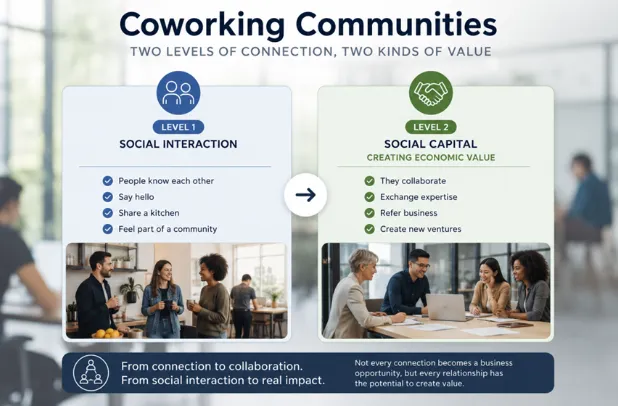
How Social Interactions can become Economic Assets
Remote and hybrid work have brought flexibility, but they have also reduced the informal interactions that once supported collaboration, learning, and professional growth. Fai believes this makes the intentional design of coworking spaces more important than ever, although she makes an important distinction:
“Coworking spaces can facilitate the creation of social capital among their members, but it has to be purposeful… providers should be honest about the lack of intentional community creation instead of riding a marketing ‘trend’ with the coworking label.”
Fai argues that a coworking space’s local identity is not incidental but earned. As social capital grows between members, it shapes a culture that gives the space its own community identity, one strong enough that some newcomers find their “tribe” and stay, while others move on. When a space makes a genuine effort to embed itself within the surrounding area, it becomes more than a workspace: it becomes a place that takes on the identity of its locality and gives members a sense of belonging. In some cases, when membership is drawn heavily from the local area, this relationship becomes reciprocal. The space evolves into what Fai calls an “anchor organization,” a fixed point that helps root other businesses in the locality and strengthens the local economy around it.

The challenge is proving it. Trust and informal collaboration tend to develop through everyday interactions that leave no data behind, which makes the value of coworking hard to quantify. Tomlinson reiterates this point: “there are few metrics on the activities and economic outcomes arising within and from coworking spaces… elements such as trust and knowledge sharing are notoriously difficult to quantify.”
While these outcomes remain difficult to quantify, the patterns revealed by the research are consistent. Coworking can support local economies through increased footfall, skills development, the revitalization of underused buildings, and stronger connections between people and businesses. In this context, Tomlinson states that coworking spaces “can play a key role in the local ecosystem,” with the potential to “re-invigorate local economies especially in provincial towns, post-industrial cities, and ‘left behind’ rural and coastal areas.”
The lasting value of coworking is therefore not found in the space itself, but in what the space makes possible. Through social capital, everyday encounters can become trusted relationships, relationships can become opportunities, and opportunities can become the innovations and economic activity that strengthen communities.