
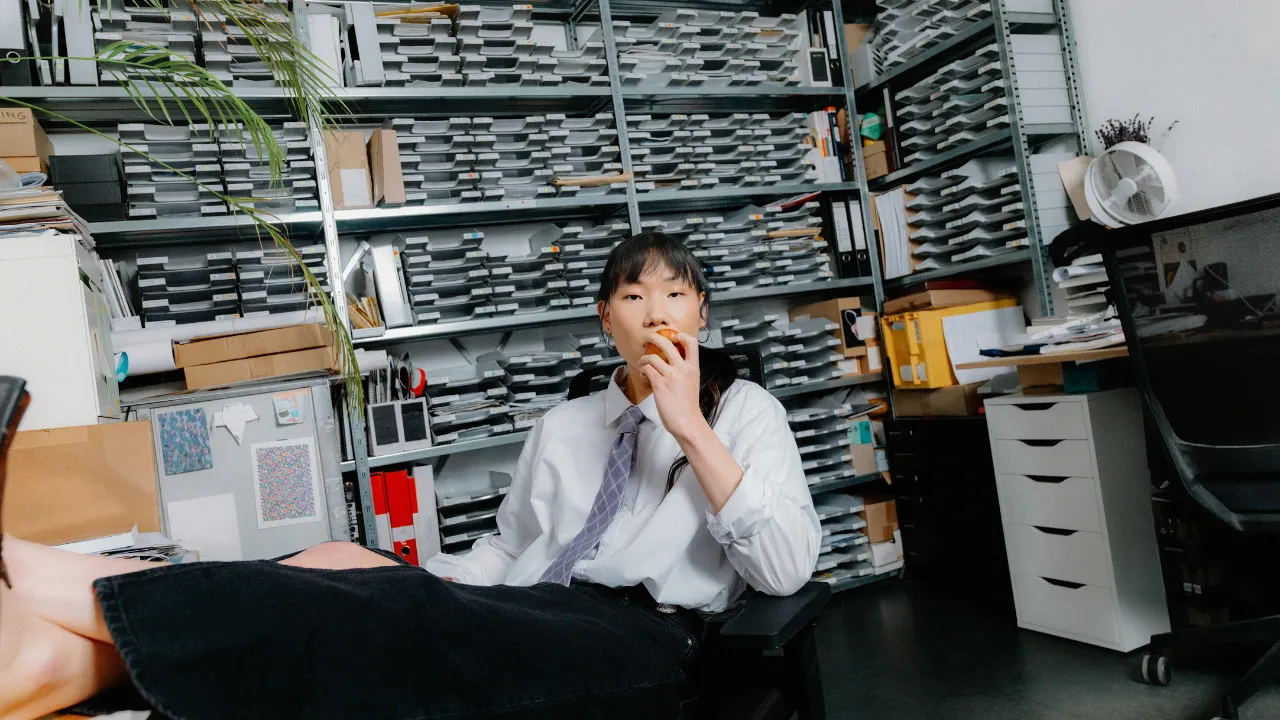
A full calendar, constant Slack activity and a packed office can make an employee look productive without showing whether meaningful work is getting done.
For many knowledge workers, the workday now includes a second layer of activity built around proving that work is happening.

Status meetings, progress updates, emails, instant messages, task trackers and visible time online can all serve a legitimate purpose. But when companies start treating those signals as evidence of productivity, employees have an incentive to optimize for visibility rather than results. That creates a problem for employers trying to understand what their workforce actually produces.
The Workday Is Already Packed With “Work About Work”
There is evidence that a large portion of the knowledge worker’s day is consumed by activities surrounding actual work. Asana’s research has found that knowledge workers spend about 60% of their time on “work about work,” including communicating about tasks, searching for information, switching between applications and managing priorities.

That doesn’t mean 60% of the workday is fake; coordination is necessary, but the problem comes when coordination becomes a substitute for progress.
A meeting about a project can look productive because calendars are full. A detailed status report can demonstrate activity without demonstrating an outcome. A stream of messages can make someone appear constantly engaged even when little meaningful work has moved forward.
The result is an office where activity becomes easier to measure than value.
Presence Can Become Its Own Performance Metric
The pressure becomes stronger when employees believe managers are watching for signs of effort. One survey of U.S. full-time employees found that 66% said they engage in “productivity theater,” which the company defined as emphasizing the appearance of productivity rather than the work itself. Only 23% said their contributions were measured using clear, outcome-based metrics. That distinction matters as companies bring employees back into offices.
Someone sitting at a desk for eight hours is easy to see. The value created during those eight hours is much harder to observe, particularly in jobs involving writing, analysis, strategy, software development or other work where output can take days or weeks to materialize.
When visibility becomes important to performance reviews or job security, employees have a reason to make themselves visible.
AI Could Make the Problem Worse
AI adds another complication. Tools can now produce emails, presentations, reports, meeting summaries and other forms of workplace output in seconds. That makes it increasingly easy to generate evidence of activity without necessarily creating more value.
At the same time, companies are under pressure to show that AI adoption is making employees more productive. That can create another layer of measurement: how many AI-assisted tasks were completed, how many messages were handled or how quickly documents were produced.
Those numbers can be useful, but they can also miss the bigger question: Did the work actually matter?
A faster way to produce a report does not necessarily make the report more useful. Clearing 100 emails does not necessarily move a business forward. And holding more meetings does not automatically mean a team is collaborating better.
Companies Need Better Ways To Measure Work
The answer is not eliminating meetings, messages or office attendance. Companies need ways to distinguish necessary coordination from activity that exists mainly because employees feel they have to demonstrate that they are busy. That means putting more weight on outcomes: projects completed, problems solved, customers retained, revenue generated, products shipped or other results that actually matter to a particular role.
It also means giving employees enough autonomy to have periods when they are not visibly active. A worker spending two uninterrupted hours solving a difficult problem may produce more value than someone who spends those same two hours answering messages and attending meetings, yet the second worker can look far busier from the outside.
That is the trap of the “fake busy” layer: the easiest work to see is not always the most important work being done.