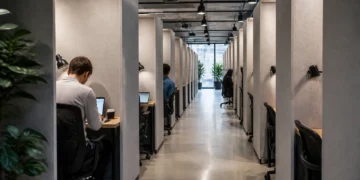


By 2030, roughly 30% of all office space will be leased on flexible terms, up from 8 to 10% before the pandemic, according to JLL research published by BOMA International. That shift is not a fringe experiment anymore. The companies moving into your space are making a deliberate calculation about cost, speed and how their teams actually work. Understanding that calculation is how you fill desks and keep them filled.
Businesses thrive after switching because coworking removes the parts of office ownership that drain time and capital. Your job as an operator is to make that value obvious from the first tour to the fiftieth renewal.
Lower fixed costs free up cash for the actual business
A traditional lease locks a company into five or ten years of rent, a build-out budget, furniture, utilities and a receptionist before a single client walks in. A growing marketing agency signing a coworking membership skips all of it. They pay one monthly fee and redirect the saved capital into hiring or product.
This is the story your prospects already believe. Lead your tours with it. Show them the math on a private office for six people against a comparable direct lease in your submarket, including the deposit and fit-out they avoid. When the savings are concrete, the decision makes itself.
Teams scale up and down without penalty
Growth is rarely smooth. A startup that wins a big contract might need four more desks next month and give two back after a seasonal project ends. A conventional lease treats that movement as a problem. Coworking treats it as a Tuesday.
Operators who market this well win the companies that hate being boxed in. When a member can add a desk through their account and see it reflected on the next invoice without a renegotiation, they stop shopping around. You can manage those membership changes, billing adjustments and booking updates from one place with Yardi Kube, so a member’s request to add two desks turns into an updated invoice in minutes rather than a back-and-forth email chain.
Amenities and community do work a solo office cannot
Companies switch for the desks. They stay for what surrounds the desks. Fast internet, staffed reception, meeting rooms with working AV and coffee that people actually drink all remove daily friction that a small business owner would otherwise handle personally.
Then there is the part no traditional lease offers. A freelancer meets a developer at the espresso machine and lands a contract. A two-person firm hires its next employee from a member down the hall. These connections are why members renew even when a cheaper desk exists across town. The events you host and the introductions you make are not extras. They are retention.
Professional space builds credibility on day one
A client meeting in a coffee shop sends one message. A client meeting in a bright conference room with your members’ logo on the booking screen sends another. For small businesses and remote teams, a professional address and a real meeting space signal permanence they could not afford to build alone.
You provide that credibility as a service. Every polished touch, from the front desk greeting to the invoice that arrives on time, reinforces the members’ own reputation with their clients.
The bottom line for operators
Businesses thrive in coworking because it converts the fixed costs and rigidity of traditional offices into flexibility, community and lower risk. For you, the takeaway is direct. Sell the savings with real numbers, make scaling effortless to execute, and treat community as the product rather than the perk.
The operators who run on those principles are the ones members stay with as they grow. Want to see how that works across your whole portfolio? Book a Yardi Kube demo and we’ll walk through your specific billing scenarios.