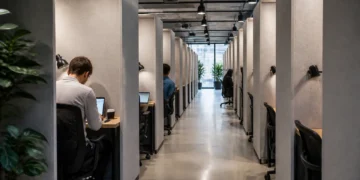






New research from the Instant Group shows that major flexible office operators are seeing healthy occupancy levels, particularly compared to competitors that are not amenity-focused.
According to the data, premium flexible offices saw their average occupancy rate reach 82% over the last few months. However, traditional spaces sat at a 74% rate.

In short, the post-pandemic era is driving the need for flexibility and highly-amenitized workspaces, thus allowing operators to quickly reach pre-pandemic levels.
“Quite simply, companies who can offer employees a five-star office with on-demand services are more likely to attract and retain the best,” said Lucinda Pullinger, UK MD at the Instant Group. “Employees expect the same convenient spaces that they have at home, but with a sense of collaboration and community that can’t be found in the home.”
Additionally, city centers in Leeds and Manchester are also seeing a spike in occupancy. In fact, 55% of offices in these areas have achieved occupancy of 80% or more, marking the first time since such regions have outpaced suburban areas.

According to Instant, this occupancy jump is being led by corporations moving into flexible offices within city centers.
“As supply of flexible workspace continues to evolve and spread out of city centers, as it has already done in London, we may well see the tables turn again,” said Pullinger.