





Advertisements
Ergonofis
  • Marketplace
  • Resources
  • Business Directory
  • Events
  • Advertise
  • Publish a Press Release
  • Submit Your Story | Get Featured
  • Get the Newsletter
  • Contact
  • About Us
The FUTURE OF WORK® since 2003
Allwork.Space
No Result
View All Result
Subscribe
  • Submit Your StoryNew
  • More
    • Columnists
      • Dr. Gleb Tsipursky – The Office Whisperer
      • Nirit Cohen – WorkFutures
      • Angela Howard – Culture Expert
      • Drew Jones – Design & Innovation
      • Jonathan Price – CRE & Flex Expert
    • Get the Newsletter
    • Events
    • Advertise With Us
    • Publish a Press Release
    • Brand PulseNew
    • Partner Portal
  • Latest News
  • Business
  • Leadership
  • Work-life
  • Career Growth
  • Tech
  • Design
  • Workforce
  • Coworking
  • CRE
  • Podcast
  • Submit Your StoryNew
  • More
    • Columnists
      • Dr. Gleb Tsipursky – The Office Whisperer
      • Nirit Cohen – WorkFutures
      • Angela Howard – Culture Expert
      • Drew Jones – Design & Innovation
      • Jonathan Price – CRE & Flex Expert
    • Get the Newsletter
    • Events
    • Advertise With Us
    • Publish a Press Release
    • Brand PulseNew
    • Partner Portal
  • Latest News
  • Business
  • Leadership
  • Work-life
  • Career Growth
  • Tech
  • Design
  • Workforce
  • Coworking
  • CRE
  • Podcast
No Result
View All Result
Subscribe
Allwork.Space
No Result
View All Result
Advertisements
Nexudus - Is Your Space Performing?
Home News

AI Cuts Entry-Level Jobs 13%, Wrecking Gen Z Careers

Stanford’s groundbreaking study reveals AI-driven automation is causing a 13% drop in entry-level jobs since 2022, disproportionately impacting young workers aged 22-25 while older employees see stable or growing employment.

Featured InsightsbyFeatured Insights
August 27, 2025
in News
Reading Time: 4 mins read
A A
A labor-market earthquake may be headed for Gen Z. Credit: MTStock Studio—Getty Images. Source: Fortune via Reuters Connect

A labor-market earthquake may be headed for Gen Z. Credit: MTStock Studio—Getty Images. Source: Fortune via Reuters Connect

Stanford University has published a first-of-its-kind study on Tuesday that reveals “the AI revolution” is already beginning to have a “significant and disproportionate impact on entry-level workers in the U.S. labor market,” especially those ages 22 to 25 in highly AI-exposed professions like software engineering and customer service.

The research, led by Erik Brynjolfsson, a top economist and AI thought leader of sorts, analyzed high-frequency payroll records from millions of American workers, generated by ADP, the largest payroll software firm in the U.S. The analysis revealed a 13% relative decline in employment for early-career workers in the most AI-exposed jobs since the widespread adoption of generative-AI tools, “even after controlling for firm-level shocks.” In contrast, employment for older, more experienced workers in the same occupations has remained stable or grown.

Advertisements
Yardi Kube automates flex & coworking operations

The study highlighted six facts that Brynjolfsson’s team believe show early and large-scale evidence that fits the hypothesis of a labor-market earthquake headed for Gen Z.

1) Entry-level workers hit hardest

First, employment disruption is not happening evenly across the workforce. The largest declines are concentrated among young, entry-level workers—those whose skills are most easily replaced by AI systems automating routine, codified tasks. The report says experience and tacit knowledge are becoming crucial buffers against displacement as AI tools excel at replacing book learning over job-specific, hard-to-codify skills.

Advertisements
Get more revenue. Do less work - Alliance Virtual Offices

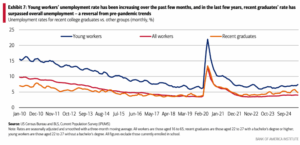
The report says it’s uncovered “substantial” declines in employment, especially for workers ages 22 to 25. This dovetails with mounting evidence from investment banks and surveys of layoff announcements, as Goldman Sachs has calculated a shrinking premium from a college degree, implying that entry-level workers are struggling to differentiate themselves in this hiring climate. Bank of America Global Research, meanwhile, has noted that since 2022, the unemployment rate for recent graduates has started to exceed the overall unemployment rate for the first time in recent memory.
2) A fading pattern since 2022

Second, the study finds fewer young people are being hired into AI-exposed occupations, with employment growth for young workers stagnant since late 2022—consistent with BofA’s analysis of census data.

In jobs less exposed to AI, the study says, young workers have experienced comparable employment growth to older workers. In contrast, entry-level workers in the occupations most exposed to AI have experienced a 6% decline in employment from late 2022 to July 2025, while older workers have seen 6% to 9% growth. The results suggest that the AI revolution is driving “tepid” overall employment growth for workers ages 22 to 25, the study adds.

3) Automation vs. augmentation

An important distinction is that not every use case for AI is leading to a decline in employment, the data suggests. The negative impacts are concentrated in fields where AI is more likely to automate tasks rather than augment work, and occupations with mainly augmentative AI applications have not seen similar declines in entry-level hires.

Advertisements
Deel - Upgrade your global team management

The team says it distinguished between automation and augmentation “empirically,” using estimates of the extent to which observed queries either substitute or complement for tasks in a given occupation. “These findings are consistent with automative uses of AI substituting for labor while augmentative uses do not,” the authors write.

This is similar to a line adopted by Joshua Wöhle, CEO of Mindstone, a firm that provides AI upskilling services to workforces. “We’re near the point where [AI is] more intelligent than most people doing knowledge work. But that’s precisely why augmentation beats automation,” Wöhle wrote on LinkedIn about his experiences with AI retraining. And Eric Vaughan, CEO of IgniteTech, took the drastic step of laying off nearly 80% of his company in 2023, telling Fortune that he didn’t do so because he wanted fewer workers, but because his team was not augmenting their work with AI tools fast enough.

4) Sturdiness

Stanford’s analysis rules out several other explanations, such as COVID-era disruptions or interest rate shocks. The effects only emerged after late 2022, coinciding with rapid generative-AI adoption, and are not limited to computer-related jobs, the authors write, stating the robustness of these findings as significant.

For workers ages 22 to 25, researchers say they found a decline in relative employment for the most AI-exposed quintiles compared to the least exposed quintile, a “large and statistically significant effect.” Other age groups had much smaller and statistically insignificant estimates, on the other hand.

More stories for you

70% of Executives Plan Office Expansion in 2026, With Coworking Playing a Bigger Role

70% of Executives Plan Office Expansion in 2026, With Coworking Playing a Bigger Role

1 day ago
With Fewer Offices Being Built, Coworking Gains Ground Nationwide

With Fewer Offices Being Built, Coworking Gains Ground Nationwide

1 day ago
Ditch The Cult Of Productivity How Leaders Can Move Teams From Survival Mode To Quiet Thriving

Ditch The Cult Of Productivity: How Leaders Can Move Teams From Survival Mode To Quiet Thriving

2 days ago
GM Invests $242M Over Five Years to Train Skilled Trades Amid Labor Shortage

GM Invests $242M Over Five Years to Train Skilled Trades Amid Labor Shortage

2 days ago

5) Employment, not wages

Fears of collapsing income related to AI may be overblown, the study says, finding that the adjustment in the labor market is happening largely through decreased employment rather than lower wages. Pay rates have not shifted dramatically, according to Stanford, with “little difference in annual salary trends by age or exposure quintile, suggesting possible wage stickiness.” If this is true, they write, AI may have larger effects on employment than on wages, at least to begin with.

6) Widespread consistency

Finally, the Stanford team argues these facts are largely consistent across various samples, with patterns in the data appearing “most acutely starting in late 2022, around the time of rapid proliferation of generative AI tools.”

Written by Nick Lichtenberg for Fortune as “First-of-its-kind Stanford study says AI is starting to have a ‘significant and disproportionate impact’ on entry-level workers in the U.S.” and republished with permission.


Advertisements
Your Brand Deserves The Spotlight - Advertise With Us - Allwork.Space
Source: Fortune
Tags: AINorth AmericaWorkforce
Share9Tweet6Share2
Featured Insights

Featured Insights

Articles under Featured Insights are sourced from leading publications such as Fortune, offered through our collaboration with Reuters. Each piece is hand-selected to provide valuable perspectives and exceptional journalism to keep you informed on the trends shaping the future of work. If you would also like to be considered for syndication on Allwork.Space, please contact us.

Other Stories Recommended For You

70% of Executives Plan Office Expansion in 2026, With Coworking Playing a Bigger Role
News

70% of Executives Plan Office Expansion in 2026, With Coworking Playing a Bigger Role

byAllwork.Space News Team
1 day ago

Office expansion plans rise for 2026 as coworking plays a larger role.

Read more
With Fewer Offices Being Built, Coworking Gains Ground Nationwide

With Fewer Offices Being Built, Coworking Gains Ground Nationwide

1 day ago
Ditch The Cult Of Productivity How Leaders Can Move Teams From Survival Mode To Quiet Thriving

Ditch The Cult Of Productivity: How Leaders Can Move Teams From Survival Mode To Quiet Thriving

2 days ago
GM Invests $242M Over Five Years to Train Skilled Trades Amid Labor Shortage

GM Invests $242M Over Five Years to Train Skilled Trades Amid Labor Shortage

2 days ago
Advertisements
Yardi Kube automates flex & coworking operations
Advertisements
UltraSoftBIS Work Smarter, Not Harder

Unlock your competitive edge in tomorrow's workplace.

Join a community of forward-thinking professionals who get exclusive access to the latest news, trends, and innovations that are shaping the future of work.

2025 Allwork.Space News Corporation. Exploring the Future Of Work® since 2003. All Rights Reserved

Advertise  Submit Your Story   Newsletters   Privacy Policy   Terms Of Use   About Us   Contact   Submit a Press Release   Brand Pulse   Podcast   Events   

No Result
View All Result
  • Home
  • Latest News
  • Topics
    • Business
    • Leadership
    • Work-life
    • Workforce
    • Career Growth
    • Design
    • Tech
    • Coworking
    • Marketing
    • CRE
  • Podcast
  • Events
  • About Us
  • Advertise | Media Kit
  • Submit Your Story
Subscribe

Welcome Back!

Login to your account below

Forgotten Password?

Retrieve your password

Please enter your username or email address to reset your password.

Log In
This website uses cookies. By continuing to use this website you are giving consent to cookies being used. Visit our Privacy and Cookie Policy.
-
00:00
00:00

Queue

Update Required Flash plugin
-
00:00
00:00