




- Social media is becoming a popular recruitment tool among hiring managers (especially Gen Z).
- Generational preferences influence hiring styles and standards, with Gen X currently the most favored group among recruiters.
- Professionalism still matters, and candidates must balance bold social media strategies tactfully.
Recruitment is entering the world of direct messages (DMs), and there is growing evidence to show it’s more than just a trend.
Once dismissed as a workplace distraction, social media is now being taken seriously by hiring managers (and not only for background checking). In 2025, your digital presence is an extension of your professional identity, and platforms once known for selfies and memes are quickly becoming unexpected hubs for hiring.

Resume Genius’s 2025 Unfiltered Hiring Insights Survey backs this up, revealing that social media is no longer just a tool for marketing or brand awareness. Of 1,000 U.S. hiring managers surveyed, 63% said they are now open to receiving job applications through platforms such as Instagram, TikTok, and LinkedIn.
This is a clear indication that what once felt too casual is now being normalized as a credible way to secure a job.
Unsurprisingly, Gen Z hiring managers are leading this trend. They are 70% more likely than Boomers to accept applications through social media, underscoring a stark generational divide in recruitment styles.
How DMs Are Becoming a Recruitment Tool
Previously limited to social communication, DMs have now transitioned into the professional realm. It’s not just on LinkedIn, either. On platforms such as Instagram and TikTok, job seekers are increasingly reaching out to recruiters and companies via unsolicited messages to express interest in (or apply directly for) roles. This has gone from unconventional to now becoming a valid way to get noticed.
Younger professionals, in particular, are bypassing traditional job application routes in favor of direct messages. Candidates consider this a high-impact, faster, and more transparent way to introduce themselves to hiring managers.
“While applying through social media isn’t standard in every industry, it’s gaining popularity in fields where creativity, communication, and brand awareness matter,” explains Eva Chan, Career Expert at Resume Genius. “In industries like marketing, media, design, and even hospitality, it’s not unusual for candidates to reach out via social media — especially for freelance, content, or early-career roles. When done thoughtfully, applying through social media platforms can show initiative and that the candidate already understands how the brand connects with its audience.”
While more hiring managers are open to these informal channels, there are still some specific rules of engagement.
LinkedIn recruiters, in particular, are inundated with messages and often spend only seconds reviewing each one.
“Job seekers should be mindful of how and where they’re applying,” Chan notes. “Not every message will reach the right person, and applications can easily get lost in a crowded inbox.”
What’s Considered Professional and Who’s Getting Hired?
What is viewed as professional behavior in recruitment often depends on who is doing the hiring. Older generations tend to favor more formal, traditional practices (for instance, submitting résumés and cover letters), while younger professionals are adopting more informal and direct approaches.
Despite new hiring practices, Gen X currently holds the top spot as the most sought-after generation of employees among hiring managers, with 72% identifying them as the best fit for modern workplaces. Millennials follow closely at 68%, while Gen Z ranks lowest at 54%.The ranking suggests that experience still carries weight in today’s job market.
“When hiring managers rank Gen X as the most hireable, it reflects how well they align with the needs of today’s workplace,” said Nathan Soto, Career Expert at Resume Genius. “Gen X professionals have built careers through periods of major economic and technological change, and many have stepped into leadership and mentorship roles along the way.”
Soto added that this combination of experience and adaptability positions Gen X as the backbone of today’s multigenerational workforce. Their perceived reliability may be a key reason why hiring managers across all age groups consistently rate them highly.
Generational loyalty does not always follow predictable lines. Gen Z hiring managers, for example, rated Millennials (72%) higher than their Gen Z peers (65%), making them the only generation to favor another over their own.
In contrast, Gen X recruiters were the most loyal to their cohort, with 82% rating Gen X candidates the highest. Boomer recruiters also leaned toward their own (74%), and Millennials preferred their peers too (76%).
Social Media Hiring: Access, Bias, and Who Gets Seen
The rise of social media as a recruitment tool is changing how job seekers connect with employers. According to Resume Genius’s data, almost half (44%) of all hiring managers report an increase in applicants per role this year compared to 2024.
The pattern, however, changes depending on which generation you speak to. The majority of Gen Z (53%) and Millennial (51%) hiring managers have seen an increase in applications, while only 36% of Gen X and Boomer recruiters have received more applications. Furthermore, 18% of Gen X hiring managers actually received fewer applicants this year.
This generational difference may reflect younger recruiters’ more frequent use of informal channels to connect with candidates.
As social media recruitment becomes more popular, some concerns have arisen about access, fairness, and who benefits most from these new methods. The DM approach, for instance, could benefit more digitally-savvy candidates who are competent at using social media for networking.
Candidates who are less familiar with these platforms or less inclined to reach out informally may be overlooked. Additionally, some hiring managers might unconsciously favor candidates who “show initiative” in ways that align with their own communication styles.
At the same time, proponents argue that hiring via social platforms can broaden access. With fewer gatekeepers and lower costs, smaller companies and start-ups (often without dedicated HR teams) can tap into a wider talent pool.
In that sense, social media may be helping to democratize hiring, even as it introduces new forms of bias.
What Candidate Behaviors Still Cross the Line?
“Sliding into an employer’s DMs” is a bold move, but one that calls for consideration. Experts stress the importance of being concise, respectful, and professional. Messages should feel authentic yet polished, and avoid over-familiarity or desperation.
Direct messaging a potential employer takes a certain level of chutzpah, but with the right tone, it can transform invisibility into real opportunity. This idea was reinforced in a recent Allwork.Space podcast, where career expert and bestselling author Vicky Oliver noted that fear of rejection or perfectionism can prevent candidates from taking bold steps that might advance their careers.
Oliver also emphasized that a lack of confidence can become a form of career self-sabotage.
Demonstrating initiative matters, but so do the basics of professional conduct. According to Resume Genius, being late to an interview is the top hiring dealbreaker across all age groups, with 38% of hiring managers listing it as their biggest frustration.
“Being late still signals a lack of respect for the process, and that hasn’t changed in 2025,” said Nathan Soto, Career Expert at Resume Genius. “Basic professionalism is still the baseline. When competition is tight, small slip-ups like tardiness can cost strong candidates the offer.”
Generational expectations also shape what hiring managers view as unprofessional. Boomers are most frustrated by arrogance and unrealistic demands. Gen Z managers are particularly cautious of candidates who fail to follow instructions. Millennials cite poor communication as their biggest complaint, while Gen X is least tolerant of unprepared applicants.
Taking bold action does not mean abandoning professionalism. By pairing modern outreach strategies with tact and attention to generational preferences, candidates can stand out without crossing the line.
A Quick Guide on How Best to Slide Into Those DMs
A thoughtfully crafted direct message can open doors that traditional methods often miss. With the right approach, reaching out via DMs can help candidates stand out in overly-saturated job markets and connect with opportunities that may never appear on public job boards.
For those exploring this less formal job search route, experts recommend several key steps.
First, be clear about your goal: know who you are contacting and the specific role you are interested in. Then write a personalized message demonstrating how your background, skills and interests align with the job requirements.
Generic messages such as “I’m open to opportunities” are usually ignored. If there is no reply after a week, a polite follow-up is acceptable. Patience and professionalism are essential throughout.
Tips for Sliding into Hiring Manager DMs
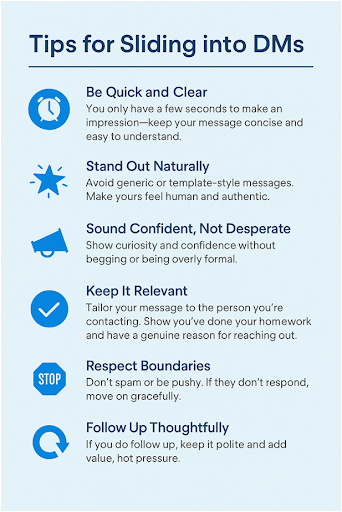
- Be Quick and Clear: You only have a few seconds to make an impression-keep your message concise and easy to understand.
- Stand Out Naturally: Avoid generic or template-style messages. Make yours feel human and authentic.
- Sound Confident, Not Desperate: Show curiosity and confidence without begging or being overly formal.
- Keep It Relevant: Tailor your message to the person you’re contacting. Show you’ve done your homework and have a genuine reason for reaching out.
- Respect Boundaries: Don’t spam or be pushy. If they don’t respond, move on gracefully.
- Follow Up Thoughtfully: If you do follow up, keep it polite and add value, hot pressure.
As direct messaging becomes more common, so do scams. A recruiter in your inbox is not always good news. Candidates should look out for signs of fraud, such as vague outreach, unprofessional profiles, or job offers that come without an interview.
It is also worth remembering that not every success story you see on LinkedIn or TikTok is a blueprint for success. Some candidates simply “get lucky” or happen to stand out for reasons that cannot be emulated.
However, with clear intent, a personal touch, and a respectful tone, a well-placed DM might do what a résumé alone cannot.