
If you have ever looked at a rigid, hierarchical organization and wondered if there was a better way to work, then you are not alone.
Many professionals see traditional top-down structures as outdated and out of step with today’s values-driven workplace culture. Fortunately, there’s a more progressive, human-centered alternative: the Teal model.

In Teal organizations, employees are genuinely empowered, decision-making is decentralized, and the company evolves in harmony with the needs of both its people and its purpose.
Frederic Laloux, a former McKinsey consultant, introduced the concept of Teal in his groundbreaking book, Reinventing Organizations, which has sold over a million copies in its first decade alone. In the book, Laloux notes that the problem is not with individual leaders but with entire management systems.

He observes that many executives privately confess to burnout and a growing sense that “something is broken” in how organizations are run. Employees, too, are seeking workplaces that value their full humanity, not just their productivity.
In stark contrast, Teal organizations emphasize autonomous, self-managing teams, authenticity in the workplace, and a focus on purpose and collaboration over profit, competition, and control.
In Reinventing Organizations, Laloux states, “Every time we, as a species, have changed the way we think about the world, we have come up with more powerful types of organizations.”
With this in mind, could Teal mark the next phase in our approach to work in the 21st century?

What is Teal?
For his book, Laloux researched organizations that operated without traditional hierarchies or rigid management systems. Interestingly, many of the organizations he studied had already been functioning in this way for thirty to forty years before his book was published. In Reinventing Organizations, Laloux demonstrates how the practices of these organizations align to form a coherent, values-driven model known as Teal.
He identifies three defining principles shared by these companies: self-management, wholeness, and evolutionary purpose.
In Teal workplaces, authority is distributed, trust is built, and employees bring their full selves to work. The organization adapts by continually realigning around its core purpose. Another key feature of Teal is collective intelligence — the increased capacity for problem-solving and decision-making driven by collaboration and shared expertise.
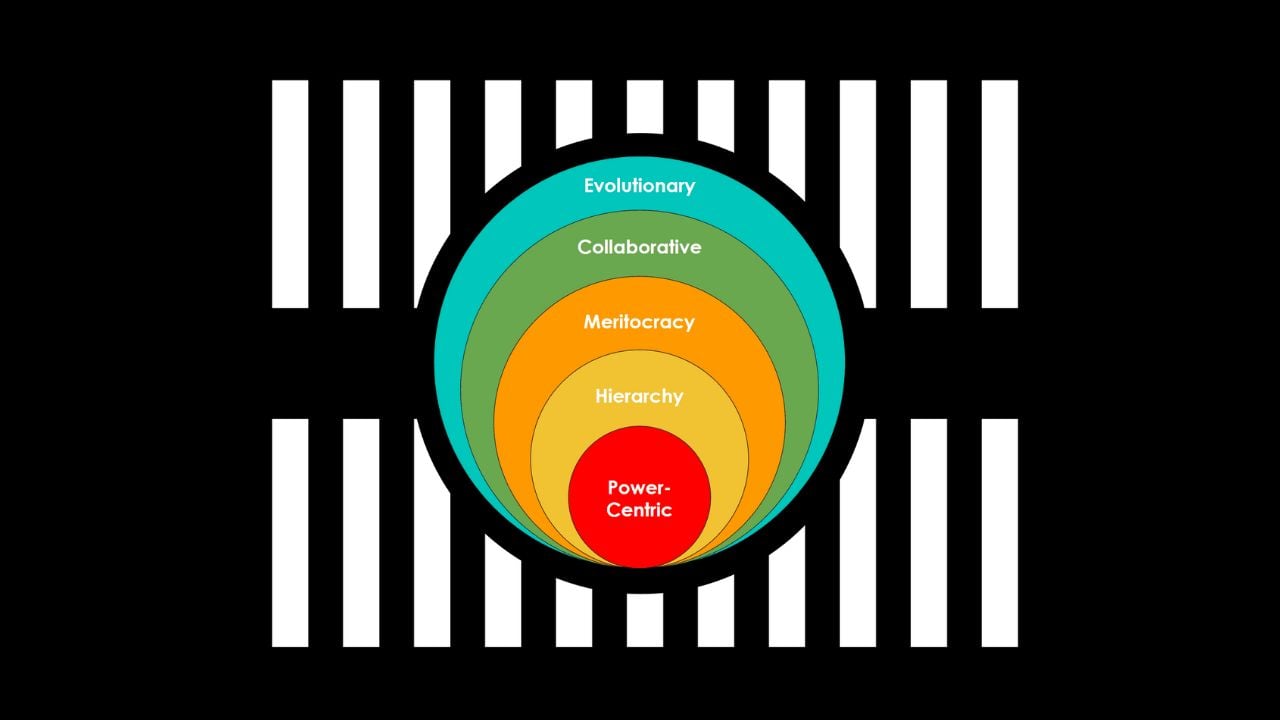
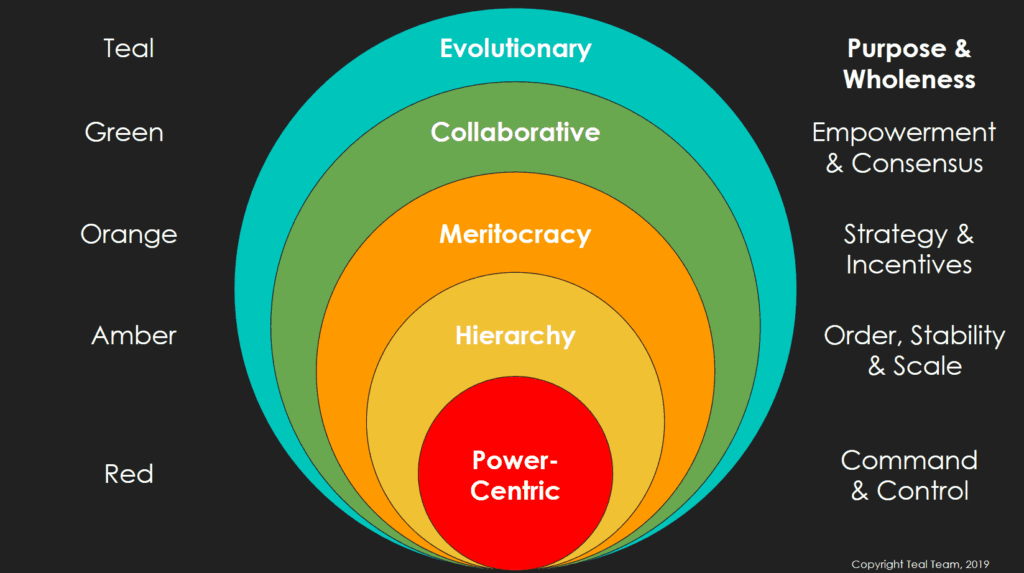
Laloux describes the progression to Teal as an evolution of consciousness, with each stage reflecting how people relate to power, purpose, and collaboration. Organizations typically develop through five distinct stages:
- Red (Impulsive): Power and control dominate (top-down authority).
- Amber (Conformist): Stability through rules, hierarchy, and order.
- Orange (Achievement): Results-driven innovation and meritocracy (modern corporations).
- Green (Pluralistic): Emphasis on culture, empowerment, and community values (e.g., nonprofits).
- Teal (Evolutionary): Organizations function as living systems grounded in purpose, authenticity, and shared leadership.
Some organizations evolve smoothly toward more adaptive, human-centered models (Green, Teal), while others remain stuck in older paradigms (Red, Amber).
The Principles of Teal
Teal organizations operate around these three core principles:
1.Self-Management
Self-management positions teams, not individual leaders, as the foundation of organizational success. Team members are empowered to take initiative and define their roles, with the option to move into a different role if desired.
Individuals work within their own strengths and talents, with the freedom to move between teams that best align with their skills and interests. Self-management typically operates within small teams of around 10–12 members, even in large organizations (to maintain agility and accountability).
While there are no traditional bosses, teams take full responsibility for their own functions — including hiring, conflict resolution, decision-making, and resource allocation. Guidance is available through coaches who facilitate discussions when needed, though they hold no formal authority.
2.Wholeness
In Teal organizations, wholeness means people are encouraged to bring their full, authentic selves to work, without the need to hide behind ‘professional masks.’ This includes recognizing diverse perspectives, intuition, and emotion as valuable inputs in the decision-making process.
The goal is not merely to make employees feel good, but rather, to facilitate a genuine acceptance of individuals as they are. This sense of psychological safety enables people to perform at their best and can lead to increased levels of engagement, trust, and collaboration.
3.Evolutionary Purpose
An evolutionary purpose refers to an organization’s own sense of direction and capacity for change (i.e., What does it wish to become? Where does it wish to go? How does it want to interact?). At its core, an organization’s commitment to a mission beyond profit reflects an effort to create value that extends to additional bottom lines, like social, environmental, or human impact.
This purpose evolves naturally over time and is not driven by any one individual employee. Examples of organizations that operate around an evolutionary purpose include B Corps, Conscious Capitalism firms, and social enterprises.
The Benefits of Turning Teal
Teal offers a compelling alternative to hierarchical or matrixed models, especially as changes to how and where we work reveal the limitations of these more traditional structures. Teal’s principles of trust, autonomy, and self-management are becoming increasingly relevant, as Spaur observes:
“The location and means of work continue to become decentralized. We see this in the rise of gig work, the demand for flexible workspaces and schedules, and in the proliferation of digital tools available anywhere you can find a Wi-Fi connection. Centralized work with command-and-control structures breaks down when confronted with these trends.”
“On the other hand,” he adds, “self-managed teams guided by an evolving purpose provide the responsiveness and adaptability needed for decentralized, always-changing work.”

Putting people first is a central principle of Teal organizations; not simply to make employees feel comfortable or motivated, but to unlock their full potential within the organization.
In a Teal workplace, each individual’s unique strengths, creativity, and insight are fully utilized. No one is confined to a rigid role or label unless they choose to be; instead, everyone contributes to the shared purpose of the organization.
When it comes to how Teal organizations operate, the focus is not on rigid agility frameworks but on co-creative decision-making. Another defining feature is full transparency within the day-to-day operations, as well as across all aspects of the organization. Information, resources, salaries, bonuses, and promotions are openly shared, creating trust, accountability, and a genuine sense of collective ownership.
Ricci says this level of transparency fosters collaboration, learning, and engagement, allowing people to contribute their best work. The impact, she notes, extends beyond profitability. Teal companies strengthen social connections, empower employees to make meaningful decisions, and drive positive change while still achieving strong financial results.
Success stories include Buurtzorg, a Dutch home-nursing organization that demonstrates how self-managing teams can deliver both meaningful work and strong results. Buurtzorg’s approach has been successfully adopted in several countries, most notably in Sweden, which has one of the highest proportions of nurses in Europe. Buurtzorg Netherlands also lends staff and expertise to international teams and organizations seeking to learn and implement this model.
Other examples of organizations incorporating elements of Teal include Patagonia, Salesforce, Whole Foods, and Microsoft.
Key benefits of Teal include:
- Enhanced Adaptability: Self-management and decentralized decision-making allow rapid responses to change.
- Increased Employee Engagement: Wholeness and authenticity drive higher satisfaction and commitment.
- Driving Innovation: Trust and autonomy encourage experimentation and creativity.
- Improved Collaboration: Flatter structures facilitate open communication, resource sharing, engaging conflict resolution processes (before problems arise), and effective (and efficient) problem-solving.
- Purpose-Driven Culture: Organizational goals align with broader societal values, helping create meaningful work. It also frames the organization as an adaptive system with its own direction and identity. Employees are encouraged to stay attuned to these shifts, enabling them to contribute effectively and support the organization’s evolving objectives.
The Teal Team and Teal Landscape Report 2025
Based in San Francisco but with a global outlook, The Teal Team is a collective of coaches, consultants, and change practitioners advancing the Teal movement.
Team member Margaret Ricci, FRSA, Founder and CEO of Cultural Strategies, LLC, helps individuals and organizations align their values, culture, and systems for maximum impact. Ricci places Teal within the broader evolution of management thinking, noting that even major corporations, such as Amazon, are experimenting with “flattened” management structures.
She points out that the vast majority of the world remains unaware of Teal, which motivates her to promote greater understanding of this philosophy.
Matthew Spaur is a marketing and HR professional with over 20 years of experience across diverse industries. Matthew is the founder of the advisory firm, Marketing the Social Good. He is also a key member of the Teal Team. Allwork.Space asked Spaur about Teal and its growing momentum. Explaining Teal’s rationale, Spaur says:
“We as humans are social creatures living in evolving cultures. We organize into businesses, governments, charities, and other structures as a way to address our collective problems and needs. As our cultures and their problems evolve, so too must our ways of organizing.”
“A sentiment often attributed to Albert Einstein says that ‘we cannot solve our problems with the same level of thinking that created them.’ I think that definitely applies to Teal,” Spaur explains. “We collectively have major problems to address, and outdated organizations aren’t up to the challenge.”
Produced in partnership with Human First Works, The Teal Landscape Report 2025 from The Teal Team maps over 300 organizations worldwide, offering insights into their structures, practices, and impact. The report helps advocates and practitioners accelerate adoption, identify partners, mentors, and clients, and understand the global ecosystem of purpose-driven organizations.
“In our report, we see Teal organizations in every geographical area, with continental Europe as the strongest region,” Spaur, who is also one of the report’s authors, notes. “The biggest industry sector we find for Teal organizations is professional, scientific, and technical services. But I’m always surprised by how many manufacturing and retail companies we find, as well, since those sectors look nothing like the services sector.”
Ricci suggests that after decades of experimentation, this model is working across diverse sectors worldwide. Ricci notes that while Europe currently leads in the number of Teal-inspired organizations, the movement is expanding globally.
She points to growing interest in the United States, as well as in unexpected regions such as China and parts of Africa. Many companies, she explains, begin by adopting one or two Teal principles and gradually evolve toward broader or more fully realized Teal practices.
The report concludes on an optimistic note. While the movement is still in its early stages, its global presence is undeniable. Around thirty billion-dollar companies and thirty publicly traded organizations already apply Teal practices, demonstrating that self-management and wholeness can succeed at scale.
Meanwhile, many smaller, progressive organizations are transitioning alongside long-established corporations, proving that Teal is viable across all industries and organization sizes.
Teal provides a practical blueprint for a more balanced, purposeful, and human-centered future of work. As these principles take hold, Teal ultimately equips organizations with a transformative framework for meeting today’s complex challenges while unlocking the full potential of their people.
Allwork.Space would like to thank members of The Teal Team, particularly Margaret Ricci and Matthew Spaur, as well as Matthew Kalman Mezey and Rebecca Young, for sharing their expertise, resources, and insights for this article.