



Los Angeles is becoming a proving ground for a new kind of workplace: part coworking hub, part members-only social club.
Two newly opened projects — Arc Beverly in Beverly Hills and The Lighthouse in Venice — are betting that blending flexible offices with hospitality-style amenities can attract professionals who no longer see value in traditional office leases.

The concepts arrive as the region struggles with elevated vacancy rates and employers experiment with ways to bring people back into shared spaces, according to CoStar.
Offices Built Around Experience
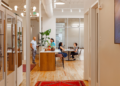
Arc Beverly opened this year as a 65,000-square-foot private work and social club on Wilshire Boulevard. The space targets executives, entrepreneurs, and creative professionals, offering a mix of coworking areas, private offices, conference rooms, screening rooms, and rooftop terraces. Memberships start at $300 per month.
The project is operated by Good City Studio, a lifestyle development firm founded by veterans of Equinox Hotels. Arc Beverly is its first such club, though the company has more than 20 hospitality and community-focused projects open or in development nationwide.
In Venice, The Lighthouse takes a more industry-specific approach. The 31,282-square-foot facility occupies a redeveloped 1939 post office near Venice Beach and is designed primarily for digital creators and production teams. The property includes soundproof recording and filming rooms, editing suites, podcast studios, communal and private workspaces, event areas, a café, and a small theater.
Backers say the goal is to serve professionals who work on a project-by-project basis and don’t require permanent office space.
A Market Still Adjusting to Hybrid Work
Both projects are launching into a Los Angeles office market that remains under pressure. Office vacancy in the region has reached roughly 16%, above the national average, as many companies continue to embrace hybrid schedules or downsize their physical footprints.
Rather than competing with traditional offices on square footage or lease terms, operators of these new spaces are emphasizing flexibility and experience. Amenities such as rooftop lounges, gyms, culinary programs, and curated events are positioned as reasons for members to leave home offices behind.
Developers and construction firms working on these projects describe them as “hospitality campuses” — environments designed to support work, networking, and social interaction in one place.
Los Angeles as a Testing Ground for Private Clubs
The coworking-club hybrid is not entirely new to Los Angeles. The city already hosts high-profile private clubs such as SoHo House in West Hollywood and San Vicente Bungalows near Beverly Grove. These venues have helped normalize the idea of members-only spaces that blur the line between work, leisure, and networking.
What’s different about the latest wave is the explicit focus on flexible work. Rather than functioning purely as social destinations, Arc Beverly and The Lighthouse are positioning themselves as places where members are expected to spend significant portions of their workday.
This strategy reflects the rise of so-called “third spaces” — locations that are neither home nor traditional offices, but somewhere in between.
Across the country, similar concepts have emerged catering to specific professional communities, political or cultural affiliations, or creative industries.
Not All Experiments Succeed
The renewed interest in coworking clubs comes with notable risks. Not every upscale flexible workspace has survived the post-pandemic reset.
NeueHouse, a once-prominent coworking and social club with celebrity backing, filed for Chapter 7 bankruptcy in October and shuttered roughly 150,000 square feet across Los Angeles and New York. In fact, Convene Hospitality Group just acquired NeueHouse’s intellectual property and assumed operations of its Manhattan location.

Those closures underscore the challenge facing operators: balancing high operating costs with a membership base that may fluctuate as work habits continue to evolve.
Creator-Focused Expansion Plans
Despite the risks, The Lighthouse’s backers are moving forward with expansion. The Venice location is the first of several planned sites. Additional outposts are expected to open in Brooklyn, New York, and London, with the London club targeted for 2026.
The Lighthouse is part of Whalar Group, a global marketing and advertising network focused on the creator economy. Executives involved with the project say Los Angeles’ concentration of media, entertainment, and digital talent makes it an ideal launch market.
Hospitality Influences Shape Design
Hospitality elements play a central role in both developments. At Arc Beverly, the culinary program is overseen by chef Victor Totoris, and the interiors were designed by BA Collective and wHY Architecture. The space includes screening rooms and a 50-seat theater alongside traditional work areas.
The Arc Beverly property and an adjacent parking structure were sold last summer to Corinthia Hotels International, with backing from international investors. Local business leaders say the project adds another layer to Beverly Hills’ evolving commercial mix.
In Venice, The Lighthouse’s adaptive reuse of a historic post office aligns with a broader trend of repositioning older civic and industrial buildings as flexible work destinations.
A Sign of What Comes Next
Whether coworking clubs become a durable solution or a temporary response to uncertain office demand remains an open question. But in Los Angeles, at least, operators are clearly testing the idea that workers no longer want offices defined solely by desks and leases.
Instead, the next phase of workplace real estate may hinge on community, flexibility, and experience — with the city once again serving as an early proving ground.