




For workers and employers alike, getting the right person into the right job is becoming increasingly difficult.
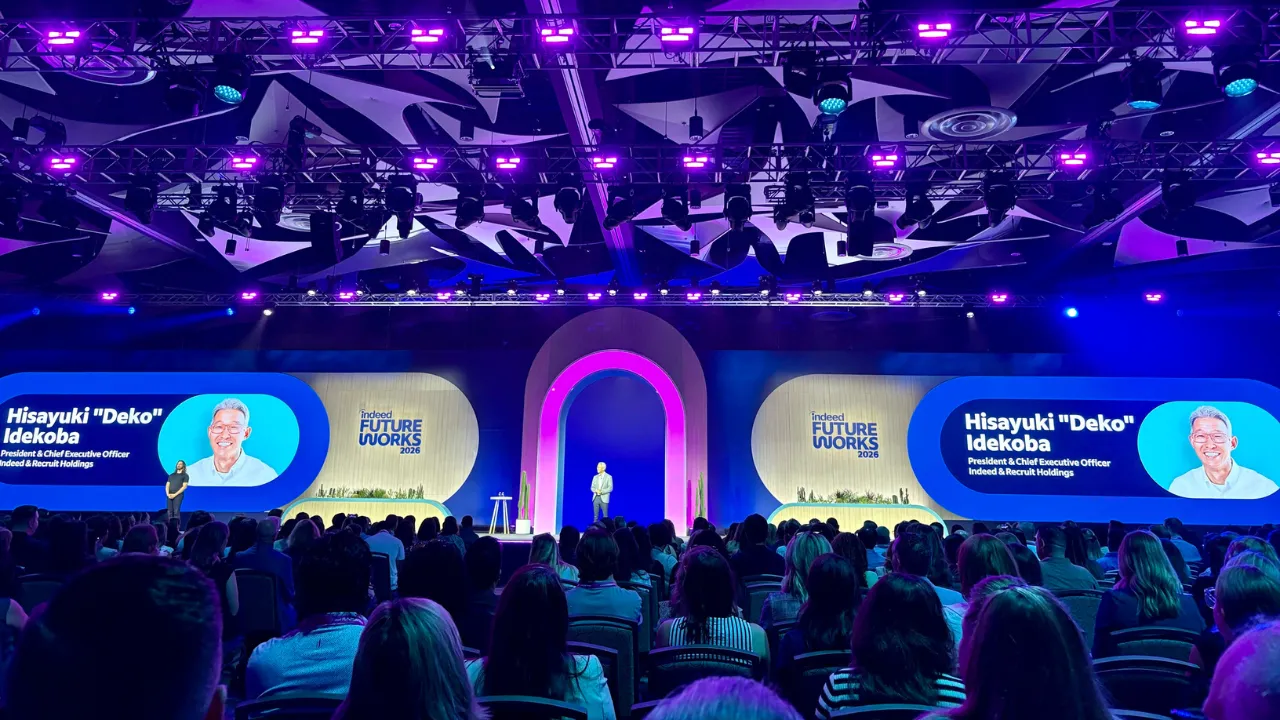
Allwork.Space attended the Indeed FutureWorks conference in Phoenix, where labor market experts, business leaders and workplace thinkers wrestled with a question that is becoming harder to avoid: What happens when companies need talent, workers need opportunities and both sides are struggling to find each other?

The Indeed conference left us with a pretty stark picture of the U.S. labor market: companies are hiring less, firing less and becoming more cautious about who they bring in.
Shonda Rhimes’ Bold Hiring Advice
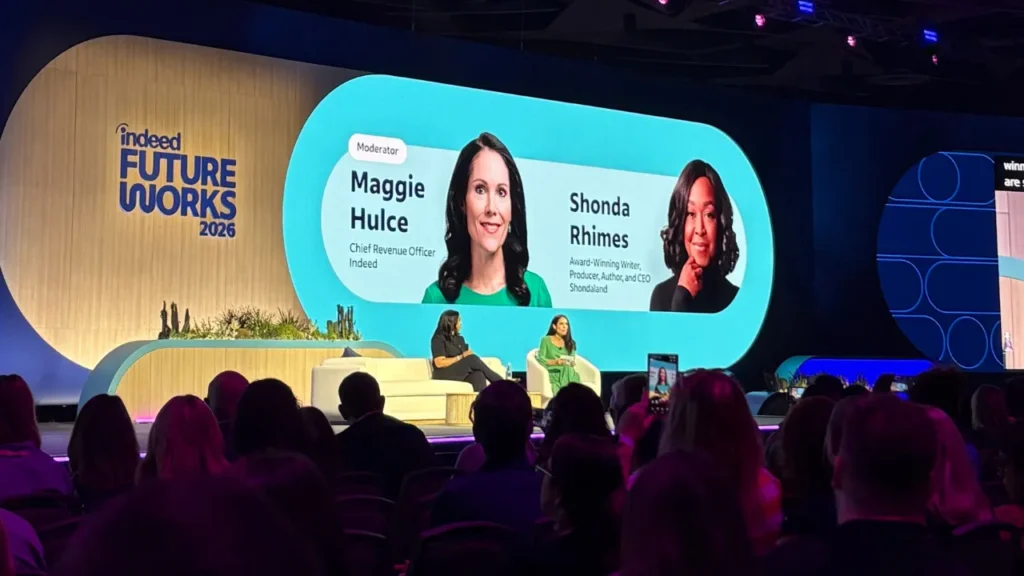
Before getting into the numbers, however, FutureWorks offered a reminder that hiring is still deeply human. The people making those decisions are deciding who gets a shot, who gets overlooked and which skills a company believes are worth betting on.

Shonda Rhimes, the creator behind Bridgerton, Grey’s Anatomy, and Scandal, took the main stage to speak to attendees about the intersection of creative ambition and authentic leadership, and how embracing bold choices can transform not just a career, but an entire industry.
Rhimes urged hiring managers to trust their judgment rather than chase every new hiring trend, stay open to ideas and talent from unexpected places, and focus on finding people who genuinely add value to the organization.
Rhimes’ advice to trust your gut sounds simple. In today’s hiring market, it may be one of the harder things for employers to do.
We Are in a Low Hire, Low Fire Economy
Hiring has fallen to levels not seen since around 2014, while unemployment remains relatively low. That creates a “low hire, low fire” market where workers are holding onto jobs, but people trying to get into the workforce are finding fewer openings.
That pressure is especially visible at the entry level. Entry-level job postings on Indeed are down 7.5%, making it harder for younger workers and people trying to get their first foothold in a career to get started.
At the same time, living expenses are continuing to outpace paychecks. If that gap persists, weaker consumer spending could eventually weigh on GDP and broader economic growth, Indeed experts said at the conference held at the Phoenix Convention Center.
AI Is Moving Into the Workforce Slowly
AI came up repeatedly, but the message wasn’t that every job is about to disappear overnight. One phrase that stuck with us was that “AI’s tentacles are spreading slowly but surely.” The technology is already working its way into different parts of the labor market, while also creating entirely new roles.
There’s an important historical reminder here: 60% of the jobs that exist today did not exist in the 1940s. That suggests the future labor market will likely contain jobs that are difficult to imagine today.
The more immediate concern, however, is what happens during the transition, particularly for workers entering the market as companies experiment with AI and rethink how much human labor they need.
A Smaller Workforce Adds Another Layer
Demographics make the situation more complicated. By 2030, U.S. natural population growth is expected to decline, while foreign interest in U.S. jobs is reportedly at a six-year low. That could eventually make labor shortages more difficult for employers to solve through population growth or international talent.
The future of work will have fewer people entering the workforce, fewer entry-level opportunities and employers becoming more selective about where human workers add value.
That brings the conversation back to something surprisingly basic: If companies are hiring cautiously and workers are competing for fewer openings, are employers actually struggling to find qualified people? Or have they simply become terrible at finding them?
That was one of the questions Allwork.Space put to Indeed’s Kyle M.K., Senior Talent Strategy Advisor and self-described “labor market weather man,” at the conference. His answer points to a hiring process that may be creating some of its own problems.
He said one of the biggest problems is that the technology making it easier to apply for jobs has also created an overwhelming volume of applications for employers to sort through.
“Most candidates can be found in the applications that employers are receiving, but because they’re so overwhelmed, it’s difficult to find that needle in a haystack,” he told us.
That creates a strange problem for the modern hiring market: candidates can apply to jobs with a few clicks, while employers can end up buried under applications and still struggle to identify the right person.
The Problem May Be the Way Employers Screen
M.K. said employers also need to look at the technology they are using to evaluate candidates. Some screening systems rely heavily on exact keyword matches, meaning qualified candidates can be overlooked simply because their résumé does not use the same terminology as the job description. He also pointed to job descriptions themselves as part of the problem.
Generic requirements such as “must have great written and verbal communication skills” can attract enormous numbers of applicants because almost everyone can see themselves as meeting the requirement. M.K. said employers should instead define what those skills actually mean for the job. That could mean being able to simplify complex information, resolve conflict or communicate with a particular audience.
The goal is to make the job description specific enough that employers attract people who actually fit the role, while giving screening technology enough useful information to identify those candidates. That also means moving beyond systems that simply look for identical words.
Indeed Does Not Think AI Résumés Are the Enemy
AI-generated résumés have become an easy target as employers struggle to process applications, but M.K. pushed back on the idea that AI itself is the problem. Applicants are going to use the tools available to them, he said.
Using AI to help write or improve a résumé does not automatically mean someone is being dishonest. The issue is actually whether a candidate is falsely claiming experience or qualifications they do not have.
For employers, that means trying to detect whether a résumé was written by AI may be less useful than figuring out whether the person actually possesses the skills the job requires.
M.K. said employers may be “trying to find blame” because they are underwater with the amount of applications that they’re getting.
Instead of starting with AI detection, he argued that employers should look inward at how clearly they define what they want and how effectively their hiring systems identify it.
Indeed Wants AI to Handle the Busywork, Not the Hiring Decision
M.K. said there are parts of recruiting that AI can reasonably automate, including scheduling, initial matching and some initial screening, but the final decision should remain human.
He described extending a job offer as one of the most consequential decisions an employer can make for another person. Questions about who moves forward, who gets hired, why they were selected and how they will contribute to a team still require human judgment.
M.K. also expressed skepticism about AI interviews as a way to find better talent. He said he has not seen evidence showing that AI interviews identify stronger candidates than human interviews, particularly when employers are trying to understand personality and team fit.
That distinction matters as employers experiment with increasingly automated hiring systems. AI can help reduce the administrative burden, but Indeed’s position is that efficiency should not come at the expense of the human judgment involved in actually hiring someone.
Job Seekers Need to Give Employers Something AI Cannot
For candidates, M.K.’s advice was essentially the opposite of writing a résumé that sounds as broadly appealing as possible: get specific.
AI is good at generalizing, so candidates should provide the details that make their experience difficult to confuse with anyone else’s. That means showing actual results, processes, tools used and experiences rather than relying on generic descriptions of being a “team player,” “hard worker,” or “great communicator.”
M.K. said employers are looking for people who can meet the needs of the existing team while also bringing something it does not already have.
Indeed is also pointing employers toward clearer standards around AI use during hiring. M.K. highlighted Zapier’s guidance on acceptable AI use as an example of the kind of transparency employers can provide to candidates rather than leaving applicants guessing about what is allowed.
Indeed is Also Fighting Ghost Jobs
 Another part of Indeed’s effort to improve the job search involves so-called “ghost jobs.” Ghost jobs are essentially fake jobs posts that project a false sense of company expansion and stability to investors or competitors. Job applicants waste their time applying to these positions that only exist online to improve the company’s social imaging.
Indeed has increased its efforts to identify problematic listings like these through a combination of automation, human review and reports from job seekers. Indeed also looks at signals such as repeated identical postings and how long a job has remained unchanged. Its relevance system takes the age of a listing into account, meaning stale jobs can lose visibility over time.
Job seekers can also flag suspicious or fraudulent listings directly on the platform.
“We do not allow ghost jobs on our platform. We require that all job postings on Indeed are connected to a real employer actively hiring for a specific role. If we learn that a posted job doesn’t represent a legitimate intent to hire, we take it off the site,” Indeed says on their site.
Indeed is Putting the Job Seeker at the Center
M.K. said the “job seeker experience” is a major priority at Indeed. That puts Indeed in an interesting position — the company has helped make applying for jobs easier, but that convenience contributed to the application overload employers now face.
So, Indeed is trying to improve the matching process itself: make job descriptions more specific, help employers identify relevant skills beyond exact keywords, use AI where it can remove administrative work, keep consequential hiring decisions human, identify problematic listings and give job seekers clearer information about how employers use AI.
The larger challenge for the hiring market is therefore less about getting more people to apply and more about making sure the right people can actually be seen.