


A work task that once took hours can now be completed in a fraction of the time. It is one of AI’s most obvious benefits: helping us work faster and accomplish more in a single day.
But amid the focus on speed and productivity, what are we overlooking?

Working faster does not necessarily make work less mentally demanding. Workers still need to check for errors, assess what is useful, revise AI-generated work, and decide what they can actually trust. And for younger professionals in particular, there is another question. If AI is increasingly doing the work they once learned from, what happens to the skills, knowledge, and experience they would have gained along the way?
The question, then, is not simply how much time AI saves, but what new cognitive demands it creates and what younger workers could be losing with fewer opportunities to develop judgment, knowledge, and problem-solving skills.

When AI Makes Work Faster, Is It Really Easier?
Research from the University of Michigan suggests that while AI can speed up work, human oversight remains just as important. In a study of professional designers using generative AI, researchers found that workers still had to assess whether AI-generated material was relevant, appropriate, and suited to their clients’ needs. In other words, speeding up one part of the creative process does not necessarily speed up the entire process.
Learning scientist and generative AI expert Dr Philippa Hardman takes this idea further in AI Is Making You Faster — and Slower. She argues that while generative AI can accelerate tasks such as producing first drafts and generating ideas, workers may then need to devote more mental effort to evaluating what it produces. The work may happen faster, but that does not necessarily mean it becomes easier.
New data from a Getsolved survey reflects this contradiction. Among 3,000 Americans aged 18 to 28 who use AI daily, 75% said the technology had made them more productive at work. Sixty-six percent said AI had made their working lives easier overall, while 60% said it helped them work faster and with less effort.
However, the same survey also suggests that those gains can coexist with considerable mental strain. Fifty-two percent avoided using AI because they found it too mentally draining to oversee. Forty percent said they needed a full evening of rest to recover after an “AI-heavy” workday, while 23% said AI at work had negatively affected their mental health.

The reasons respondents gave help explain why. Twenty-five percent said incorrect information from AI had made their jobs harder, while 12% identified constant fact-checking as the main problem. The difficulty is not simply that AI can be wrong, but that the possibility of error adds responsibility for the person using it. Information may need to be questioned, verified, corrected and placed in context before it can be relied upon.
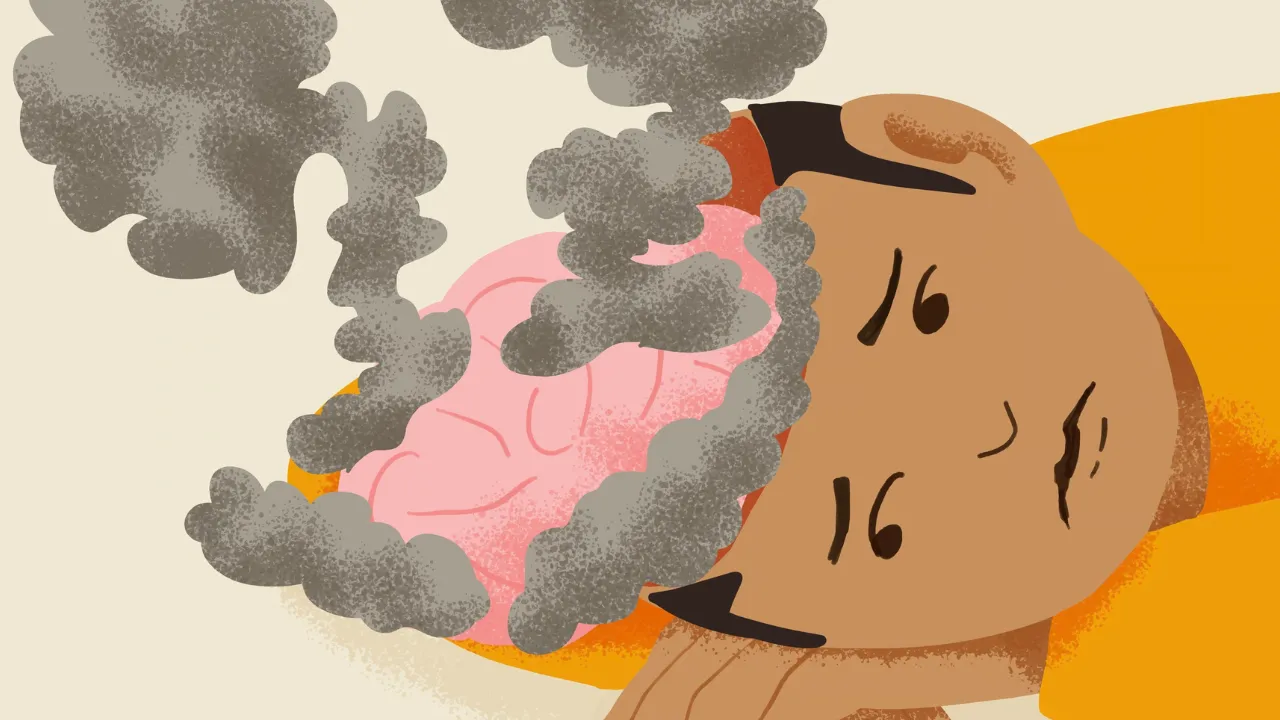
The cognitive strain reported by younger workers is increasingly being described as “AI brain fry,” a form of mental fatigue linked to repeatedly monitoring, checking and managing AI-generated content. Reported symptoms include mental fog, difficulty concentrating, irritability, anxiety, fatigue and, in some cases, headaches after prolonged periods of monitoring AI output.
The survey suggests these experiences are relatively common among younger daily AI users. Thirty-six percent of this cohort reported mental fog or difficulty focusing almost every day, 37% said they felt worn out even when the work itself was not particularly difficult, and 34% reported regularly feeling irritable or less patient.
What makes these findings particularly striking is that people can experience these symptoms while still viewing AI positively. Eighty-seven percent of respondents said they felt either neutral or energized after AI-heavy workdays, despite reporting many of the symptoms associated with “AI brain fry.”
What Happens When AI Does the Work We Used to Learn From?
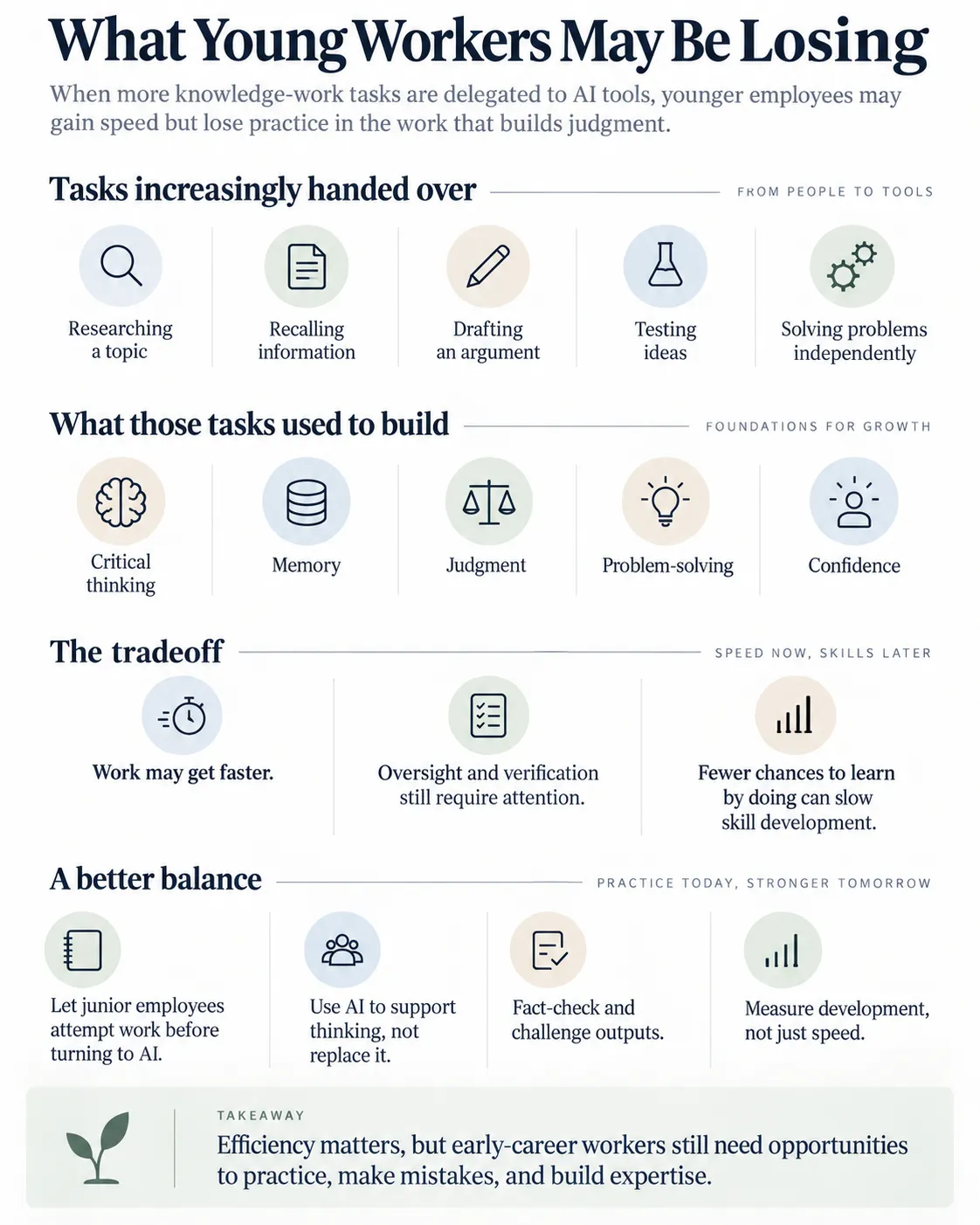
According to experts such as Professor K. Sudhir of the Yale School of Management, AI is increasingly taking over entry-level work that once gave junior employees valuable learning experience. These are tasks that traditionally helped younger professionals develop judgment, confidence, and problem-solving skills. Researching, drafting, testing ideas, and making mistakes give people valuable experience of working through problems for themselves.
As AI takes on more of this work, younger employees may become more efficient but have fewer opportunities to gain the practical experience that helps turn knowledge into expertise.
This practice is known as cognitive offloading: using external tools to handle mental tasks such as recalling information, solving problems, or making sense of complex material. There is nothing inherently wrong with doing this, but relying too heavily on AI can mean spending less time practicing the skills needed to think through problems independently.
A recent American Psychological Association (APA) review raises a similar issue. Research has found a link between greater reliance on generative AI and lower levels of critical thinking, particularly when people accept what AI produces without thinking through the task themselves.
For young workers, the distinction is important. Using AI when you already have the experience to question its output is very different from relying on it before you have developed those skills. Junior employees can now produce higher-quality work sooner, but that does not necessarily mean they are developing the knowledge and confidence they need at the same pace.
The challenge, then, is not to keep young professionals away from AI, but to make sure it supports rather than replaces the experiences that help them become more capable over time. Getting that balance right will become even more important as AI plays a greater role in everyday work life.
What Should Workplaces Do to Get the Balance Right?
The focus now needs to be on how workplaces use AI without creating new forms of mental strain or limiting the development of essential human capabilities.
In the Getsolved survey, 51% of respondents said their employer did not address the mental load associated with AI work, 29% said it had not been considered at all, and 10% said greater AI use was being encouraged without acknowledging its cognitive cost. The findings suggest that many workplaces are introducing AI without giving the same attention to how employees experience using it.
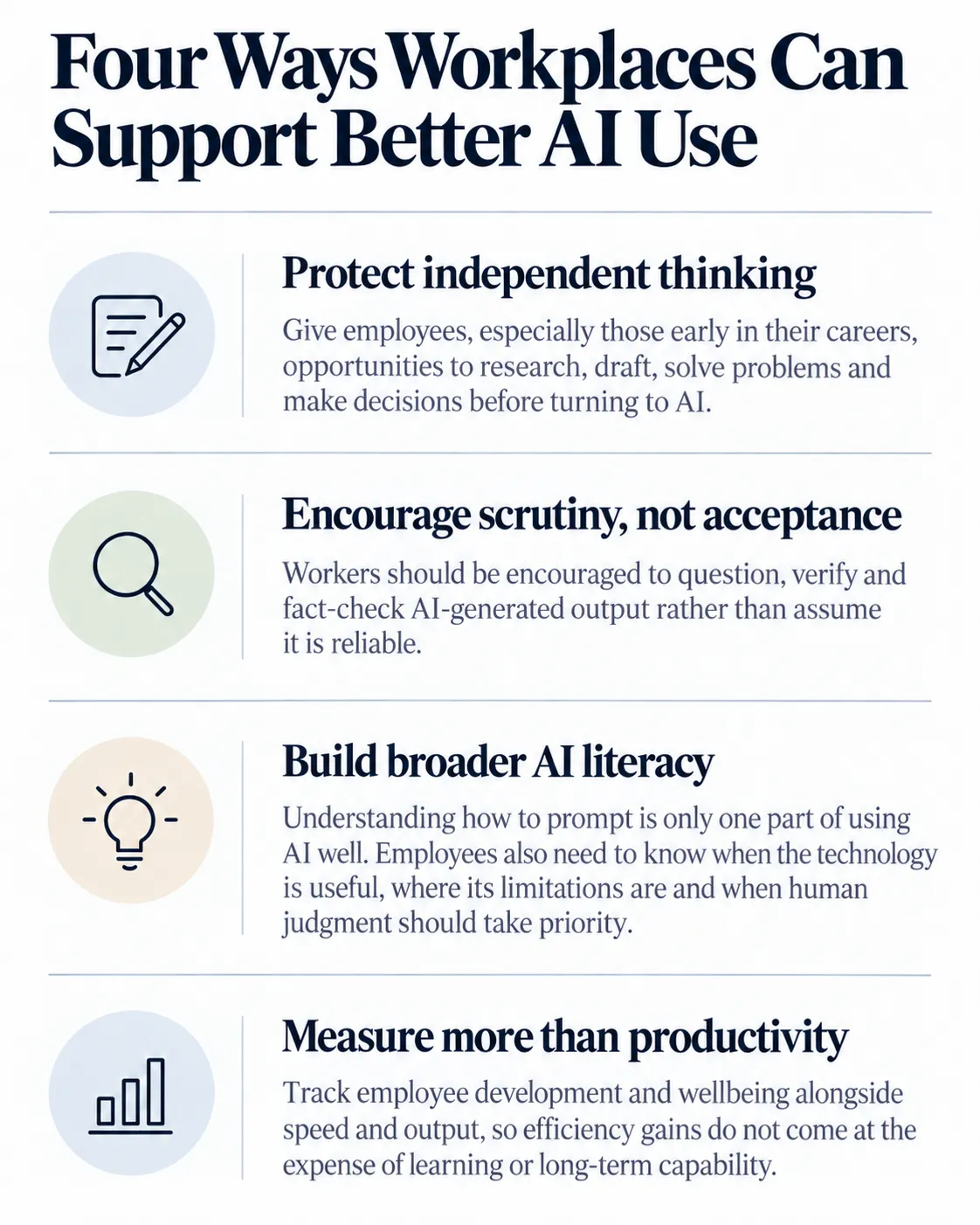
So what can employers do differently? One priority is to protect opportunities for independent thinking, particularly for employees starting their careers. Employers can ensure younger workers still have opportunities to research, draft, solve problems, and make decisions for themselves rather than automatically turning to AI.
Workplaces should encourage employees to question, verify, and fact-check what AI produces rather than accept it at face value. The APA research points to the importance of asking questions, reflecting on AI-generated answers and checking whether they make sense. That means creating a culture in which questioning and fact-checking AI output are treated as part of using the technology effectively, rather than as unnecessary extra work.
Training is also essential, but it needs to go beyond teaching employees how to write better prompts. AI literacy should include understanding what the technology does well, its limitations, and when human judgment should take priority. This can help employees make more deliberate decisions about when to use AI and when to rely on their own knowledge and reasoning.
Finally, workplaces need to measure more than productivity. Faster output may be easy to quantify, but employers should also pay attention to employee development and wellbeing. If AI saves time while increasing mental strain or reducing opportunities to build skills for the future of work, productivity figures alone will not tell the whole story. The goal should be to capture AI’s benefits without allowing short-term efficiency gains to come at the expense of developing the people expected to use it.