



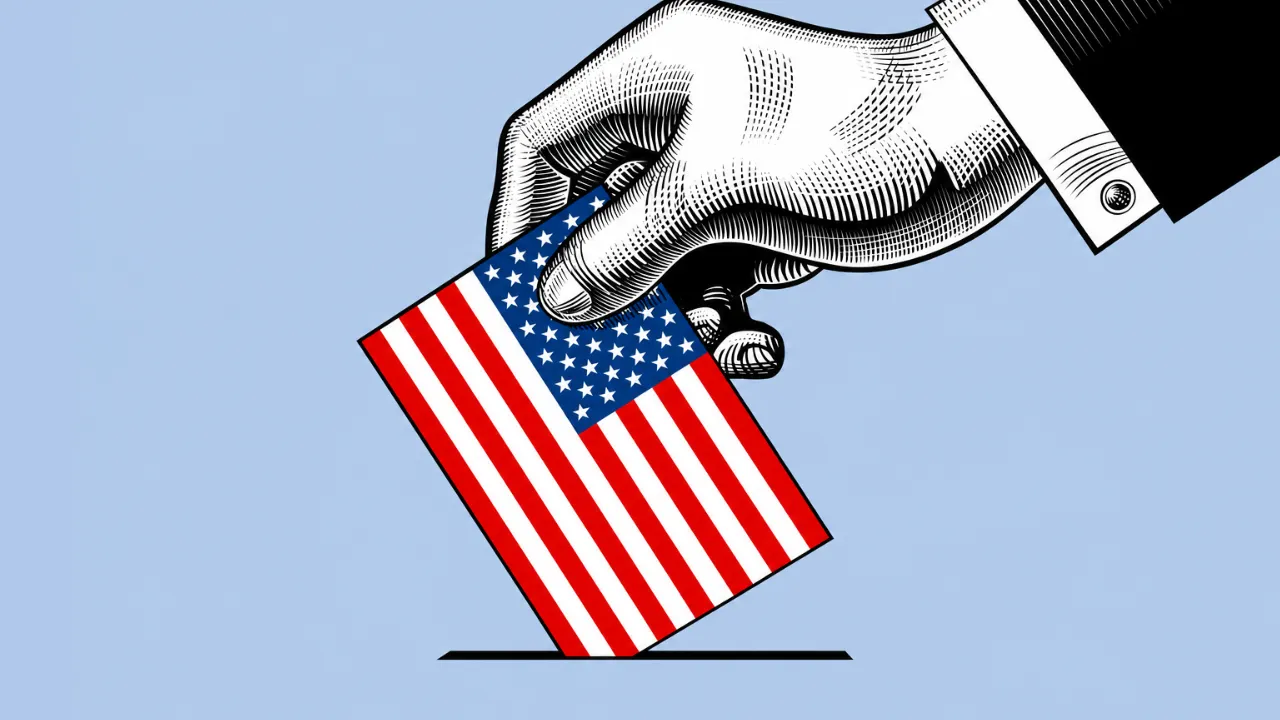
It’s hard to improve voter turnout. Just ask campaign and PAC leaders who spend hundreds of millions of dollars each election cycle trying to get people to vote—blanketing TV and social media platforms with paid advertising, and investing in canvassing, phone banks, and mailers. All this money barely moves the needle. Randomized trials suggest that even a well-executed canvass can only juice turnout by a point or two at most.
New research has uncovered a much more powerful lever for driving turnout: America’s employers. Researchers linked LinkedIn employment records to voter files—studying 30 million workers at 377,000 employers. They found that a person’s workplace is decisive in whether or not they choose to vote.

To account for employee selection bias, researchers at Michigan, Harvard, Columbia, and Maryland also tracked 8 million people who changed jobs. Their findings? Workers who moved to a higher-scoring employer became 3.5 percentage points more likely to vote. If they moved from an employer at the 25th percentile to one at the 75th, they became 5.8 percentage points more likely to vote. And the effects hold across political affiliations.
These results point to a striking conclusion: employers have enormous influence over whether or not their employees vote.

We know that people are powerfully influenced by the environments where they spend most of their time — and workplaces top the list. Employers set the tone for civic engagement. They can remind employees that elections are happening and that democratic participation matters. They also control formal levers that can prevent people from voting, like scheduling and leave policy for Election Day.
Most corporate leaders don’t think very much about employee voting—and they likely have no idea where their companies fall on this distribution. We believe they have an obligation to find out and that they should make an effort to climb the rankings.
At the companies we run, we’ve found out that driving voter turnout is a management problem with an easy solution.
At Weyco, we have a simple communications calendar. Several weeks before an election, employees are encouraged to make a plan to vote. When early voting opens, they hear about it. They then receive a friendly reminder the week before Election Day, and again on the day itself. Employees who want to vote or serve as poll workers are encouraged to take paid leave to do it, and we arrange a ride for anyone who needs one. Weyco also brings voter registration assistance into the building.
At Goodmans, we’ve partnered with Power the Polls to recruit employees to serve as poll workers. Employees who participate receive a small stipend and a paid day off.
In both cases, these programs are simple to administer and cost little. Neither requires an outside consultant or a new department. Wisconsin Business Leaders for Democracy publishes a toolkit with a communications timeline and templates any company can adapt. Both of us have also worked alongside fellow business leaders to come up with plans through Leadership Now Project.
For most employers, the cost is a few emails and some scheduling flexibility. The overall playbook is simple: Give people time to vote, remind them when to do so, and help connect them to their local election officials to find out how.
Another important step: encourage anyone interested to work the polls. Nearly half of local election jurisdictions had difficulty recruiting enough workers for the 2024 general election, according to the U.S. Election Assistance Commission. This fall, Milwaukee, Kenosha, and Maricopa County are short, along with jurisdictions in Ohio, North Carolina, Nevada, and many more. Poll worker shortages lead to longer lines and more friction for voters.
There is a long-running argument in corporate America about whether and when a CEO should speak on matters of politics. For many, it remains a challenging question. The good news: helping employees participate in democracy requires none of it. At no point does an employer need to ask any employee about their political preferences or about specific candidates. And it doesn’t require leaders to take a political position or risk ending up in a news cycle.
Better still, the effects won’t expire in November. The research suggests that voting is a habit-forming activity: employees continue even after they leave us. Those employees, in turn, influence their households—family members of workers at higher-scoring employers vote more too. And the impact of employers is largest in primaries, which are the contests where additional turnout makes the biggest difference.
Helping employees vote is the right thing to do, but it’s also good business. Higher levels of participation lead to greater trust in our democracy. That, in turn, reinforces the stability that lets businesses plan for the future, invest, and hire.
Employers are already shaping whether or not people vote. Our experience is that with even minimal effort, they can use that power for good.
Written by Tom Florsheim Jr. and Adam Goodman for Fortune as “Want to increase voter turnout? Start with the workplace” and republished legally through syndication agreement with Reuters Connect. Tom Florsheim Jr. is chairman and CEO of Weyco Group. Adam Goodman is president and CEO of Goodmans Interior Structures. Both are part of Leadership Now Project’s network of business leaders; the group is named in this piece.