

The late plays by William Shakespeare are alternately called his “romances” or his “problem plays,” because of their ambiguity in tone, as they alternate from passages of magical realism to stark scenes that grapple with complex social issues. At times, they point the way toward the prestige TV of the early 21st century where, for instance, The Sopranos could range from broad comedy to intense violence to avant-garde dream sequences, all in one episode. It’s from the romances that we get phrases that stick with us today, like the description from The Tempest of a “sea change into something rich and strange.”
Full disclosure: The author’s brother is an eminent Shakespearean scholar, often quoted in The New York Times, although never previously in Fortune, and so I asked him to explain what this particular term means. “Toward the end of his career,” Drew Lichtenberg of the Shakespeare Theatre Company in Washington DC, said in a statement to Fortune, “Shakespeare started writing genre-defying plays with sudden and miraculous changes of fortune.” Shakespeare used the phrase “sea change” to describe a “magical storm at sea that has the power to snuff out life or restore it in less than a second.”

What do Shakespeare’s plays of miraculous changes of fortune have to do with, well, Fortune? Bank of America Institute has projected a “sea change” in the economy.
It sees a pivotal transformation in worker productivity at America’s largest companies, driven by lessons from post-pandemic inflation and supercharged by a wave of artificial intelligence and automation.

The institute worked hand in hand with projections from Bank of America Research to project a rewiring of the fundamental valuation landscape of the S&P 500, with profound implications for investors and the “quality premium” that U.S. stocks traditionally command.
Fortune talked to BofA Research’s Head of US Equity & Quantitative Strategy, Savita Subramanian, to dig into this change, potentially to something rich and strange.
It’s not quite that mystical, she said, but she still thinks it’s a big deal.
Finally, a productivity surge?
Subramanian explained that what her team has projected isn’t as exciting or dramatic as having actual wizards working at the gears of the economy. The more prosaic insight, she says, is that the combination of AI technology and lessons learned from the inflation wave of the 2020s mean that worker productivity is finally showing signs of increasing. That’s the sea change taking place.
At its heart, her work is all about the famous “productivity paradox” identified by Nobel prize-winning economist Robert Solow. “You can see the computer age everywhere but in the productivity statistics,” he said in 1987, long before the productivity crisis of the 21st century set in. As Fortune‘s Jeremy Kahn has discussed, workers still don’t seem to be getting more productive despite the bevy of new technologies at their disposal.
In fact, McKinsey’s Chris White and Olivia White argued in 2024 that productivity has been dismal for nearly a generation, hovering around 1% a year, with a dip after the Great Financial Crisis. Subramanian agrees, telling Fortune that if you look at productivity measures, “they haven’t really improved all that much since 2001.”
Subramanian wrote on Aug. 8 that the end goal of the massive AI spending that’s rippling through the economy is a “sea-change” in the scale and scope of efficiency gains—and this productivity cycle is already under way. Post-pandemic wage inflation forced companies “to do more with fewer people,” she added, and now AI tools are due to kick that up a notch.
But the official stats don’t show a complete understanding of how productivity really functions, Subramanian explained. So BofA took sales, adjusted for inflation, and then divided sales by the number of people working at S&P 500 companies, showing real sales growth versus number of people, what she called a “decent proxy” for productivity, “because if you’re productive, you are doing things more efficiently, you need less labor. And this is more labor efficiency than anything else.”
Look at what she found.
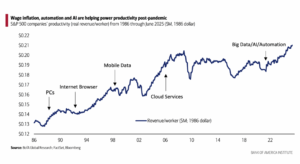 This means companies are learning to do more with less, and that is kind of magical. Companies have had to do harder work to generate earnings and keep margins healthy, often by replacing their people with processes. “A process is almost free and it’s replicable for eternity,” she said, adding that she thinks this is why the companies exercising efficiency gains have tended to outperform. It’s not only about AI displacing workers, but a fundamental shift in how business is being done.
‘It feels like sorcery’
This discussion may seem on its face to be more boring than a tempest and a wizard, she said, but there is something supernatural about the current moment. “I think people love this AI technology because it feels like sorcery,” she said, before adding, “the truth is it hasn’t really changed the world that much yet, but I don’t think it’s something to be dismissed.”
Overall, Subramanian finds the S&P 500 has shifted from its 1980s model of asset- and labor-intensive manufacturing to asset- and labor-light innovation, namely tech and health care firms. Showing her work, she calculates that the S&P 500 firms with a focus on innovation, measured through high research and development expenditures, trade at structurally higher multiples of 29x forward earnings per share. More capital-intensive manufacturers, on the other hand, trade at a 21x multiple. The current AI boom is actually a bit risky, she wrote, because the massive data center investments represent a shift from an asset-light to an asset-heavier focus.

To be sure, BofA finds that the S&P 500 is now statistically expensive on 19 out of the 20 metrics that they track, including P/E, price to book, price to cash flow, and market cap/GDP. That’s where the sea change matters, because if the shift from manufacturing to innovation is real, then valuations have to shift as well. Hence the “innovation premium” from BofA’s research.
Excluding Tesla, Subramanian talks about the other members of the “Magnificent Seven” as evidence of firms losing some of their innovation premium as a result of a shift toward asset-heaviness. As a basket of stocks, Microsoft, Google, Amazon, Meta, Nvidia and Apple’s average shareholder yield (i.e., dividends plus net buybacks) has dropped by over 1% since 2015.
There are other shifts afoot as well, she told Fortune. “We seem to be at least pausing on this globalization theme,” she said, citing China’s admission to the World Trade Organization in 2001 as a big driver of margin expansion, enabling cost-cutting as a huge lever to keep margins expanding. (It was also the year when worker productivity froze in its tracks.)
In the globalization regime, “you didn’t have to think too hard to make money and expand your margins,” she said. It was “very easy and fungible and frictionless” for companies to buy things from different places and contain costs. She also cited the low-interest-rate environment that persisted for much of the past few decades, enabling lots of “financial engineering.”
For example, Subramanian said it was common to see companies that knew they would miss their earnings estimates borrowing money and buying back stock to hit their targets, adding the caveat that “there are good reasons to do share buybacks and bad reasons to do share buybacks.” This all “really created a lot of bizarre behavior.”
Warren Buffett’s long-time fondness for stock buybacks has even come under fire from other investors, with Jeremy Grantham writing in 2023 that it facilitates stock manipulation and should be illegal. BofA Research found in July 2025, however, that stock buybacks had decelerated a bit, albeit they remained high by historical standards.
The situation now is harder in many ways, but companies aren’t able to financially engineer their way to earnings growth, she added. Now that’s a sea change.
Written by Nick Lichtenberg for Fortune as “BofA sees the replacement of people with process solving the ‘productivity paradox,’ because ‘a process is almost free and it’s replicable for eternity’” and republished with permission.