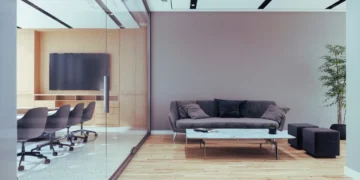





Regulations are tightening, and landlords cannot afford to leave sustainability until the last minute.
In the U.K., Minimum Energy Efficiency Standards (MEES) are set to require landlords of non-domestic rented buildings to hold valid energy performance certificates (EPCs) and to progressively improve performance. Under current proposals, all properties should have registered a valid EPC by 2025, be aiming for at least a C rating by 2027, and be on track for a B rating by 2030.

So, it really shouldn’t come as a surprise that energy performance is becoming central to future-proofing workspaces. We’re seeing this particularly in cities like London, where demand for Grade A space remains high and older stock often lags behind modern standards.
While final details are yet to be confirmed, the message from regulators and the wider industry is unmistakable: if you own or manage property, sustainability needs to be progressively built into your planning now.

2030 is closer than it feels
Sustainability is often framed as a regulatory issue: something enforced and reactive, which is often addressed at the last possible moment. When we think about office fit outs, the conversation is increasingly dominated by aesthetics (the polished Instagram shots and visual “wow” factor certainly wield more influence these days). But sustainability is broader than regulation and deeper than cosmetics.
It’s about whether a workspace will still function comfortably and efficiently in five, seven, or even ten years down the line. It’s also about commercial durability, and creating offices that perform and endure, remaining relevant long after the first occupier moves in.
Refurbishment is often where the biggest gains are hiding. In a recent fit-out of a Grade II listed converted chapel in London, upgrading services, lighting and thermal performance helped achieve an improved EPC rating of B. This is proof that older stock can be repositioned for a more efficient future without losing its character.
Workspaces are more sustainable when they’re designed for repeat occupation
Landlords sometimes get sustainability wrong by treating EPCs as a compliance exercise rather than a performance issue. Too many refurbs focus on short-term, low-cost fixes or surface-level upgrades, without considering how the space will actually be used over time.

The result is a false economy: cheap refurbishments that technically meet today’s standards but fall short on comfort, efficiency and longevity. In practice, cutting corners or doing it cheaply first often means paying twice further down the line, instead of investing once, properly, with long-term resilience in mind.
Workspaces need to endure beyond a single occupier cycle. The most wasteful pattern in commercial property remains repeated strip-outs and constant, short-term refits, each one consuming material, energy, and time.
A workspace that performs across multiple occupiers is inherently more sustainable than one that is rebuilt every few years.
Sustainability as a commercial foresight
After three decades in this industry, I can honestly say that the best sustainability decisions are made early, when the conversation begins by asking:
“What is the smartest, most durable use of materials and investment?”
Managed offices make that question unavoidable, because the space must work for the next occupier as well as the current one. The future of work needs workspaces that last operationally, environmentally, and experientially.
Being proactive will pay dividends for all three.
Futureproofing is a sustainability strategy
Recycled content and carbon-neutral claims may sound impressive on paper, but they only matter if the product actually lasts. A core tenet of sustainability is durability. Only then can the loop be closed, and the life cycle of a product and/or space be meaningfully extended.

The challenge, of course, comes with translating this knowledge into practice.
Higher-quality materials and tried-and-tested fit-out choices should not be dismissed as an indulgence. Longer-life materials like ROCKWOOL stone wool insulation, IPS systems, high-grade laminates, and vitreous china are designed to avoid constant replacement cycles. You’ll find these in MetSpace offices because they are sustainable, yes, but also because they have stood the test of time.
We’ve also found that LED lighting can deliver 50-70% energy savings compared with traditional systems, while occupancy sensors reduce unnecessary energy use across shared areas. The kitchen light doesn’t need to stay on overnight or between pit stops for that afternoon round of tea.
Water efficiency is another overlooked opportunity. Low-flow, self-closing taps can deliver more than 50% water savings. That’s a considerable impact both environmentally and commercially. Energy Star-certified appliances are increasingly standard in efficient fit-outs. Cool roof systems are helping to reduce heat gain and cooling demand.
These are practical, proactive interventions, and they all go a long way to making a big difference.
Refurbishment done well creates the Grade A space the market needs
Much of London’s office stock is in urgent need of an upgrade, and sustainable refurbishment is one of the most realistic routes to achieving it. Refurbishing thoughtfully can bring older, disused buildings up to modern expectations. It’s a practical way to deliver more high-performing workspace without unnecessary rebuilds.
Managed office operators can play a crucial role here, helping existing assets work harder, for longer. We’ve been approached by landlords with buildings sitting empty for years, and often, the right changes can transform market appeal almost instantly and see the space let within a week.
Practical sustainability impacts the user experience directly
Sustainability may feel invisible on the surface, but its impact can be tangible for occupants and supply chains. Spaces that feel better to work in support retention.
For instance, low-VOC paints, adhesives, and finishes improve indoor air quality, which creates healthier working environments that support satisfaction and long-term occupancy. The knock-on effect should never be underestimated.
Often, it’s the functional details that matter most. Teams need to be catered for down to the ratio of microwaves per employee — a surprisingly vital fit out choice, and one that tends to matter far more than the color of the wall paint.
We also prioritize shorter, lower-impact supply chains. Again, what does that actually look like? For us, 81.5% of carpets are locally sourced, and 90% of furniture is U.K.-manufactured, allowing us to actively reduce transport emissions while supporting national industry.
Recycling plays a role, too — we look to recycled content for our carpets (58% are made with ECONYL® yarns + recycled plastic bottles) and prioritize FSC and Cradle to Cradle™ Bronze in flooring.
By moving sustainability much further up the considerations list, we can not only develop for a compliant future, but for a cost effective and durable one, too.