
Will a digital twin land you your next job?
It sounds like science fiction, but it’s quickly become a real question job seekers need to answer.

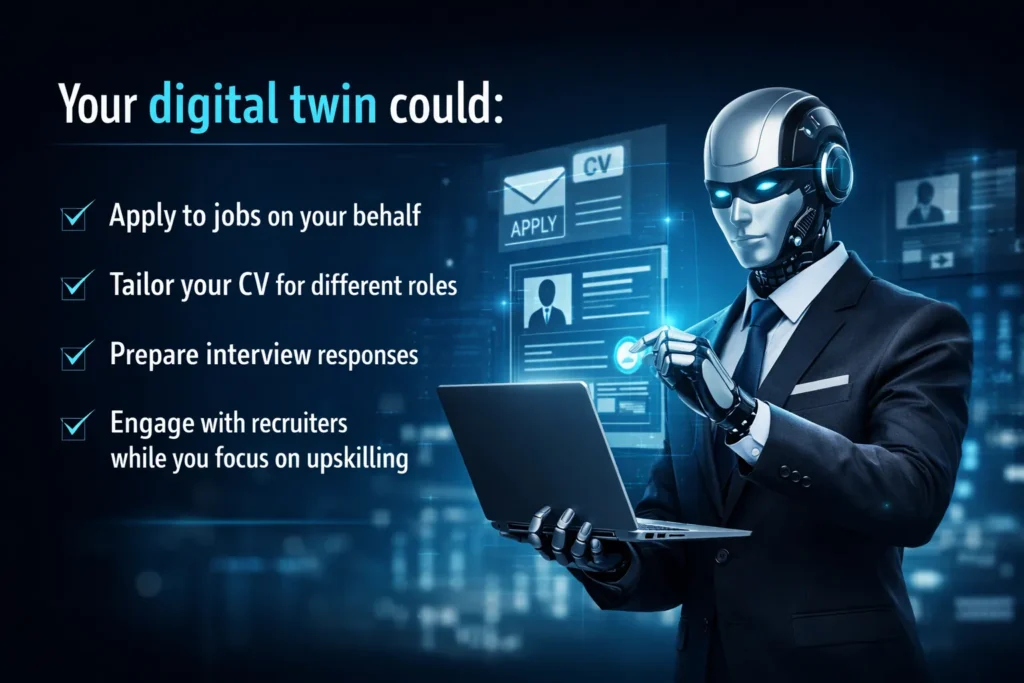
Imagine an AI-powered version of you working in the background while you focus on building skills or preparing for interviews. It could be submitting applications, tailoring your CV, and responding to recruiters. Not a basic bot, but a detailed digital representation of your skills, preferences, and communication style.
In theory, this digital twin extends your reach and acts as a team collaborator in a competitive job market.

This is no longer purely hypothetical. Some companies are already testing AI-driven digital twins in early-stage recruitment, where recruiters may interact with a candidate’s “twin” before speaking to the person — engaging with a dynamic profile that can respond, adapt, and present information in real time.
For job seekers, the real question is whether a digital twin improves your chances of getting an offer or simply adds another layer of complexity to an already competitive hiring process.
What a Digital Twin Actually Means for Job Seekers
Digital twins (or clones) are AI-driven models that represent how individuals work, communicate, and make decisions — effectively creating a digital version of a person’s professional behavior.
Allwork.Space predicted they would become a workforce disruptor, and that is now beginning to take shape across industries. In recruitment, their role is still evolving. The key question is what this means for job seekers and how it may affect the way they are evaluated.
Digital twins reflect the transition toward automated, employer-driven hiring, where applications are screened or prioritized before reaching a human reviewer. Within this process, an AI-powered version can help submit applications, tailor CVs, prepare responses, and engage recruiters — expanding reach and reducing the time required for customization.
On the surface, this appears advantageous in a market where speed and visibility matter.
Early tools already help refine CVs, simulate interviews, and identify relevant roles, offering ways to improve applications and better align with opportunities. However, most remain limited to simulation rather than managing real-world job searches, and they are not designed primarily with job seekers in mind.
As part of this system, digital twins add another layer of evaluation rather than giving candidates a direct advantage.
This raises a central question: who are they really for?
In practice, digital twins primarily serve employers by enabling more efficient, large-scale screening and evaluation. They extend existing hiring systems rather than replace them, allowing recruiters to compare candidates, surface relevant information, and process high volumes of applications more efficiently.
For job seekers, the benefits are indirect but meaningful. These systems can support faster application processes, improve alignment with role requirements through better tailoring, and help present skills and experience more clearly when used effectively. This can increase reach, save time, and improve the overall quality of applications.
However, success still depends on how well candidates demonstrate value beyond automated systems. While digital systems can process and structure information, they still struggle with nuance, context, and originality — areas where individuals retain a clear advantage.

 How Will Recruiters Respond to Digital Twins?
It remains unclear how prepared employers are to use digital twins in recruitment. Many recruiters are still adapting to existing AI tools, and digital twins may add further complexity — particularly when interpreting AI-generated profiles and judging their relevance. As a result, their adoption is likely to be inconsistent, with some employers viewing them as useful signals and others as unreliable or unnecessary.
In practical terms, recruitment has always involved two core functions: identifying candidates (search) and narrowing the pool (screening). Digital twins do not fundamentally change this process. Instead, they strengthen screening by helping process large volumes of applications more efficiently, without clearly improving the discovery of overlooked or unconventional talent.
It is also important to distinguish between true digital twins and what is currently in use. Most systems today function more like enhanced profiles or digital shadows — more interactive than a CV, but still limited in accuracy, completeness, and predictive value. As a result, they are likely to be used as supplementary inputs alongside CVs and interviews rather than as a definitive assessment tool.
Will Digital Twins Reduce Bias — or Reinforce It?
Digital twins are often promoted as a way to make hiring more objective, but they can only be as unbiased as the data behind them. Because they learn from historical behaviour, performance metrics, and past decisions, any bias in that data is carried forward — and in some cases amplified — into future evaluations.
This can lead to two outcomes: candidates who do not match common patterns may be overlooked, and others may be assessed in ways that favour more conventional profiles.
At their core, digital twins identify patterns and generate outputs based on those patterns. While they can process structured data and highlight correlations at scale, they do not interpret context, lived experience, or nuance in a human sense. As a result, their outputs still require human judgment to be interpreted and validated.
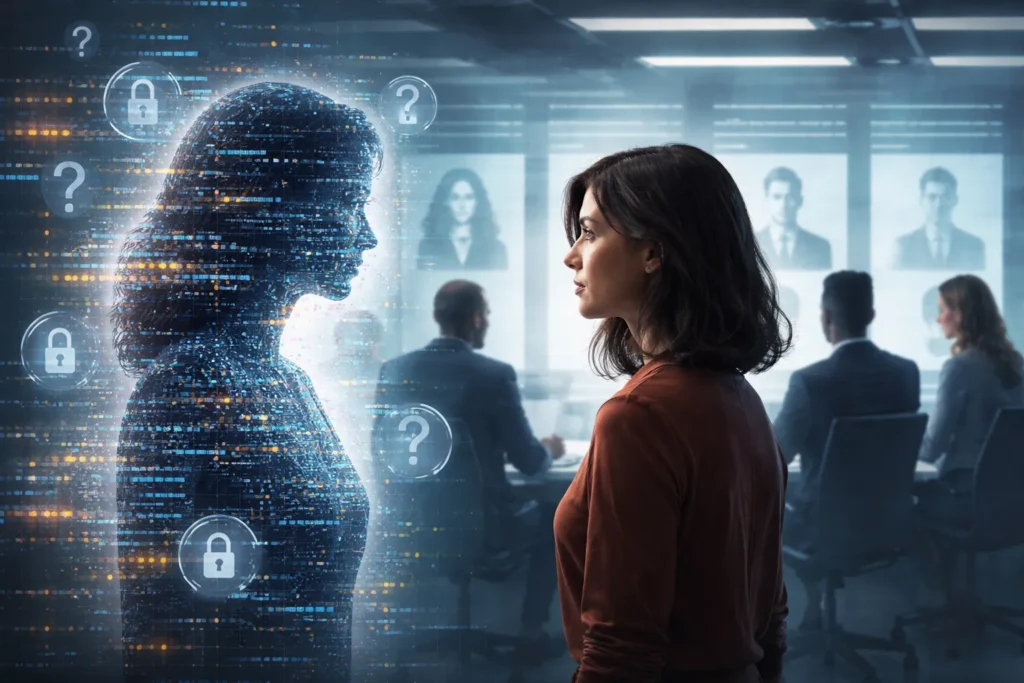
Beyond bias, digital twins raise unresolved questions around data use, ownership, and control. In practice, it is often unclear how much personal data is collected and used to build these systems, who owns and controls the resulting digital twin, who is responsible for maintaining it, and what happens to it when an individual changes roles or organizations.
 Do You Actually Need a Digital Twin Right Now?
Digital twins are advancing quickly, but they have not yet become embedded in mainstream recruitment. For now, they remain early-stage systems rather than established infrastructure, and they do not provide candidates with a consistent or reliable advantage.
With that in mind, job seekers and organizations should focus on what matters today.
What to Do To Get Hired Today
- Gain hands-on experience with AI by using it in practice
• Maintain a clear, credible online presence that reflects your work
• Emphasize measurable outcomes over duties or skills alone
• Stay adaptable as tools and expectations evolve
What to Watch Next
- Whether recruiters adopt digital twins as core tools or treat them as supplements
• How regulation evolves around transparency, consent, and ownership
• Whether these systems expand beyond screening into broader evaluation
Hype vs. Reality
- The Hype: Fully autonomous digital twins managing career searches end-to-end
• The Reality: Incremental tools that support visibility and screening, while still relying on human judgment
The Takeaway
Periods of technological change create uncertainty, but they tend to lead to more structured and effective systems over time. The challenge is not adopting every new tool, but identifying the ones that genuinely improve how people find work and how organizations evaluate talent.
Digital twins may eventually impact hiring by improving information sharing and providing a more complete view of candidates. For now, they remain part of a broader shift toward data-driven, automated hiring.
The systems, trust, and standards required for reliable use are still developing.
So the practical question is not whether you need this technology, but how it may be used and how to prepare for it. Job seekers who understand these systems can adapt with intent — aligning CVs, portfolios, and online presence with employer criteria, and presenting clear, measurable outcomes that make their strengths visible and easy to assess.