

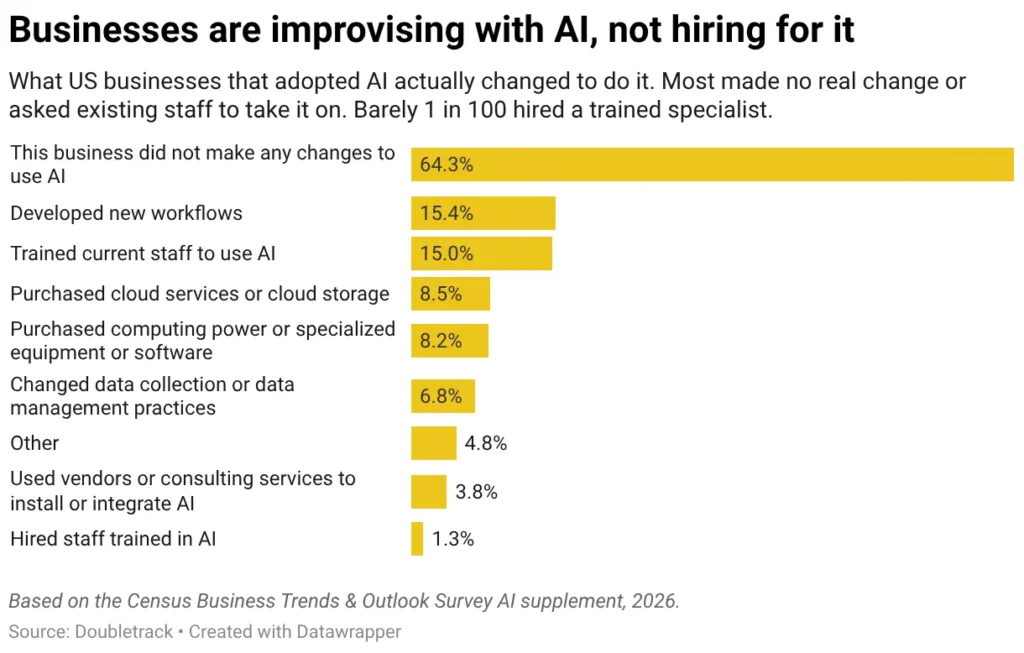
About one in five U.S. businesses now use AI. Across the country’s largest metros, it’s closer to one in four. But according to a DoubleTrack analysis of U.S. Census and Bureau of Labor Statistics data mapping AI adoption against the AI workforce, just 1.3% of those businesses have hired anyone trained to run it.
Ask the businesses not using AI why, and the shortage of skilled workers ranks near the bottom of their answers, cited by roughly 1 in 14. A majority (61.6%) said AI simply isn’t applicable to their business.

That answer is the tell. Most companies haven’t hired AI talent because they haven’t done the work to determine what to hire for.
A gap that follows the map
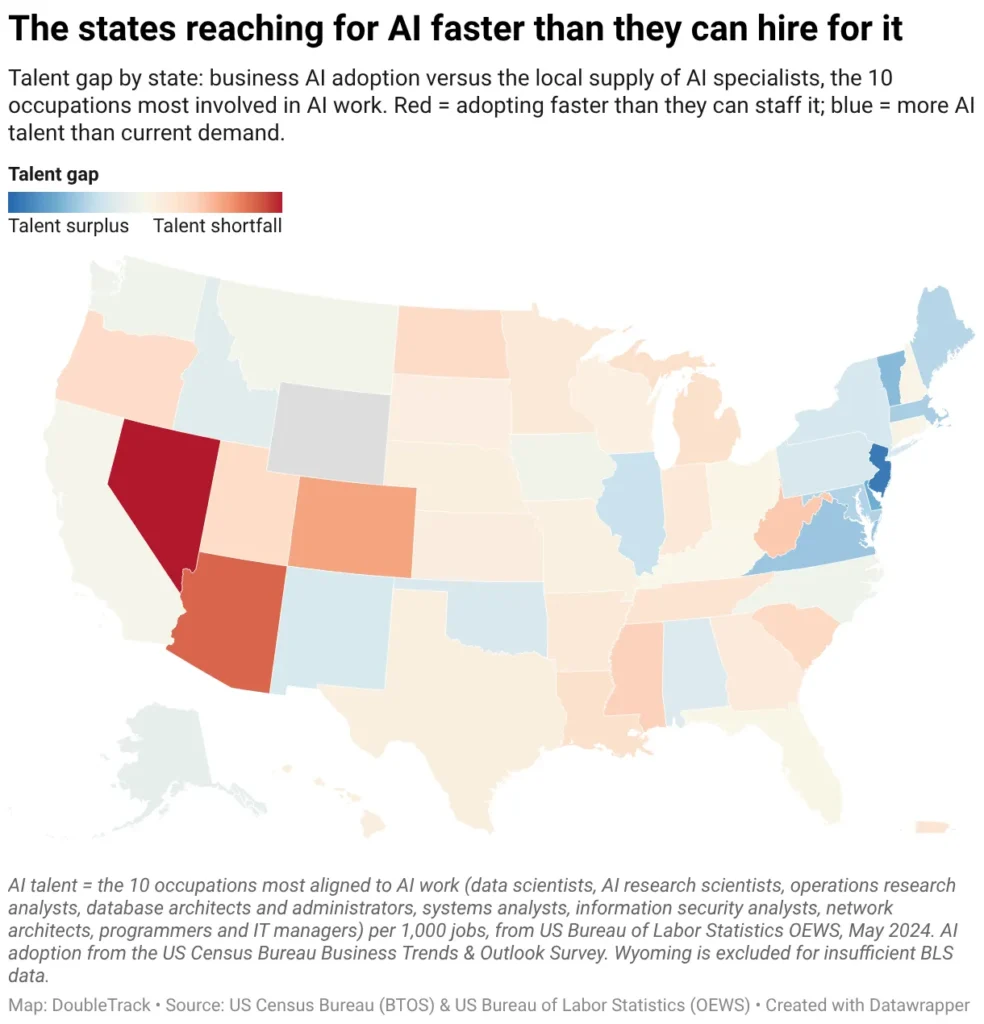
The analysis found the widest gaps between AI adoption and local AI talent supply cluster in the Sun Belt. Phoenix leads, with roughly a third of businesses reporting AI use despite having fewer data scientists per capita than most major metros. San Antonio, San Diego and Miami follow the same pattern, and Arizona, Colorado and Nevada lead among states.

The opposite pattern holds on the coasts. San Francisco has close to four data scientists per 1,000 jobs, the deepest bench of any metro measured, with New York, Boston and Seattle not far behind. Adoption there is healthy, but not outrunning the local talent pool.
The study also found that company size creates gaps among AI hiring rates. Small companies are hiring at about 17.6%, while larger ones are nearly double that, at 30.6%. Keep in mind that the median AI-aligned worker earns about $130,000 a year. That is roughly 2.6 times a typical employee’s pay, and considerably more in tech hubs, so this could play a part in why we’re seeing a large divide among company sizes.
“Not applicable” reveals potential foundational issues regarding AI
That 61.6% figure of companies that believe AI isn’t applicable to their business assumes those businesses conducted the analysis to reach that conclusion, whereas, in reality, most haven’t.
In practice, “not applicable” is often the answer a company gives when no one has asked a more basic question: what decision would this actually change, and what would we need to trust before making it? Without that step, employees adopt AI tools informally, on their own judgment, with no way to measure whether it’s working. That’s consistent with widely cited MIT research, which found that the vast majority of corporate AI pilots have no measurable effect on the bottom line.
Companies that hire before laying that groundwork end up staffing for a problem they haven’t defined yet.
Who should own the groundwork for AI pilots? Look internally first.
At many companies, AI ends up in the hands of whoever’s most comfortable with the technology, usually someone in IT, absorbing it alongside their existing job. That’s an accident of convenience. It shows up in this data as no formal owner, no training tied to outcomes, and no one accountable for whether any of it works.
Before hiring an AI specialist, organizations should first look internally to ensure that the right stakeholder in the IT department (or relevant business unit) is formally given the time and space to own the organization’s data architecture. And if they need help accomplishing this, consider hiring a data consultant.
The idea behind this accomplishes two things: defining the organizational problems that AI is meant to address and ensuring that the data fed in is clean and reliable. Doing this exercise formally will help lay the foundation for a successful AI pilot program prior to making the hiring investment.
When should companies hire AI talent? Consider the cost.
The right time to hire varies by organization, but there are two reliable signals: a clean data architecture and well-defined goals for AI adoption across the organization.
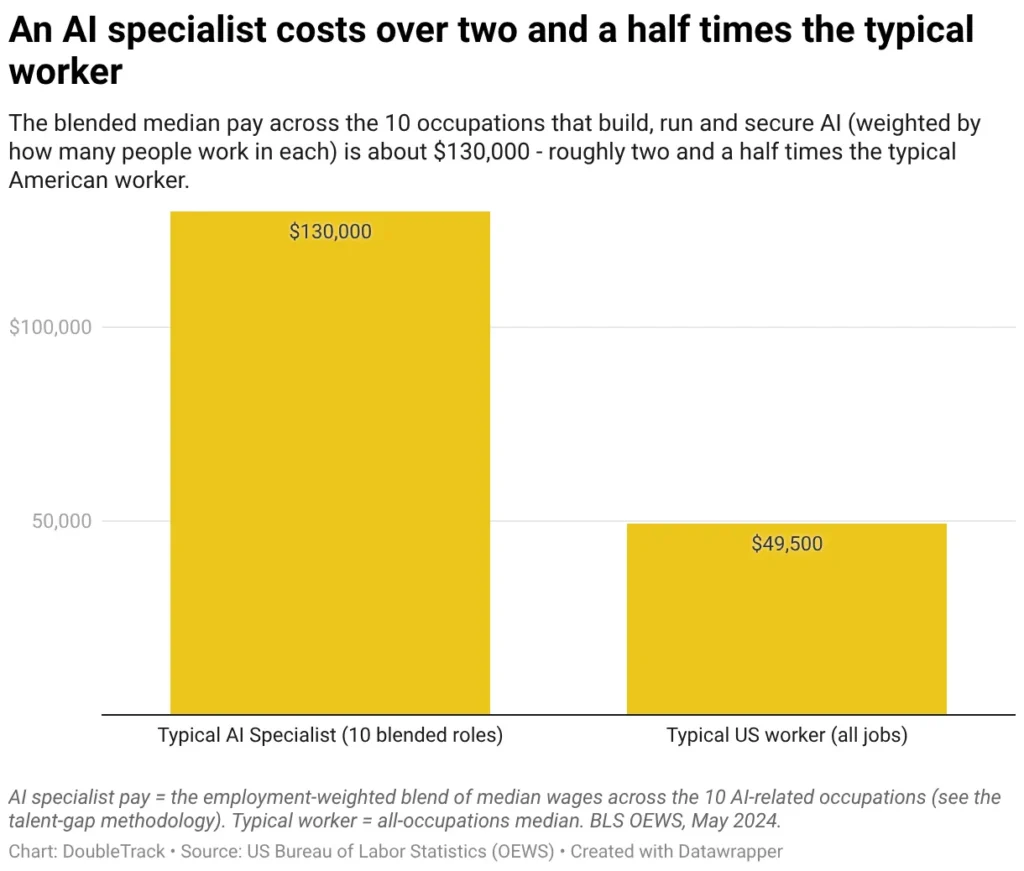
When a company decides to hire before that point, a $130,000 specialist spends their first two quarters untangling data problems instead of building anything. Many companies cannot afford to make this costly mistake.
Outside a handful of coastal metros, AI talent is both expensive and scarce, and workers with AI skills already command a 56% wage premium over their peers, according to PwC. A company that hires at the wrong moment in a market like Phoenix or San Antonio may not get a second chance to try again locally. Indeed, hiring AI talent is a significant financial investment regardless of organization size, so when and how you use it can have a significant impact on your bottom line.
The businesses pulling ahead did the unglamorous work of fixing what their data actually says before making this financial investment for someone new to act on it.