


What role should a building play in people’s lives and communities? The question is not new, but the rate and complexity of change are. Global economic, sociological, technological, environmental, and policy forces are reshaping how people live, work, and connect.
Futurist Jamais Cascio’s BANI framework describes today’s conditions as brittle, anxious, nonlinear, and incomprehensible, which means change is difficult to anticipate, and the effects are often disproportionate to the cause. Who does not feel some version of BANI these days?

For commercial real estate, the implications are significant. The industry has spent years focused on longevity, efficiency, and stability; however, a bigger question needs our attention now: How can a building help evolve the human race?
This next stage in real estate must move beyond amenities, toward human capability. Enter the Cognitive Commons.

We may be underestimating how quickly things can change
A fundamental shift in the built environment sounds ambitious until you look at what’s already happening.
In August, the National University of Singapore, DayOne and Cortical Labs unveiled the world’s first independently operated biologically integrated server rack. The 20-unit system combines living human neurons derived from stem cells with silicon-based hardware in an active research environment. Biological computing is still early, but something that resembles science fiction is now sitting in a server rack.
Materials are moving in equally surprising directions. Neri Oxman’s Aguahoja explores architectural composites made from cellulose, chitosan, and other biopolymers, some programmed to decompose and return to natural cycles. Her work points toward a future where the distinction between something grown and something manufactured becomes harder to distinguish.
MIT’s Tangible Media Group has explored physical environments that change form. Its TRANSFORM research demonstrated shape-changing furniture that can move objects, create dividers, and alter its configuration in response to use.

These few examples barely scratch the surface of current innovation and cannot predict what future buildings will look like. But they do begin to challenge our assumptions about a building’s potential and mission.
Erik Brynjolfsson and Andrew McAfee, MIT researchers, used the classic chessboard story in their 2012 brief Race Against the Machine to explain exponential progress: place one grain of rice on the first square and double it on each following square. The first half seems manageable; the second scales beyond imagination.
They argued that digital technologies were already carrying us into the second half of the chessboard. Since then, consider how much has changed. If progress continues to compound, the next decade could bring change at a scale that still exceeds our intuition.
To assume the built environment will remain unaffected would be a major oversight.
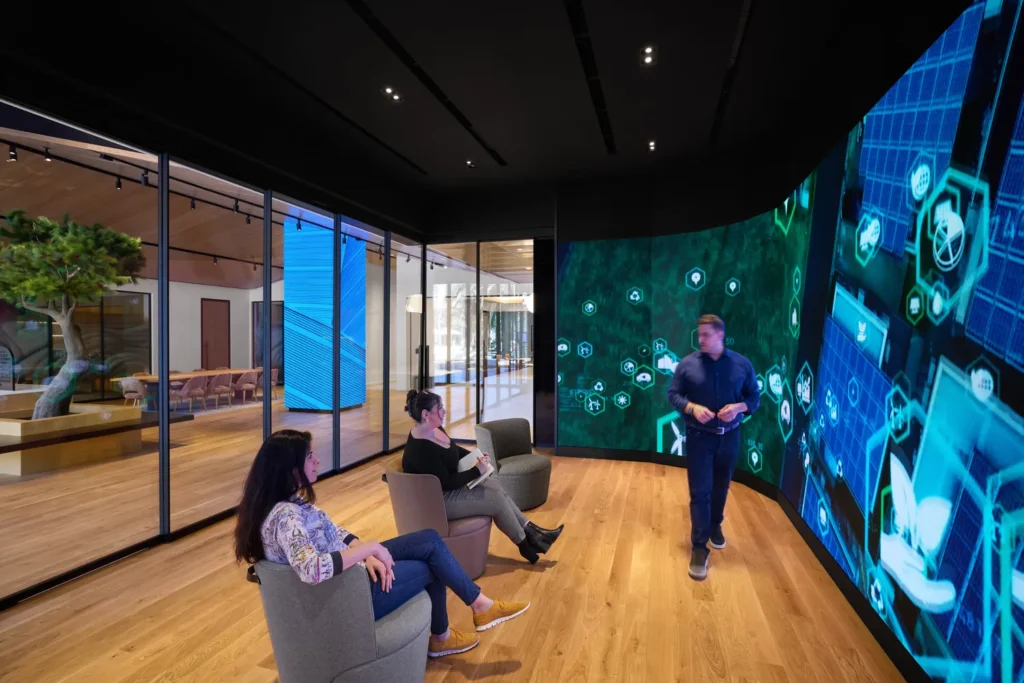
What happens when human ability becomes the brief?
As routine work is automated, people may spend more time on work that places heavier demands on human cognition. That should change what we expect from a building.
A tenant can create an exceptional interior, yet much of the experience is determined before a lease is signed. Infrastructure and operational quality begin with the base building. Developers must therefore treat the core and shell as a layer that directly affects human performance with purposeful roles such as:
Performance Anchors, where living or self-repairing materials are used to regulate heat, light, acoustics, and air while reducing maintenance burdens. Low-energy biological computing could eventually help those systems learn and adapt.
Knowledge Exchanges, where data reveals patterns of encounter that generate ideas across tenants. Shape-changing furniture and partitions could allow shared spaces to reorganize around the work they currently support.
Landing Places, buildings that recognize the transition from home to work and amplify the experience by auto-reserving spaces for recovery based on calendars and physiological responses.
Convening Platforms, that use responsive materials, adaptive environments, and shared digital-physical interfaces to make lobbies and common floors active sites of culture and civic life.
Regardless of the final purpose, each building role creates a Cognitive Commons that strengthens human capability.
What if the whole journey mattered?
Once human performance becomes fundamental to the brief, even transitional spaces will become more interesting.
Imagine arriving in a building lobby after an overstimulating, driverless commute and entering an elevator that helps you recalibrate by using light, sound, or visual movement for the optimal cognitive boost. Suddenly, those two minutes of vertical circulation carry real value instead of awkward silence or stressful news headlines.
Responsive materials, gesture-based interfaces, robotics, and adaptive physical systems expand what these experiences could become, allowing a building’s materiality and surfaces to move beyond aesthetics.
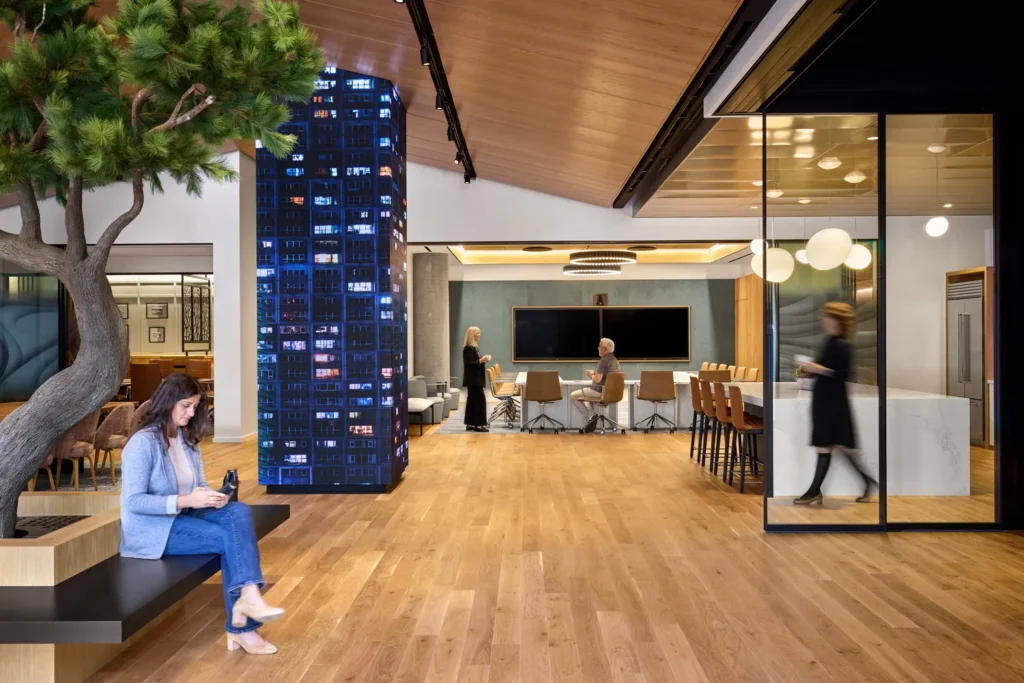
The Cognitive Commons cannot stop at the property line
A Cognitive Commons should also extend beyond the building, creating value through what it offers and how seamlessly it connects people to nearby resources, experiences, and the community.
A Yale-led study of pedestrian behavior in New York, Boston, and Philadelphia, using recordings made roughly 30 years apart, found that people walked 15% faster, spent about half as much time lingering, and formed fewer spontaneous groups. Public spaces were increasingly functioning as corridors for movement rather than places for social interaction.
Connection may become one of the most valuable things physical environments can provide.
One speculative project offers an interesting signal. Quartz, a ring concept developed by Modem and Retinaa, uses an actual handshake to establish a verified connection and help authenticate future digital communication. The product may never become mainstream, but its underlying idea is revealing: as synthetic interaction becomes easier to create, proof that two humans actually met may carry value in the future.
Why wouldn’t you want your building to be a hub for those connections?
What will buildings compete on next?
Commercial buildings have competed on location, quality, and, more recently, experience. Human ability may be the next source of value.
A building that actively helps people think more clearly, recover more effectively, or form stronger human connections is doing a lot more than simply housing office space.
That is the Cognitive Commons: buildings and public spaces designed to elevate human capability and make the environments we inhabit more valuable because of what they help us become.