



We’ve been solving the wrong workplace problem, Debbie Lovich, managing director and senior partner at Boston Consulting Group (BCG), told an audience of workplace professionals at the recent WORKTECH26 New York.
After decades of prioritizing shareholder returns, followed by an era of customer obsession, organizations now need to become equally obsessed with employees.

And Lovich has a business case for it.
Work is broken
Drawing on research conducted as a Future of Work Fellow at the BCG Institute, Lovich argues that more than 90 percent of workplaces are fundamentally broken because they are insufficiently employee-centric.
When employees are treated as costs to manage rather than stakeholders whose experiences matter, performance and engagement suffer.
Hybrid policies, amenities, and even upskilling programs can’t fix the underlying problem, warns Lovich, a co-founder of Future Forum, a global research initiative exploring how work was changing across talent, technology, and space.
Speaking with Peter Miscovich, JLL’s global future of work leader, Lovich shared lessons from her 32-year consulting career, now captured in her forthcoming bookn Make Work Work.
The next revolution: From shareholders to customers to employees
In the late 1980s, “we worshiped on the altar of shareholder value creation,” Lovich explained, measuring success with ROI, total shareholder value and BCG’s experience curve.
Cutting costs, achieving scale and maximizing returns to shareholders took precedence over customers who were demanding more products, services, resources and personalization.
“All that eats into margin,” recalled Lovich of the prevailing sentiment of the time.
Then technology turned that thinking on its head, demonstrating that “being customer obsessed is not a trade-off with shareholder value. It’s a driver of it.”
Over the following decades, customer-centricity became a business imperative, with organizations embracing design thinking, customer journeys, segmentation, personalization, A/B testing, and cocreation.
Lovich believes we’re at a similar inflection point today.
Despite decades of attention to employee engagement and wellbeing, workers remain burnt out and disengaged, according to Gallup’s employee engagement research, which notes a continued decline. Yet many organizations continue to view employee demands – higher salaries, more benefits, workplace amenities, flexible work, fewer hours – as costs that eat into shareholder and customer value.
“Work is the product,” Lovich maintains. “Employees are its consumers.” Every day, they decide how much of their energy, creativity and commitment to invest.
Companies such as Costco, Best Buy and Delta Air Lines demonstrate the potential business value of this approach.
For example, Costco “pays people amazingly,” according to Lovich, while generating more than double the industry average in revenue per employee.
Delta CEO Ed Bastian attributes the airline’s competitive advantage to how it treats its people, despite operating with essentially the same aircraft, fuel costs and regulations as its competitors.
Five deceptively simple ways to make work work
After decades of advising organizations on leadership, culture and ways of working, Lovich distilled her recommendations into five practices that employees and leaders at every level can apply. They may sound obvious, she acknowledged, but organizations frequently fail to put them into practice.
- Celebrate people. Don’t reserve appreciation for formal recognition programs. Tell people when they’ve done something well and be specific about why. “Think about your happiest days at work,” Lovich suggested. “It’s probably when someone said something you did was awesome.”
- Go see and help. Practice servant leadership by getting out of the executive office, spending time with employees, understanding their challenges and pitching in — even on small tasks. Lovich recalled ordering dinner for her consulting team during a late-night work session rather than delegating the errand to a junior associate. No task should be beneath a leader.
- Be interested in people. Get to know colleagues as human beings, not just job titles. Ask about their lives outside work, remember what’s important to them and demonstrate genuine interest. Lovich keeps notes to help remember personal details about colleagues and their families. People want to know they matter.
- Co-create everything. Involve employees from the beginning when redesigning work or implementing technology that affects their daily experience. Don’t do things to employees; do them with employees. Lovich argues that organizations spend too much effort managing resistance to changes that employees had little role in shaping. “This is one of the harder ones,” Lovich acknowledged, adding “but the payback can be significant.” When employees help create solutions, they develop a sense of ownership and are more invested in making them succeed.
- Do it first. Leaders must model the behavior they expect from others. Want employees to spend more time with customers? Do it yourself. Want them to embrace AI? Start learning and experimenting with it. Lovich emphasized that leaders must become comfortable being uncomfortable — including acknowledging what they don’t know and learning from more technologically proficient colleagues.
The business case: Employee-centricity delivers results
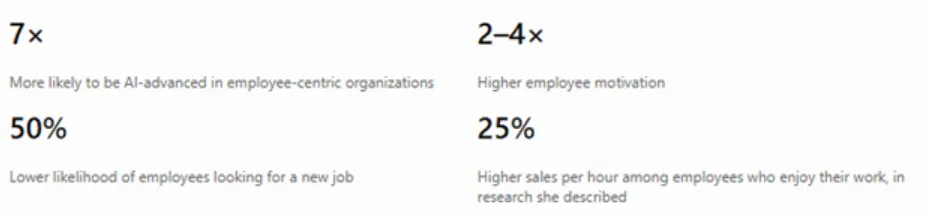
Lovich cited research published in Harvard Business Review and by BCG linking employee-centricity to measurable business outcomes, including stronger motivation, improved retention, higher sales productivity, and more successful AI adoption.
Sources:
25% higher sales per hour. HBR, March 24, 2026
7× more likely to succeed with AI. HBR, November 26, 2025
50% less likely to seek another job. HBR, June 12, 2024; BCG, August 2025
2–4× more motivated. BCG, August 2025
Why employee-centricity matters in the age of AI
Lovich argues that many organizations are approaching AI adoption from the wrong direction: introducing new tools without considering how employees experience the change. For workers worried about job security, increased workloads or losing hard-won expertise, AI can feel more like a threat than an opportunity.
Her alternative? Engage employees. Rather than prescribe AI use cases from the top down, let employees identify tedious tasks and experiment with redesigning their own workflows.
Such an approach embraces two of her key principles – co-create everything and do it first. Employees should help shape the changes that affect them, while leaders model willingness to learn and experiment themselves.
The distinction is important: technology should not just make employees more productive for the organization. It should make work more enjoyable and fulfilling for employees themselves.
Making work better is everyone’s business
While seemingly simple, Lovich’s principles do require a shift in mindset. For organizations accustomed to optimizing work around business performance, employee-centricity asks a different starting question: What would work look like if it were designed to be genuinely rewarding for the people doing it? Lovich argues that rather than compete with business performance, employee-centricity may be the key to achieving it.