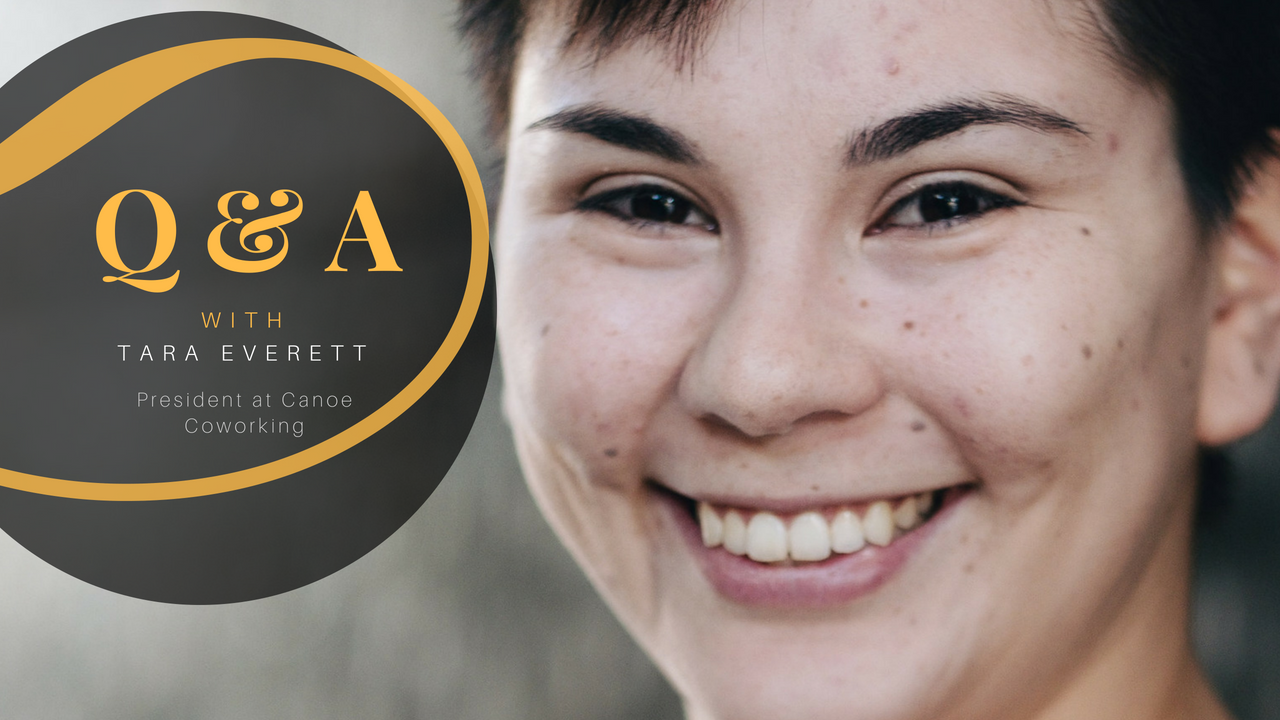
Tara Everett is working to bring community coworking to Winnipeg, the capital of the Canadian province of Manitoba. More specifically, she’s creating an indigenous coworking space providing workspace, community and a gathering place.
The founder of Canoe Coworking and an indigenous woman herself, Everett recognized the need for an open, community-focused workspace in Winnipeg, a town with an abundance of casinos, smoke shops and gas stations. Allwork.space spoke with Everett about her vision for Canoe, indigenous-focused coworking, and creating a space that respects cultural protocol. Here are the highlights of our conversation.

Allwork.space: You’ve been transparent about every step in the creation of Canoe Coworking. In doing so, you bring the larger coworking community along on your journey of opening a space and building a community. It’s great to be part of that because there’s a temptation, among new space operators, to wait until everything is perfect before they introduce their space to the world.
Tara Everett: I didn’t intentionally do it that way. I just realized that I needed to see progress because when I’m in the midst of a project, I can never see that progress myself. When I shared on social media that I got the key to my space—to validate my own thought that I’ve made a big step—people came and offered support, and acknowledged that I’m doing crazy amounts of stuff, and encouraged me to take a weekend off. That’s exactly what coworking is.

Allwork.Space: How is the concept of coworking being received in Winnipeg?
I want to open more minds to coworking because it’s so needed right now. My community has a lot of smoke shops, casinos, gas stations, primary industries like forestry and agriculture. Those are the big economic drivers. There needs to be something different, but when you bring something different to them, they’re hesitant about it.
People don’t understand what coworking is, but I’m doing collaborative, educational events before I open to help them understand.
For indigenous cultures here in Canada, we’re extremely marginalized and there’s a lot of mistrust.

Allwork.space: Old-school coworking people would say you’re doing it right—putting your community in place before your space is ready. One of the mistakes people make is getting everything just right in isolation, then opening the doors and thinking members will flood in. But it rarely happens that way.
I have OCD, anxiety and depression, so my mental health played an important part in this. I really strongly identified the space as something that I needed to be healthy. There needed to be an already-established community before the doors opened. Without that, there was no purpose for the space.
It’s funny that you say “old-school coworkers.” Indigenous people have been coworking since the beginning of time—we’ve been working outside of colonial cultures, in a coworking endeavor, since forever. There was no method of payment with money, or with trade—everything was done collectively, as a group. Different groups, or segments of people, had different rules.
That’s what we’re going back to now as we move forward with technology: we’re starting to find those niche groups again. I find that exciting. Then everyone can do what they want to do. If you’re a hunter, you’re hunting; if you’re a gatherer, you’re gathering; if you’re a little bit of both, you’re doing that, instead of being forced into these rules where you have to fit in a tiny shoebox.
Allwork.space: Thanks for that perspective—it’s an important reminder. Will you tell me your coworking story—how you found this movement, and your decision to open a space?
I stumbled upon coworking just over a year and a half ago, so it’s really new to me. There weren’t a lot of spaces within Winnipeg that were what I wanted. I’ve always longed for a space that was a collaborative, welcoming environment. I’m very social, but I’m an ambivert, so I do need that time to take myself in and do my work. I haven’t had that anywhere—there’s never been anyplace comfortable for me to work, that had the right amenities, that was collaborative and that was a community.
I was working full-time with a nonprofit organization—my background is primarily nonprofit and economic development—and my job was to help other people find jobs. I found that so empowering. People were coming to me in their moment of greatest need. That evolved into program policy and I started getting calls to participate and present to people, then last year I had to leave work very suddenly.
I stumbled across coworking and started doing a lot of research. Once I started reading about it, and the philosophy behind it, I realized the spaces here in our community weren’t quite my segment or demographic or what I would want in a space, so I thought, ‘Why don’t I do my own?’
Allwork.space: How has it been bringing your vision to life in Manitoba?
It was really hard for me to access programming. Manitoba is historically very conservative, which is why it took me so long to start. They’re excited about new ideas, but those new ideas take months, if not years, for people to get comfortable with. Our innovation centers are just building up steam now.
Coworking is like building a hotel—you try to build a hotel, but you don’t know your costs and you can’t get those costs without spending money. I saw that the shoestring budget model wasn’t going to work—I couldn’t do it that way. I needed the expert opinions and the backgrounds.
It was suggested to have people purchase memberships upfront, but that doesn’t happen here. I’m dealing with a lot of First Nations, which are indigenous people, and they follow the government fiscal year. They can’t write-off work expenses like that and, at the end of the day, a lot of these people aren’t going to be in control of their money.
When I started looking for other indigenous spaces, I found Songhees Innovation Centre, which is in Lekwungen (Songhees) territory in British Columbia, but they’re run by three major partnerships. I’m the only one doing this solo, as far as I know. It’s exciting, but terrifying. People ask if I want to franchise, and the answer is no. I always want the ownership of the coworking space to be within the community. That’s really important to me.
Allwork.space: Will Canoe be strictly for indigenous people?
Absolutely not. There will be a safety net though—a community atmosphere. If a non-indigenous person wants to come in and ask questions in a respectful, thoughtful and open way, come on in.
Allwork.space: How do you describe the space? We’re hearing a lot more about women-focused spaces. Is there a phrase you’ve landed on to describe what you’re doing with Canoe.
Everyone will have a different experience based on who they are as a person. It also depends on cultural aspects. I’ve thought about describing it as culturally-open, or relevant, or a safe space. There hasn’t been anything yet, and I don’t think there will be. I choose to use the word indigenous, which is the newly accepted word for First Nations.
Colonization separated the peoples into three pillars and the funding is different for each pillar. My big goal is to try to bring all three of those pillars into my space. Even though we can’t necessarily access the same funding or programs, we’re all just people within the space. But we have enough knowledge about each other’s cultures that we don’t feel that we have to explain everything. It’s exhausting for people to have to explain their culture over and over again.
Allwork.space: Where are you in the process of opening?
I’m currently doing our five-year business plan. We had a mayoral visit recently, our first event in the space and coverage from three different news outlets. It’s completely unfinished right now. Once I have the space open, I’ll qualify tenants. There’s a potential cornerstone tenant coming in who will take one-third of the space at the end of the month, and a lot of interest in membership.
Allwork.space: How will Canoe be designed? Will you have open workspace and offices?
It’s a three-story building and I’m converting the third floor into private offices. I like open workspaces, but the reality is, a lot of indigenous people are very respectful of one another’s space.
There are certain cultural protocols that need to be followed. A lot of the independent freelance workers tend to work on very sensitive issues, like missing and murdered women, which is a huge issue here in Canada. And things like the residential school survivors. There’s a greater need for private or semi-enclosed spaces, but the main floor will be more open—a flexible, drop-in and event space. The basement will be more private offices and a couple of team workspaces for two people.
We’ll have an elder lounge, which is unique to our space as far as I know. That allows cultural protocol to be followed, which is really important to me. You can agree to disagree with the elders, but there’s an aspect of making sure they’re always taken care of. They can rest or, if there’s someone who needs their guidance, they’ll be here.
There will be a quiet space, because that’s what people sometimes need. If you’re having a rough day because you’re working on some really dark stuff, you can go in there and meditate, or quietly listen to music, or just take a minute for yourself.
From my market research, I found that’s what my people need. It’s not my choice, it’s theirs. It’s their space, not mine. I feel really strong about that. That’s why I didn’t go with a nonprofit model—I don’t want a board of directors determining what they think is right for the space, because they won’t be there every day.
Allwork.space: How are you funding the space?
When I started looking for investors, it was through programs the government offered. Because of my barriers to entry and I didn’t have the capital they required, I was excluded from 12 different programs. I’m currently looking for outside investors.
Allwork.space: Thanks, Tara. Any big picture thoughts about Canoe or coworking you’d like to share?
Indigenous people tend to be very holistic in their approach to policies and looking at all sides of things, not just dollars. We look at how something will make people feel and how it will impact our community. There’s so much more to coworking than just coming into work.