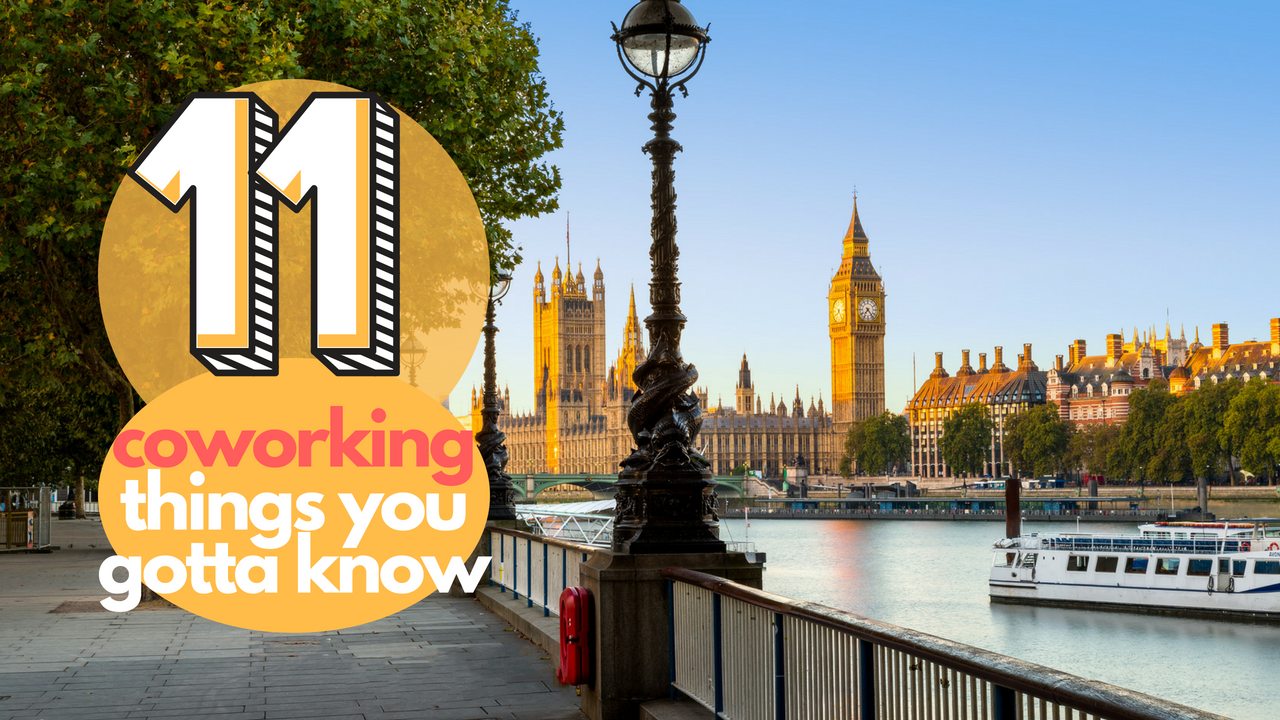
- A rundown of some of the things that make coworking in the UK so awesome.
- From the tallest buildings to the most unusual spaces (coworking in a mortuary, anyone?) the UK is full of fascinating workspaces.
- Explore some of them here, and dig deeper into the UK’s coworking scene at GCUC UK later this month.
Did you know that London is the global capital for flexible space? Yes, you probably already knew that. How about this one: did you know that you can find flexible space in 7 of the UK’s 10 tallest buildings?
There are tons of fascinating, useful, wonderful and downright weird facts relating to flexible space in the UK. We’re expecting to hear many more at GCUC UK in London later this month, and you can tour some of the city’s unique spaces on Day 3 of GCUC UK, including Huckletree, 42 Acres, Work.Life and The Ministry (open to ticket-holders only!)

But for now, we’ve rounded up 11 things you (probably) didn’t know about coworking in the UK, right here. We’d love to hear yours too — share them with us at [email protected].
1. London’s economy is led by tech, and it’s driving huge demand for coworking.
The number of people working in technology, media and telecoms (TMT) overtook finance back in 2013, and it’s having a huge impact on the growth of coworking in London. According to Knight Frank, “technology advancement sits at the forefront of the flexible and coworking success story.”

2. WeWork’s London footprint is smaller than you think.
WeWork is London’s largest corporate occupier of office space, yet according to Almacantar’s Mike Hussey, “even at 2 million sq ft in London, WeWork are catering for less than 1% of the capital’s working population… There is scope for much more.”
3. It’s not just about London.
Two-thirds of the UK flexible workspace market is outside London. Take-up of flexible space in the UK’s largest regional cities — Birmingham, Bristol, Cardiff, Edinburgh, Glasgow, Leeds, Manchester, and Newcastle — increased from 2% of all city centre take-up in 2016 to 7.5% in 2017 (Cushman & Wakefield).
4. Coworking is supporting business growth in smaller towns too.
Entrepreneurs can now access desk space in rural towns like Huddersfield in Yorkshire, and even tiny Narberth in Wales, thanks to forward-thinking operators like The Media Centre and IndyCube.
5. Women-oriented spaces are blossoming.
We’ve seen a number of female-oriented spaces flourish in the US, and it’s taking off in the UK too (although currently only in London). They include The AllBright and GCUC host Lu Li’s Blooms, but according to Wired, this trend could be set to grow further as New York’s The Wing is eyeing up London for potential expansion.
6. Bars moonlight as coworking spaces.
In virtually every UK city, town, village and hamlet, there’s a pub — yet many of them stand empty during the day. Now, finally, some are opening their doors to coworkers. Andco is one company that’s helping pubs make the transformation and it makes perfect sense, according to Elaine Rossall, former Head of UK Offices Research at Cushman & Wakefield. She says that “pubs, hotels and libraries are increasingly of interest to flexible space providers, building on the popularity of coffee shops and cafes as flexible workspaces.”
7. You can cowork in the UK’s tallest building.
Thanks to The Office Group, The Shard in London — also the tallest building in Europe — is home to flexible space with seriously amazing views.
8. In fact, you can cowork in 7 of the UK’s 10 tallest buildings.
As a marker of just how far and wide (and tall) the flexible space industry has grown, 7 of the UK’s 10 tallest buildings are now home to flexible space. They are:
#1 – The Shard (The Office Group)
#2 – One Canada Square (Regus)
#3 – 110 Bishopsgate/Heron Tower (Landmark Offices)
#4 – The Leadenhall Building (Servcorp)
#5 – 25 Canada Square (Regus)
#7 – Tower 42 (Regus)
#8 – 30 St Mary Axe (again, Regus)
9. There’s a coworking member that organizes morning raves.
If you knew nothing of the morning rave scene, allow us to introduce you to Morning Gloryville. They’re a startup that organises sober morning dance parties to “rave your way into the day” — and they’re based at Huckletree Shoreditch, London. Could the morning rave become a new coworking amenity?
10. You can now cowork consciously.
As flexible space continues to explore ever more niche sectors, 42 Acres is a beautiful example of how the coworking movement can make positive change in the world. Billed a “conscious” coworking space, 42 Acres has locations in Somerset and London and has a firm focus on sustainability. It’s zero waste, uses reclaimed materials, natural light and ventilation, low-energy LED bulbs, reusable coffee cups and bags, and has an on-site wormery for breaking down kitchen waste. (You can take an insider tour of 42 Acres on Day 3 of GCUC UK – open to ticket-holders only!)

11. Historic spaces are treasured.
Although repurposing older buildings may not be as straightforward as constructing new ones, particularly where stringent Listed regulations come into force, the UK has a love affair with historic buildings that’s reflected in its beautiful coworking spaces. The UK is full of them. Just three examples are:
Ormeau Baths in Belfast, Northern Ireland, a coworking space based in a converted Victorian bath house.
Colony in Manchester, which was formerly a place to stay for local mill workers during the industrial revolution.
Liberty Space in Scotland, which has a number of spaces including a former courthouse and mortuary in Kinross, and a converted flour mill in Dundee.
Dig deeper into the UK coworking industry at GCUC UK, which takes place in London on 25th and 26th September 2018. Find out more and get your ticket here: uk.gcuc.co