

- Employees and employers are weighing the costs of commuting against the benefits of in-person work, with many finding that the expenses and time associated with commuting need to be balanced by other compensations.
- Companies are enhancing the office experience by offering food programs, such as gourmet coffee carts and subsidized meals, which save employees time and money, while fostering workplace community and collaboration.
- The shift towards a hybrid work model is influencing office design to prioritize flexibility, personalization, and amenities that encourage employees to return to the office, recognizing the value of in-person interactions for mentorship, collaboration, and company culture.
This article was written by RSP’s Alissa Franconi and Christine Shaw for Work Design Magazine.
Returning to the office means a return to the grind of commuting. Of course, it also means better collaboration, deeper connections to colleagues and projects, and accessibility to mentorship and leadership. But that trade-off is a hot topic with our clients, many of whom are continuing to embrace the hybrid work model.

And, particularly in large metro areas, employees and employers are doing the math on that trade-off and finding that the costs, both in terms of finances and time, are just not adding up. If employees are spending $20 or more per day on commuting, between transportation and lunches, and two+ hours traveling compared to working from home, employees might reasonably expect to be compensated for that extra time. On the other hand, employers are finding that remote work may not be as productive as we once thought (and surveys and research back them up). They are pushing to get workers back into the office, but hesitant to mandate full-time, in-person work in a tight job market. And that’s where the Return on Commute (ROC) comes in.
The ROC of Impressive Food Programs
Across the board, from our largest, multinational clients down to single-office organizations, food has become a focal point. One of our large financial institution clients is offering big food perks with a gourmet coffee cart rolling through the office, a per diem for employees to use in the cafeteria and a farmer’s market each quarter where employees can fill a reusable shopping bag with fresh produce and local goods (our client says this is, perhaps unsurprisingly, the busiest in-person day each quarter). These programs aren’t just about delicious food—they are a direct return on the commute for employees. Workers save time and money by not having to stop at a coffee shop. They don’t have to pack a lunch if the company is picking up the tab for a cafeteria meal. And they can cut down on grocery shopping if they can take care of it at the on-site farmer’s market.

Beyond the one-to-one comparison to the financial cost of commuting, food brings people together. One study from Oxford University found that 76.4% of people believe that sharing a meal is a good way to bring people closer together. And other research has shown that enjoying meals with others is associated with better physical and mental health. As designers, we see it all the time—giving people the opportunity to eat or grab a coffee together creates connection and accidental interactions. It forms camaraderie in the office. It can facilitate collaboration and creativity. And it can bring in the element of fun that can be sorely lacking when everyone works remote. If our ultimate goal is to get people back into the office willingly, food is a great place to start.
Programming the Employee Experience
Employee experience is something that designers have always talked about. But those experiences and what employees are looking for have changed dramatically. Our clients say that, even though their employees are generally productive when they work from home, without the in-person element, the sense of connection has been subdued or even lost. The trade-off for commuting has to be a strong, amenity-rich program in the office. It has to give people what they can’t get at home while making them feel just as comfortable.
It’s a delicate balance that often depends on the industry. A financial services firm, for example, will have different needs and resources than a small tech startup. So, we’re talking with our clients a lot more about the experience of work. And, more importantly, the experience they want their employees to have at their unique workplaces. As designers, we help them navigate their resources and goals to make sure the final product works for them in more ways than just aesthetics.
What we hear a lot from clients is that they don’t want their people just sitting at their desks in the office; they want them to have a reason to come into the office. At the same time, square footage and real estate assets are top of mind for most companies. In that vein, the spaces we’re designing are flexible—the lunch area can also be used for training or townhall space or for monthly potluck birthday lunches. The truth is that no one can guess what the “must have” amenity will be in three years (remember when foosball tables were everywhere?), so it’s crucial to design spaces that can be easily transformed and feel authentic to a company’s unique culture, which is much more enduring than the latest workplace trend.
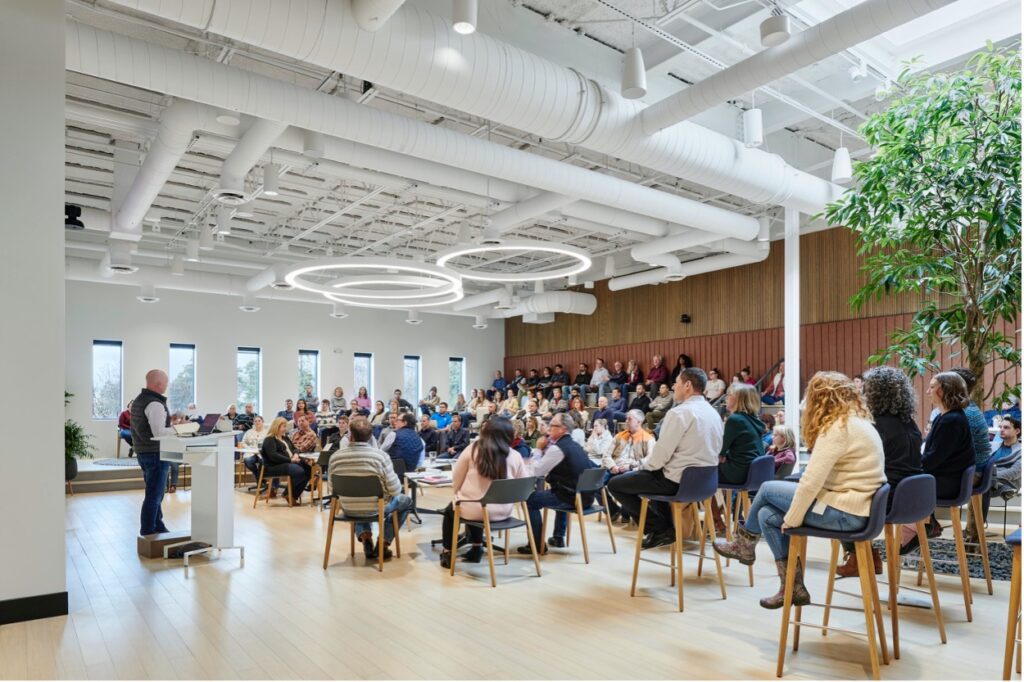
Image: SunOpta Corporate Office | Photo Credit: VONDELINDE
Layouts are changing along with an increase in flexible spaces. We’re putting these multi-purpose spaces much closer to reception than in the past. This way, guests aren’t walking through the entire office to get to event spaces and it’s also a great way to show off company culture to clients and new recruits from the first glance. At the same time, we lay out our designs to make sure private offices aren’t adjacent to communal gathering spaces.
Speaking of private offices, we have seen a substantial uptick in private office requests, which is a sea change from the almost entirely open plan projects we saw until about three years ago. People felt more productive at home because they could personalize their space, not just with family photos, but with the music, silence or other equipment that helped them be most effective. “Hot desking” and “hotelling” makes that difficult, so more companies are going back to private offices. Others are keeping open plan spaces to make the most of square footage, but they are moving away from shared workspaces and going back to assigned desks. If employers are requiring employees to come back to the office, part of the trade-off is making their space reasonably comfortable and personalized.
Outside the office space itself, our clients are looking at other programming that encourages people to get back to the office. One client is supplementing a fitness program with personal training, with the hope of fostering better health and a great reason to come into the office.
The Hybrid Model Version of Return on Commute
Something we see in our own organization, as well as our clients’, is that working 100% from home has had some potentially unintended consequences. Whether they realize it or not, employees are missing out on opportunities for connection, collaboration and access to leadership. Younger employees have missed mentorship opportunities and the chance to see how the workplace functions in person, learning valuable skills in the process.
In fact, we’ve heard this over and over again—with the right design and programming in place, the “return on commute” becomes less of an issue. People who are only asked to come in two days a week are choosing to come in three or more because the commute is worth it for knowledge sharing, face time, and other professional advantages. There is real value in working together in person. It may have taken a while for this realization to stick after years of uncertainty about the future of in-person work, but we don’t see it going away any time soon.