





Advertisements
WorkX Conference
Advertise With Us
Sunday, February 1, 2026
Explore
Allwork.Space
No Result
View All Result
Newsletters
  • Latest News
  • Leadership
  • Work-life
  • Coworking
  • Design
  • Career Growth
  • Tech
  • Workforce
  • CRE
  • Business
  • Podcast
  • More
    • Columnists
      • Dr. Gleb Tsipursky – The Office Whisperer
      • Nirit Cohen – WorkFutures
      • Angela Howard – Culture Expert
      • Drew Jones – Design & Innovation
      • Jonathan Price – CRE & Flex Expert
    • Get the Newsletter
    • Events
    • Advertise With Us
    • Publish a Press Release
    • Brand PulseNew
    • Partner Portal
No Result
View All Result
Newsletters
Allwork.Space
No Result
View All Result
  • Home
  • News
  • Leadership
  • Work-life
  • Coworking
  • Design
  • Workforce
  • Tech
  • CRE
  • Business
  • Podcast
  • Career Growth
  • Newsletters
Advertisements
Workspace Geek - Coworking Software Simplified
Home News

Small Firms Embrace Full Flexibility And Outpace Giants Who Cling To Office Mandates

New data from Flex Index shows that firms embracing full flexibility grew revenues 1.7 times faster than their mandate-driven peers between 2019 and 2024, even after adjusting for industry and size.

Allwork.Space News TeambyAllwork.Space News Team
August 27, 2025
in News, Uncategorized
Reading Time: 3 mins read
A A
Small Firms Embrace Full Flexibility And Outpace Giants Who Cling To Office Mandates

Small firms with under 500 employees offer way more flexibility — 67% are fully flexible — while big companies push stricter office rules despite data showing flexibility drives growth.

As 2025 progresses, U.S. companies are steadily increasing their office attendance expectations—but employee compliance remains low, exposing a widening gap between policy and practice.

According to the Flex Index Flex Report Q3 2025, the average U.S. firm now requires corporate employees to be in the office 2.87 days per week, up 12% from the low point of 2.49 days in mid-2024. This rise reflects two main changes: fewer companies allow zero office days (dropping from 32% to 24%) and more firms demand three to four office days weekly (increasing from 21% to 30%).

Advertisements
Nexudus - Is Your Space Performing?

However, despite this upward push in policy, actual employee attendance has only inched up 1-3%, signaling persistent resistance or flexibility in how employees choose to comply.

Polarized Work Models and Structured Hybrid Dominance

The data highlights a polarized landscape:

Advertisements
Deel - Upgrade your global team management
  • 34% of firms mandate full-time in-office presence
  • 24% have no weekly minimum office attendance
  • Very few require just 1 or 4 days per week (2% and 3%, respectively)

Structured hybrid models, where firms set a minimum number of office days, remain dominant. Now 80% of companies with structured policies use a “minimum days per week” approach, up from 74% last year. Among these, three-day in-office schedules have surged from 56% to 67%, typically clustered around Tuesday to Thursday, with Fridays rarely required.

Size and Industry Divide in Flexibility

Flexibility remains more prevalent among smaller firms:

  • 67% of companies with fewer than 500 employees offer fully flexible policies
  • These small firms employ half of the U.S. workforce and are responsible for most employment growth
  • By contrast, large enterprises and government agencies have shifted towards stricter in-office mandates, with federal government flexibility dropping 23% year-over-year

Industries leading in flexibility include Technology (94% offering flexibility) and Insurance (92%), followed by Financial Services at 82%.

Fortune 100 Firms Tighten Office Mandates, But Flexibility Persists

While large firms have increased office time demands — with 45% requiring 4-5 days per week — 71% of Fortune 100 companies still offer flexible policies, mostly hybrid. However, the move toward office-heavy models among these giants contrasts with the more flexible norms of smaller companies.

Advertisements
Alliance Virtual Offices - Automate Revenue Ops

Business Impact: Flexibility Drives Faster Growth

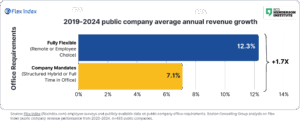
Crucially, joint research with BCG shows that firms embracing full flexibility grew revenues 1.7 times faster than their mandate-driven peers between 2019 and 2024, even after adjusting for industry and size. 

Flexible companies maintain a 34% growth advantage, tying workplace policy directly to business performance — not just employee satisfaction.

The Road Ahead

The coming months will test whether companies maintain or escalate office mandates amid a softening job market — and whether employees’ attendance behavior shifts accordingly. The ongoing tug-of-war between policy and practice will shape workplace norms and competitiveness in the post-pandemic economy.
Advertisements
Your Brand Deserves The Spotlight - Advertise With Us - Allwork.Space
Source: Flex Index
Tags: BusinessCoworkingHybrid WorkNorth AmericaWorkforce
Share6Tweet4Share1
Allwork.Space News Team

Allwork.Space News Team

The Allwork.Space News Team is a collective of experienced journalists, editors, and industry analysts dedicated to covering the ever-evolving world of work. We’re committed to delivering trusted, independent reporting on the topics that matter most to professionals navigating today’s changing workplace — including remote work, flexible offices, coworking, workplace wellness, sustainability, commercial real estate, technology, and more.

Other Stories Recommended For You

The High-Growth Roles And Transferable Talents Powering The Green Economy
Career Growth

The High-Growth Roles And Transferable Talents Powering The Green Economy

bySheya Michaelides
1 day ago

The global drive for sustainability is creating jobs and increasing the demand for green skills.

Read more
By 2040, Gen Alpha Sees Flexible Schedules and Remote Work as the Norm

By 2040, Gen Alpha Sees Flexible Schedules and Remote Work as the Norm

2 days ago
Office Attendance Rose 5.6% in 2025, but Recovery Is Losing Momentum

Office Attendance Rose 5.6% in 2025, but Recovery Is Losing Momentum

2 days ago
Germany’s Unemployment Tops 3 Million, Merz Calls Jobs Data An “Alarm Signal”

Germany’s Unemployment Tops 3 Million, Merz Calls Jobs Data An “Alarm Signal”

2 days ago
Advertisements
Workspace Geek - Coworking Software Simplified
Advertisements
Deel - Upgrade your global team management

The Future of Work® Newsletter helps you understand how work is changing — without the noise.

Choose daily or weekly updates to stay current, and monthly editions to explore worklife, work environments, and leadership in depth.

Trusted by 22,000+ leaders and professionals.

2026 Allwork.Space News Corporation. Exploring the Future Of Work® since 2003. All Rights Reserved

Advertise  Submit Your Story   Newsletters   Privacy Policy   Terms Of Use   About Us   Contact   Submit a Press Release   Brand Pulse   Podcast   Events   

No Result
View All Result
  • Home
  • Latest News
  • Topics
    • Business
    • Leadership
    • Work-life
    • Workforce
    • Career Growth
    • Design
    • Tech
    • Coworking
    • Marketing
    • CRE
  • Podcast
  • Events
  • About Us
  • Advertise | Media Kit
  • Submit Your Story
Newsletters

Welcome Back!

Login to your account below

Forgotten Password?

Retrieve your password

Please enter your username or email address to reset your password.

Log In
This website uses cookies. By continuing to use this website you are giving consent to cookies being used. Visit our Privacy and Cookie Policy.
-
00:00
00:00

Queue

Update Required Flash plugin
-
00:00
00:00