



This article originally appeared in Brian Elliot’s Work Forward newsletter.
For the past few years, we’ve known women resist return-to-office mandates more than men. The usual answer has been childcare: women bear more caregiving responsibilities, so of course they want flexibility.

But that explanation falls apart when you look at the data. Even women without children at home prefer flexibility at nearly the same rates as mothers. So what’s really driving this gap?
An uncomfortable truth: women face nearly twice the rate of gender discrimination when working in the office compared to working remotely. It’s not just about school pickup schedules. It’s about creating workplaces where half your workforce doesn’t have to choose between career advancement and daily harassment.

When your RTO mandate drives out women at 3X the rate of men, you’re not just losing talent — you’re losing the diverse perspectives that drive better decision-making and innovation.
 Women Value Flexibility
Recent research from McKinsey and Cushman & Wakefield shows that women value workplace flexibility more than men.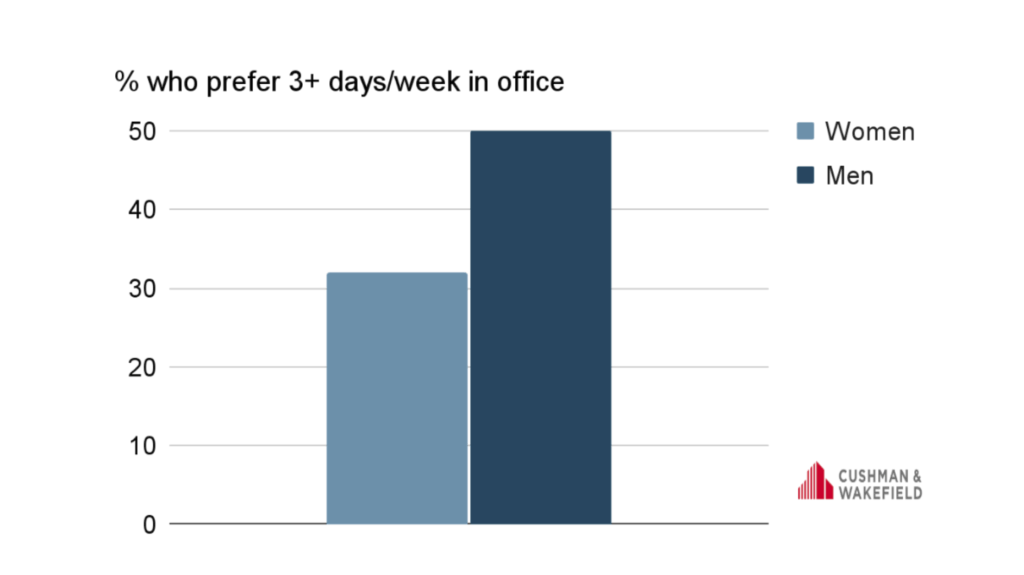 Cushman & Wakefield, Experience per Square Foot, August 2025
The McKinsey study showed that women who don’t have children at home are almost as likely to prefer more flexibility than their male counterparts. We saw the same in the Future Forum data from 2020 through 2023 — it wasn’t just women who were caregivers who wanted flexibility, it was women, period.
Discrimination Doubles On-Site
Research by professors Laura Doering and Andras Tilcsik from the University of Toronto’s Rotman School of Management reveals what many suspected but few wanted to acknowledge: women experience significantly more everyday gender discrimination when working in the office than when working remotely — 31% on-site versus 17% when working remotely.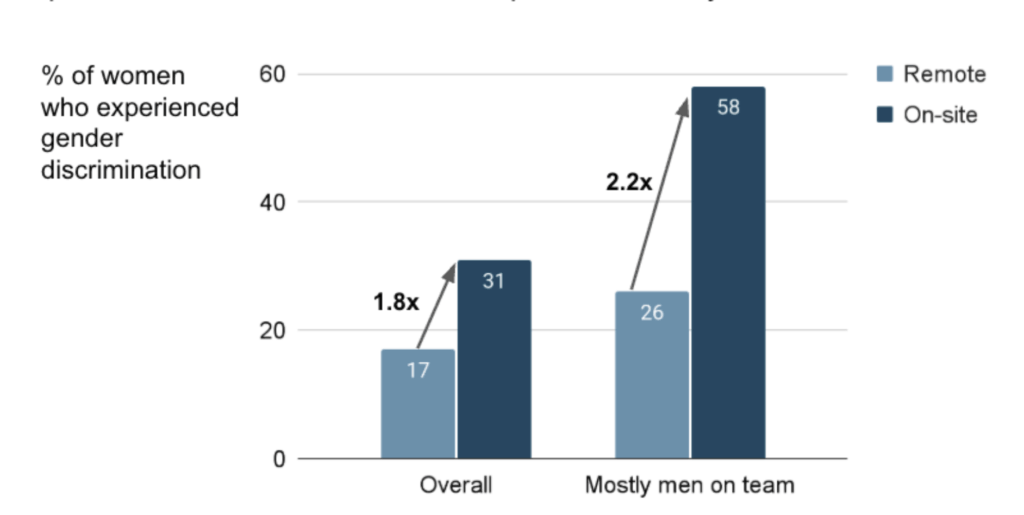 Doering & Tilsic Location Matters: Everyday Gender Discrimination in Remote and On-site Work; Dec 2024

The pattern gets worse in male-dominated teams, where women report nearly double the rate of discrimination compared to teams with better gender balance: 58% report discrimination when on-site. Younger women face higher rates: 31% report discrimination on-site, compared with 26% for women over 30.
As Doering noted in discussing the study,
“It’s rare to uncover a finding that applies so consistently across so many people working under so many different conditions.”
This puts recent data on what experts have reported for years. Back in summer 2020, Future Forum’s research showed that women, Black, and Hispanic desk workers preferred flexibility more than their white and male colleagues.
Stanford professor Brian Lowery explained it perfectly at the time:
“Even as a Stanford professor, I’m watching how I walk, how I talk when I’m on campus. Being able to work from home some days, to dial in and out of that situation, gives me a break and a chance to recharge.”
This isn’t about wanting to be fully remote. It’s about the recovery boost from going in and out of that environment that builds resiliency.
The Caregiving Reality
The preference for flexibility isn’t just about escaping bias. It’s also about managing the reality that in the vast majority of US households, women serve as the primary caregiver. US Census data shows women spend nearly three hours a day on caregiving versus just under two for men. In 78% of households, mom takes the lead.

This helps explain the sharp drop in labor force participation among mothers: a three percentage point decline in just the past year, reversing pandemic-era gains. Thanks, in part, to return-to-office mandates that multiple studies have shown drive out women at disproportionate rates.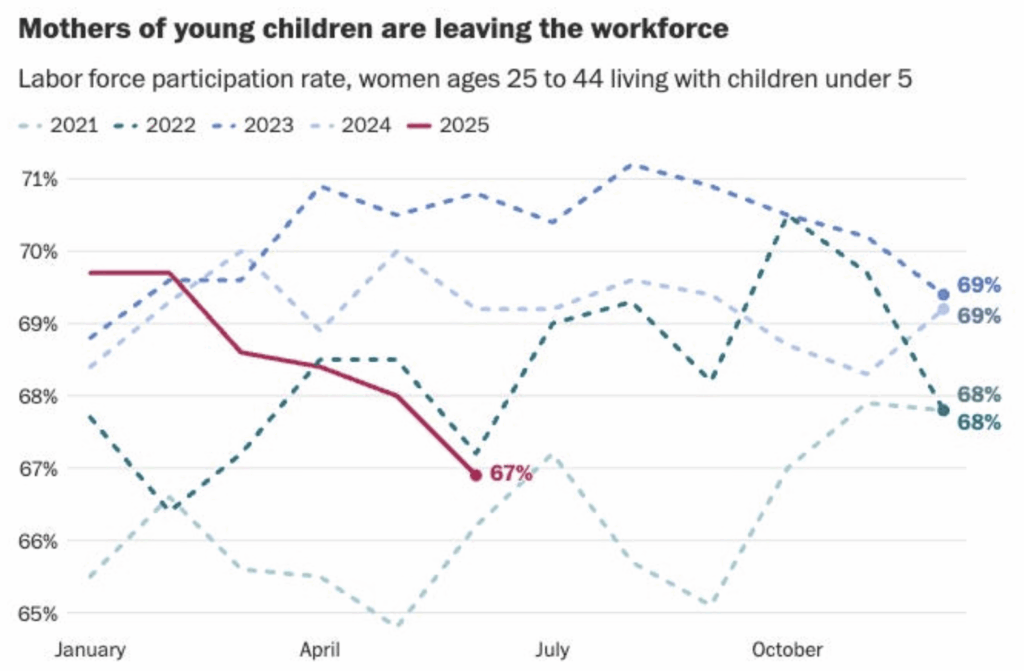 Washington Post: Misty Heggeness using Current Population Survey, Census Bureau/Bureau of Labor Statistics via ipums.org
Labor economist Misty Heggeness puts it bluntly: “It’s become harder for women, particularly those with caregiving responsibilities, to thrive in this job market. It’s clear that we’re backsliding … that the return-to-office chest pounding is having a real ripple effect.”
Beyond Bias: The Systemic Problem
The discrimination women face isn’t just individual bad behavior—it’s systemic. Recent research by professors Tim Kundro and Alyssa Tedder-King shows that reports of workplace abuse made by women are less likely to be taken seriously than identical reports made by men.
“It’s important to consider why women would be experiencing gender discrimination in the first place,” Doering noted. “I would encourage managers who learn about this research to do the hard work of addressing gender discrimination rather than pushing women into remote roles as a way of trying to get around the issue.”

For five years, we’ve debated whether remote work hurts career advancement. The real issue isn’t whether women can succeed remotely when coming to the office increases the odds of discrimination.
As Ellevest founder Sallie Krawcheck put it
“Believe me, if being in the office was going to work to get more women promoted, it would have happened already. It’s not like we didn’t try hard enough.”
The answer isn’t segregating women into remote work — that’s not what most women want either. They want more flexibility, not four and five day demands. The broader answer is building workplaces where people from all backgrounds feel they belong, are judged on the basis of their work, and don’t have to tolerate abusive behavior.
What Leaders Can Do, Even in 2025
Even if your company is pushing four or five days in the office, you have choices that can make a real difference:
Focus on belonging, not programs. In an era where DEI initiatives face pushback, the answer isn’t more training sessions — it’s creating workplaces where people from all backgrounds feel they belong. That means hiring on merit, rewarding for outcomes, and not tolerating abusive behavior. As deceptively simple, yet incredibly hard, as that.
Create flexibility within constraints. Offer shifted schedules to accommodate caregiving, quiet work zones for focused tasks, and team agreements about collaboration norms. Support parents during back-to-school season and other high-demand periods. You don’t need to change company policy to lead with humanity.
Track the data that matters. Monitor who’s leaving after RTO announcements. If departures skew heavily toward women and experienced employees, your policy is backfiring. Don’t just count bodies in seats—measure whether you’re building or destroying the culture that drives results.
Make standards crystal clear. When someone reports bias or harassment, take it seriously and act swiftly. Your response signals whether respect is just talk or an actual business standard. No special programs required—just consistent leadership.
Sound radical in 2025? So be it. The companies that figure this out will have access to more talented people, deeper engagement, and be less subject to the risks of groupthink. Those are traits that have historically led to far better outcomes.
The choice is yours: build workplaces that work for everyone, or keep watching engagement drop, and losing half your talent pool to competitors who will.