



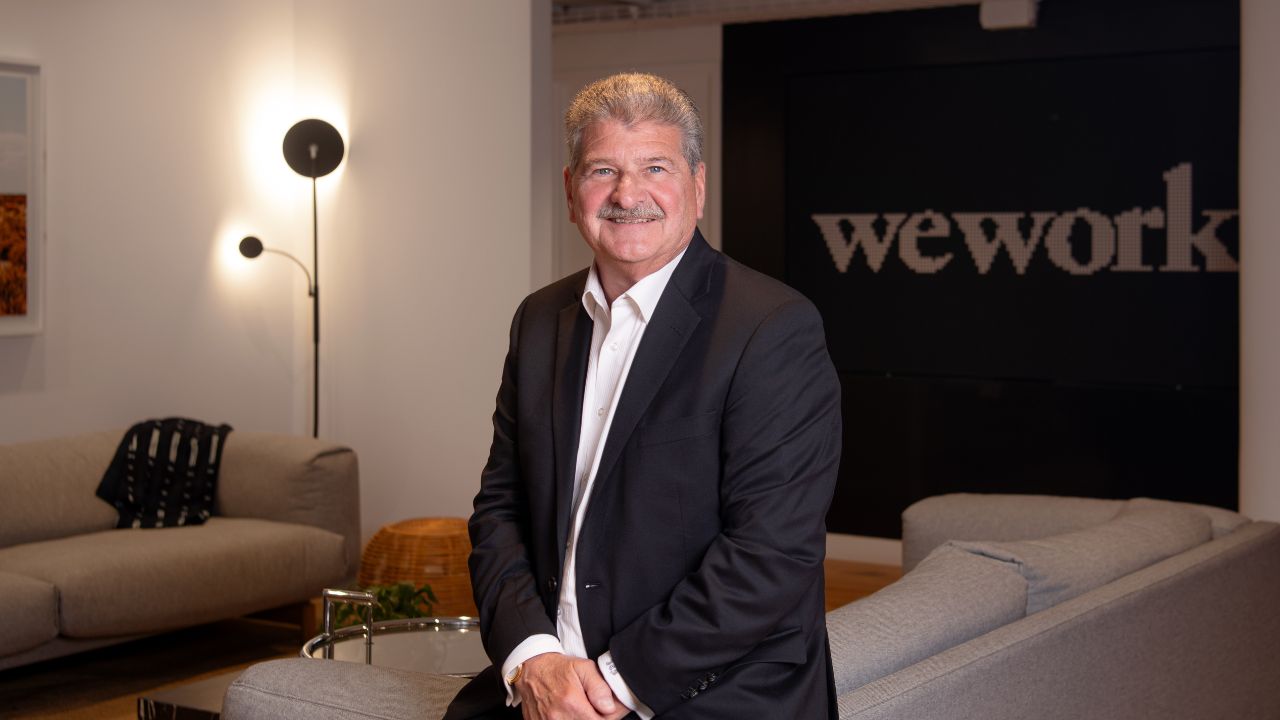
At this year’s Global Workspace Association (GWA) Conference, John Santora, CEO of WeWork, delivered one of his most candid keynotes yet — and Allwork.Space, the event’s official media partner and the industry’s go-to source for news, trends, and exclusive insights like these, was there to capture it firsthand.
In an exclusive account from his onstage remarks, Santora outlined how the flex industry’s growth is outpacing its own capacity to respond.

“When you look at all the surveys that are done, you’re seeing 20 to 30% where corporate real estate will be flexible working environments,” said John Santora, CEO of WeWork. “Back a few years, you either owned your building or you had a long-term lease — now it’s own, lease, or flex.”
That shift, he added, represents one of the biggest structural changes corporate real estate has ever seen.
But the momentum comes with a warning.
“When we do the calculations, it’s going to be between 500 million and a billion square feet,” Santora said. “Where’s all that going to come from? … We’re not taking down the space as an industry fast enough to meet the demand.”
Even as the flex market surges, Santora warns the industry risks falling behind.
A Real Estate CEO for a Real Estate Company
For Santora — a 40-year real estate veteran — the solution starts with returning to fundamentals.

“I think for my years of being in real estate, I had met so many and had relationships with so many different people in real estate — landlords, owners, brokers, engineers,” he said. “So I knew that group helped me and helped all of us get that credibility, that we were a solid company, that we were going to put a discipline in.”
Then, with refreshing frankness, he added:
“WeWork was never a technology company. It’s a real estate company at its core.”
That honesty drew nods across the room. It was an acknowledgment that the company’s comeback depends not on buzzwords, but on solid fundamentals — the same ones every operator understands.
Credibility, Discipline, and Profitability
When Santora took the helm, his top priorities were basic and ambitious:
“Bringing credibility to the brand, rebuilding our reputation, and restructuring leadership to remove silos,” he explained.
He reorganized WeWork’s internal structure, assigned profit accountability by region, and insisted that every deal must justify itself.
“Every deal needs to show profits,” he said. “At any time we’re going to take space, we had to prove that it was needed and that it would be profitable in a very short period of time.”

For Santora, this wasn’t just a turnaround strategy — it was a new operating standard for the entire flex industry.
‘You Need to Be Sure You Can Fill Your Space’
As he looked out at a room full of operators, landlords, and brokers, Santora’s advice was as pragmatic as his leadership goals.
“You need to be sure that you can fill your space,” he said. “You can’t be out ahead of your skis.”
The sentiment resonated with operators who’ve watched demand rebound unevenly since the pandemic.

Flexibility is now mainstream, but sustainability still depends on precision — not speculation.
That’s why WeWork’s new model focuses less on expansion and more on enterprise partnerships and demand-driven deals.
“If the client’s looking for 50,000 square feet or 100,000 square feet and they’re willing to commit for two or three years, then we’ll begin that from a sublease or directly from the landlord and match the term to the client’s term,” he said.
It’s a strategy rooted in accountability — the kind that smaller operators can also emulate.
Collaboration, Not Competition
Santora also urged operators to rethink how they compete.
“We’re now at a little over a thousand locations through our partner network,” he said. “By the end of the year, we’ll be adding another thousand on the international front.”
Many of these locations are, naturally, near competitors, but rather than seeing proximity as rivalry, Santora sees opportunity.
“We’re all competitors in this room,” he told attendees. “But you can leverage that and use it to benefit. When we’re full, we suggest they go down the block, and when they’re full, they suggest their clients use WeWork.”
It’s a model that favors collaboration over fragmentation — something the industry will need if it hopes to meet the growing corporate demand for flex space.
Losing the ‘WeWork-y’ Culture to Regain Stability
Santora didn’t shy away from addressing the cultural side of WeWork’s transformation.
“WeWork has lost some of its ‘WeWork-y’ aspect for sure while restructuring and exiting bankruptcy,” he admitted. “But it was necessary. We will bring it back soon.”
That blend of realism and optimism reflects a maturing phase for both the company and the coworking movement.
“We’re coming out with new designs that get a little closer to corporate — a little less ‘WeWork-y’ and more balanced in between,” he said.
Survival demanded stability. The next step, he suggested, is bringing back the human energy that made WeWork a brand synonymous with community.
The Yardi Partnership and the Power of Infrastructure
Santora credited WeWork’s survival partly to Yardi and its CEO and Founder, Anant Yardi , which acquired a majority stake during the bankruptcy process.
“Yardi had a belief in the industry,” he said. “They made a new investment in acquiring the majority of the firm as we were going through the bankruptcy process — that’s what kept us alive.”
But beyond capital, Yardi brought technological rigor.
“The technology they deliver lets us see our revenue, where it’s coming from, who it’s coming from — all in one single system,” Santora said. “That’s just an amazing tool for us.”
It’s a reminder that, while WeWork may not be a tech company, technology still plays a crucial role in creating operational efficiency — something every operator can learn from.
Beyond the Office: Flex in Hotels and Hospitality
Looking ahead, Santora believes the definition of “workspace” will stretch far beyond traditional offices.
“We’ll see new products,” he said, “and I think the physical model in the industry will move beyond just office space. We’ll somehow venture into hotels from the standpoint of how they’re activated.”
The future of flex, he hinted, might involve transforming underused hotel ballrooms and meeting spaces into hybrid hubs — blending business travel, hospitality, and work-life design in new ways.
A Stabilized Platform for a Shifting Industry
“For the last three quarters, we’ve been EBITDA positive,” Santora shared. “We actually were cash-flow positive by just a little bit this last quarter — which was just remarkable from where it’s come.”
That momentum gives WeWork — and the industry — a renewed sense of credibility.
Then, closing his remarks with perspective honed by decades in real estate, Santora left the audience with both caution and confidence:
“You should all feel good about the industry you’re in. It’s incredibly rewarding, but we all ride a little bit with real-estate markets that go up and down. All my years in this, every five to seven years we get a dip again. So always be ready to get through that.”
The Takeaway
Santora’s remarks were more than an update on WeWork’s progress — they were a message to the entire coworking ecosystem.
Flex is booming. Corporate demand is rising.
But growth without grounding won’t last.
From returning to real-estate fundamentals to championing collaboration, Santora’s WeWork is embracing what the industry has known all along: sustainability is scalability.
And his warning still echoes: the demand is there — but the industry must catch up.
Subscribe to our newsletter to get daily news about what’s next for the flexible workspace industry and exclusive insights like these that you won’t find anywhere else.