




American employees continue to take personal responsibility for customer experience, even as confidence in their organizations’ ability to deliver on promises remains low and staffing pressures intensify.
In the third quarter of 2025, 43% of U.S. workers strongly agreed they feel a great deal of responsibility for the quality of products and services customers receive. Yet only 23% strongly agreed their organization consistently delivers on its customer commitments. That gap has persisted for several years, according to a new Gallup study.

Accountability Rebounds, Confidence Stalls
Employee accountability dipped in 2024 before recovering in 2025. The decline was sharpest among frontline and production workers, younger employees, individual contributors, and fully on-site staff, with drops of five to nine percentage points. Other groups saw smaller declines.
While personal responsibility has rebounded, belief in organizational follow-through has not. Leaders are more likely than managers and individual contributors to express confidence in delivery, but even among leaders, only about three in 10 strongly agree their organization keeps its promises.

National data mirrors this stagnation. Broader customer satisfaction benchmarks have remained largely flat, suggesting that gains in internal accountability have not translated into measurable improvements in customer outcomes.
Staffing Is the Structural Constraint
When asked what most limits their ability to deliver exceptional service, 37% of employees cited staffing shortages. That far outpaced training, tools, or unclear standards.
Staffing has ranked as the top barrier in prior years as well, pointing to an ongoing capacity issue rather than a temporary disruption. Leaders and frontline workers alike identify insufficient headcount as the primary obstacle to meeting customer expectations.
The strain is intensifying. Nearly one in four employees report workforce reductions at their organization, up significantly since early 2023. Among those reporting layoffs, most say roles directly serving customers were most affected.

More Work, Fewer People
As organizations shrink headcount, workloads are expanding. In the past three months:
- 63% of employees say they have taken on additional responsibilities
- 58% report reorganizations or restructurings
- 52% cite budget reductions
Senior leaders report mounting internal strain as well, including visible stress among employees, reduced budgets, and difficulty balancing management and individual contributor duties.
Burnout is closely tied to customer confidence. Employees who frequently experience exhaustion are far less likely to believe their organization delivers on its promises, reinforcing the connection between workforce conditions and external performance.
Sector Differences Widen
Staffing pressure is particularly acute in healthcare, government, and education, where employees are more likely to report workforce reductions and capacity strain. In contrast, industries such as healthcare, hospitality, and retail report high staffing pressure but expanding headcount, suggesting differing approaches to managing demand.
Higher education and government appear most vulnerable to worsening constraints, combining elevated staffing strain with net workforce contraction.
Engagement Makes a Measurable Difference
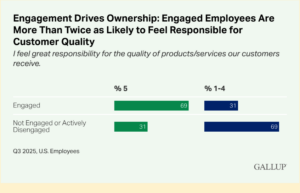
Employee engagement strongly correlates with confidence in customer delivery. Nearly seven in 10 engaged employees say they feel responsible for product and service quality, compared with less than one-third of disengaged workers. Engaged employees are also far more likely to believe their organization delivers on its promises.
The relationship appears cyclical. When employees feel supported, clear about expectations, and able to do their best work, they serve customers more effectively. Consistent delivery then reinforces engagement.
The Workforce Imperative
The data points to a growing tension in the future of work: employees remain committed to customers, but structural workforce constraints limit their ability to deliver consistently.

As organizations reduce headcount while asking employees to absorb more responsibility, customer experience becomes harder to sustain. Engagement can buffer some of the strain, but it cannot compensate for persistent understaffing.
For employers, the path forward may hinge less on messaging about customer commitment and more on aligning staffing levels, workloads, and priorities with the promises made to customers.