




Workplace culture conversations have long centered on employee engagement, empowerment, and psychological safety — yet they often overlook these same needs among senior leaders. Executives operate under intense scrutiny, reputational risk, and constant pressure to appear confident and credible. The result is a distinct vulnerability at the top.
As businesses adapt to AI and accelerating change, senior leaders recognize the need for diverse input to drive innovation. Yet a stark disconnect persists: while leaders publicly champion openness, many privately feel unsafe modeling it, fearing irreparable damage to their authority and credibility.

The risk is that when leaders fail to model curiosity, vulnerability, and openness, psychological safety erodes at the top, cascading throughout the organization.
Leaders Want Honest Feedback but Fear the Optics
A recent survey reveals this tension clearly. Although many executives claim they want more input from their teams, they often hesitate to ask due to concerns over their reputation.

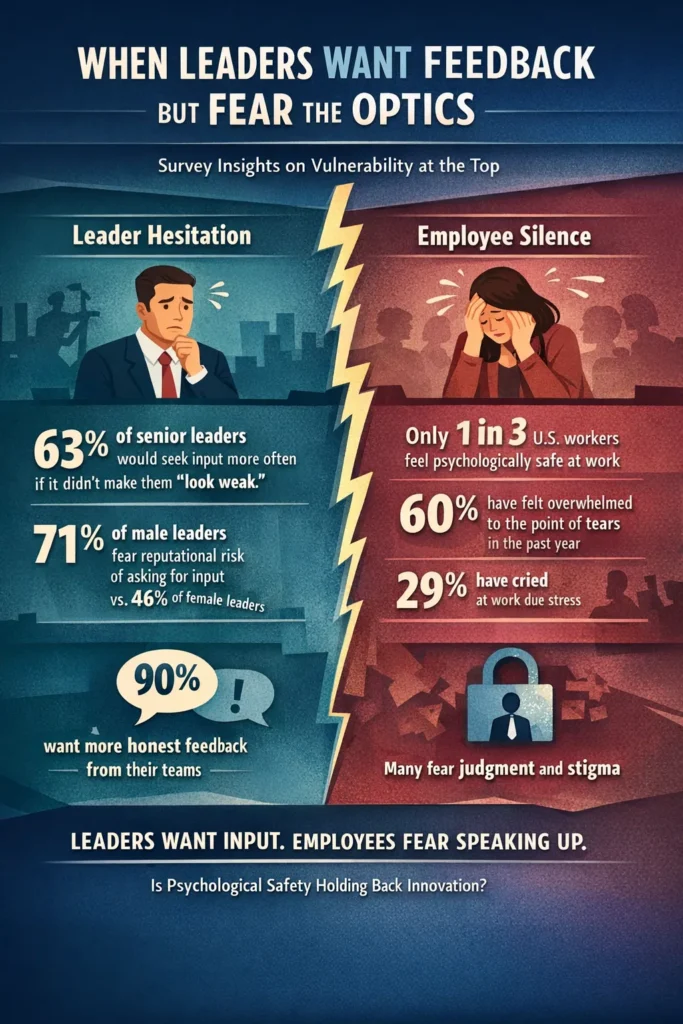
A survey of U.S. business leaders (directors and above) found that 63% would seek input more often on major decisions if they did not fear appearing weak. Male leaders were particularly cautious, with 71% expressing concern about reputational cost, compared with 46% of female leaders.
Paradoxically, a staggering 90% said they want more constructive feedback that challenges them or the status quo.
The findings expose a credibility gap: leaders encourage candid dialogue publicly, yet hold back privately to protect their image. In workplaces shaped by rapid technological change and AI-driven collaboration, this gap carries significant implications for performance and adaptability.
Workforce data suggests employees are equally hesitant to speak up. Only one-third feel safe expressing their emotions at work. More than 60% report feeling overwhelmed to the point of tears in the past year, and nearly one-third have cried at work due to stress.

Many fear judgment or dismissive reactions, such as being told to “toughen up,” which erodes trust and stifles honest communication. Formal support systems remain underutilized, with employees more likely to confide in their peers than their managers.
When taken together, these dynamics create a reinforcing cycle: employees hesitate to provide feedback, leaders hesitate to ask for it, and open communication steadily deteriorates.
Yet research indicates that when people feel heard and respected, engagement, productivity, and retention improve.
Without honest feedback, innovation, problem-solving, and adaptability all suffer. When leaders fear appearing weak, and employees refrain from speaking candidly, organizations risk losing the insights that fuel growth and resilience.
Psychological Safety Among Leaders: What the Findings Reveal
Psychological safety remains fragile across workplaces, and a recent Harris Poll survey commissioned by Turas Leadership suggests it is now fracturing at the leadership level.
Allwork.Space asked Emily Scherberth, Founder and CEO of Turas Leadership Consulting, Inc., what surprised her most about the findings and what they reveal about the psychological state of leadership. She pointed to the high percentage of leaders (90%) who want to be challenged more:
“Based on the results, it’s clear that most leaders know what good leadership looks like – they want to be able to ask for help and co-create solutions with their teams, but they just don’t have the psychological safety to do it,” Scherberth said. “They might be working in systems that punish uncertainty, so they might feel pressure to have all of the answers. But anyone in a leadership position knows that it’s nearly impossible to have all of the answers all of the time, especially in the current business environment.”
Scherberth explained that psychological safety is often described as something leaders create for others. The data, however, suggests a more complex reality:
if leaders themselves do not feel safe enough to admit uncertainty, ask for help, or invite challenge, those behaviors rarely take hold across the organization.
In other words, leaders cannot cultivate safety in others if they do not experience it themselves.

Mounting managerial pressures intensify this challenge. Eighty percent of leaders report feeling heightened responsibility for their organization’s long-term success, and 71% of top executives say they would leave their roles to protect their wellbeing.
Middle managers often feel even less psychologically safe than their teams, highlighting a critical gap: psychological safety is frequently created downward for employees, but rarely flows upward toward leaders or inward among leadership itself.
These findings underscore the urgent need to equip leaders with the skills and capacity to cultivate psychological safety — for themselves and their organizations.
Develop Leadership Capacity to Build Systemic Safety
Expanding leadership capacity is the key to addressing this gap and creating lasting, organization-wide psychological safety. The survey findings underscore that cultivating openness and vulnerability is about strengthening leaders’ ability to stay grounded and lead effectively through uncertainty without defaulting to control or micromanagement.

When leaders model these behaviors, they lay the foundation for systemic safety that supports open dialogue, collaborative problem-solving, and sustained engagement.
Scherberth emphasizes the importance of building safety across the entire system rather than in a single direction.
“When psychological safety is created only in one direction — usually downward from leaders to their teams — it only benefits a particular group,” she explained. “But when it’s built into the entire system of the organization, everyone in the system benefits.”
She also highlights the “leader-as-hero” mentality that many organizations unintentionally reinforce, which isolates leaders and pressures them to manage uncertainty by themselves. Recognizing the interdependencies among people, processes, and the external environment can improve the conditions that constrain them, embedding collaboration and shared problem-solving into the culture.
Effective leadership development, Scherberth explains, involves building the capacity to “hold paradox” — leading confidently while remaining open to new ideas, managing uncertainty, and co-creating solutions.
“Most of the time, collective intelligence is better than relying on one person’s perspective, even if they’re experienced,” she said.
She cautions against interpreting the survey results as a failure of skill or will.
“It’s about how we develop leaders against the backdrop of volatility, uncertainty, complexity, and ambiguity,” she added. “We can’t just teach leaders what to do; we also need to help them build the inner capacity to do it sustainably, under increasingly difficult circumstances, when it matters most.”
Practical tools, including the Turas Leadership Capacity Assessment™, provide leaders with actionable ways to measure and strengthen qualities, such as self-awareness, resilience, comfort with uncertainty, and openness to challenge.
By deepening self-awareness and reflecting honestly on their practices, leaders can create the conditions for systemic, lasting transformation across their organizations.
Why This Matters for the Future of Work
Scherberth explains that when leaders avoid vulnerability, they hinder the emergence of new ideas and limit the organization’s access to collective intelligence, undermining innovation and adaptability.
In complex environments, reliance on a single perspective — particularly at the top — diminishes decision quality. By contrast, collective intelligence, contextual awareness, and experimentation are critical competitive advantages.
Modern leadership is defined by tension: organizations expect innovation and resilience, yet many cultures still equate authority with certainty and penalize uncertainty. Without self-awareness and the willingness to be vulnerable, leaders struggle to model curiosity or encourage experimentation.
Complex environments demand learning cultures where insight, regardless of its source, strengthens the system and where teams can self-organize around shared purpose.
As Scherberth observes, “…in this era of volatility and uncertainty, the company led by individuals who are committed to unlocking potential at all levels will always outpace the company waiting for direction from the top.”
In a landscape increasingly shaped by distributed teams, AI-driven workflows, and constant change, the stakes are higher than ever. Innovation depends on honest feedback and shared problem-solving, but when leaders fear appearing weak and employees fear speaking candidly, collaboration is stifled.
Organizations led by individuals committed to unlocking potential at every level, however, are far better positioned to respond to future challenges with confidence, agility, and resilience.