
An extended version of this article originally appeared in Brian Elliott’s Work Forward newsletter. Subscribe to read more.
Andrew woke up at his usual time to an unusual message: His job at Oracle had been terminated overnight. He didn’t find out through a call from his boss, or HR, or an email. He figured it out because an AI-generated summary of his inbox told him it had happened.

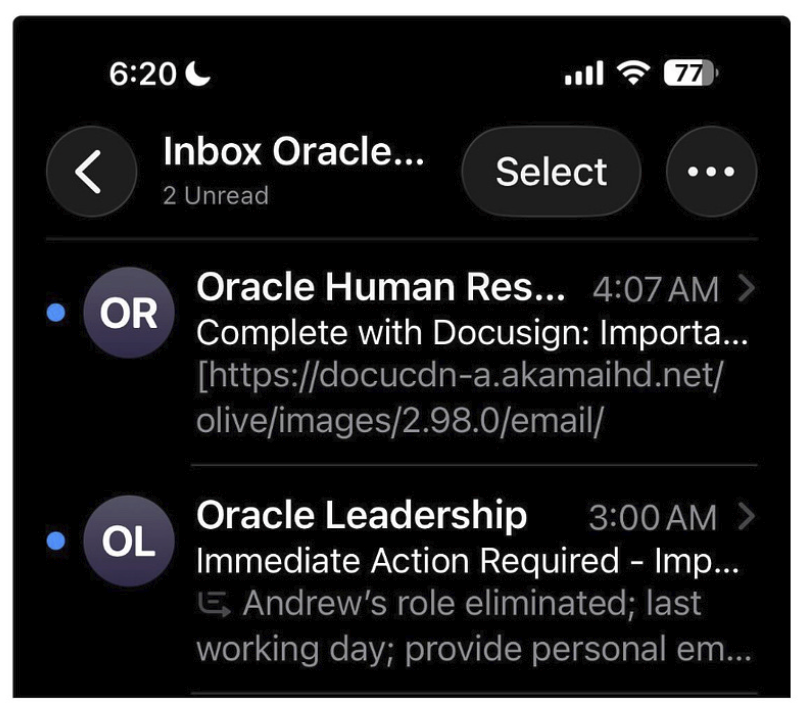
Andrew didn’t lose his job to AI, but AI is how he found out he’d lost it. Not a human, and that’s a distinction his employer apparently thought wasn’t worth making.
He was one of around 30,000 people, approximately 18% of the workforce laid off at Oracle, cut in order to continue funding AI data centers that have yet to pay off.

It’s a lesser version of the 40% of Block employees laid off a few weeks prior when CEO Jack Dorsey pointed to the potential of AI to radically restructure work; the real reasons may be tied to pandemic overhiring, sizable lawsuits and a weird dual corporate structure. But AI sounds better, especially when you’re selling AI-enabled business tools.
Oracle’s Larry Ellison, Block’s Jack Dorsey and Meta’s Mark Zuckerberg are among the notable tech founders now racing to see who can make the most of the AI opportunity to transform work. They may also be in a contest to see who can be the most badass when it comes to cutting people.
Predictably, the contagion is spreading. The WSJ reports this week that Block’s CFO is fielding calls asking for their playbook. I’ve heard the same from a number of people in San Francisco: the tech bros are out to see who can get aggressive the fastest in transforming their business, damn the side effects.
More cuts in tech are coming. The narrative is taking hold: AI is a human replacement technology.
There are alternatives, and it’s not too late to take a different approach.
How the narrative spreads
The WSJ coverage of the Block-inspired contagion points out that the cause isn’t really AI’s ability to replace workers, it’s the need to cover the costs of AI, and a convenient excuse:
“Most companies, if not all, could cut 30% to 50% of their workforce at any time and see no material difference in performance,” said Mo Koyfman, founder of the venture-capital firm Shine Capital and a former executive at the media company IAC.
Unsurprisingly, Wall Street is shifting its tone from enhancement to replacement of humans. Here is Bank of America CEO Brian Moynihan’s shift over the last four months:
Less than four months ago, Bank of America’s chief executive, Brian T. Moynihan, volunteered in a TV interview what he would say to his 210,000 employees about the chance of artificial intelligence replacing human work.
“You don’t have to worry,” he said. “It’s not a threat to their jobs.”
Last week, after Bank of America reported $8.6 billion in profit for the first quarter — $1.6 billion more than the same period a year earlier — Mr. Moynihan struck a different tone.

The bank’s bottom line, he said, was helped by shedding 1,000 jobs through attrition by “eliminating work and applying technology,” which he repeatedly specified was artificial intelligence. He predicted more of that in the months and years to come.
I doubt CEOs like Moynihan share the dreams of many tech founders, many of whom would love to be in charge of a multi-trillion enterprise with a team of eight people, or perhaps larger but with no managers in the middle and an AI instructing the humans below. But they do see the dollar signs that tech companies are floating by cutting ruthlessly.
What the research actually says
New BCG research analyzed 1,500 jobs and found that 10-15% could be eliminated over four to five years. The number that gets less airtime is that 50-55% of jobs will be restructured: AI giving workers new skills and capabilities, requiring significant changes to how teams, functions, and organizations operate. That’s the real story, and it’s a multi-year transformation, not a quarterly cost-cutting exercise.
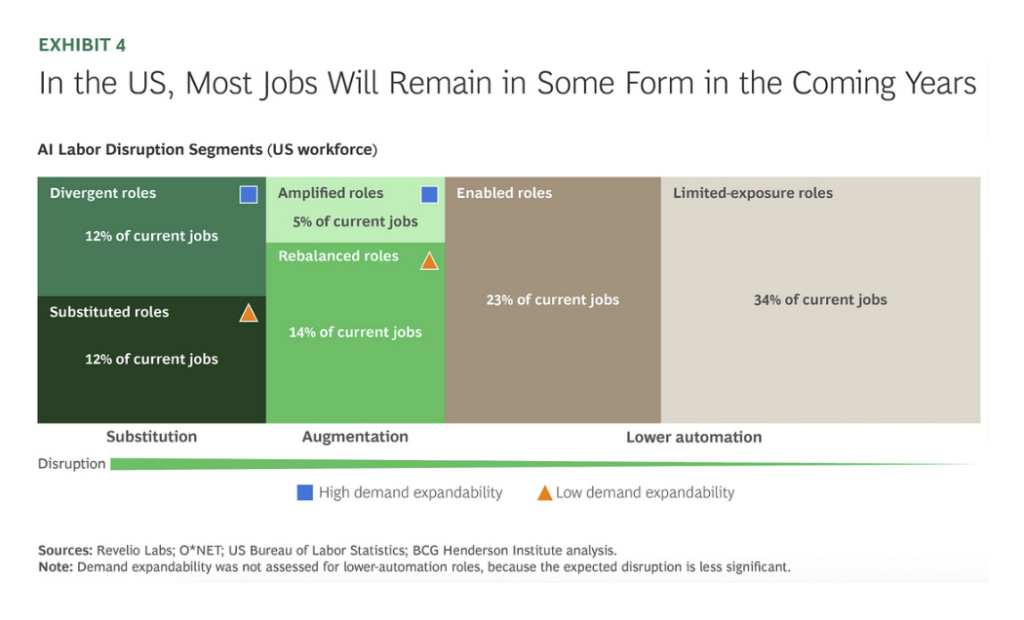
Source: AI Will Reshape More Jobs than It Replaces
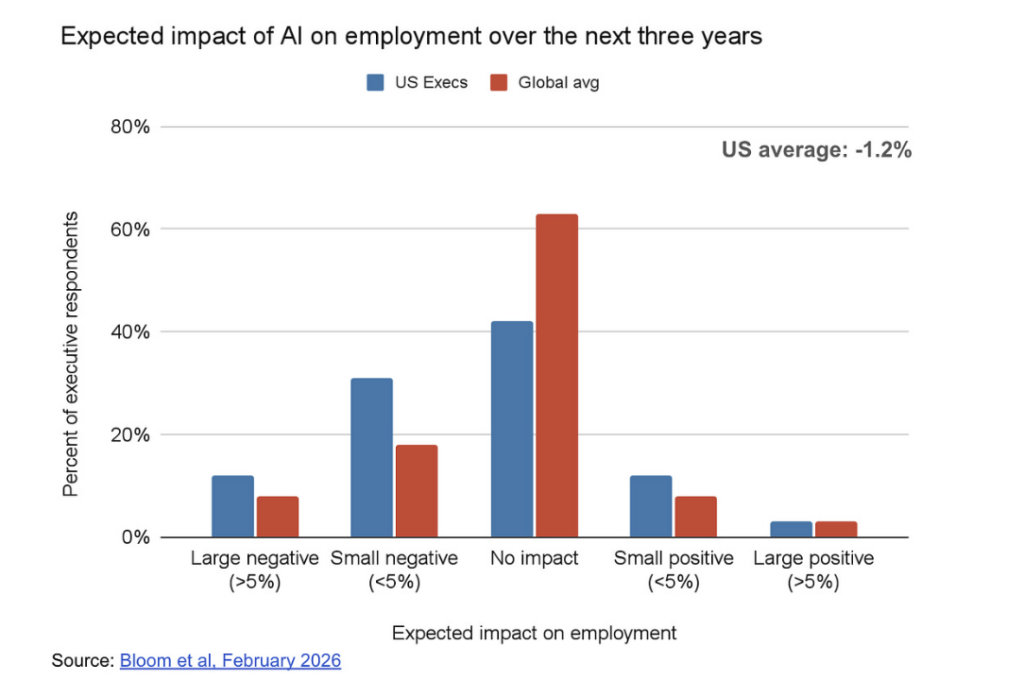
Nick Bloom’s research, tapping surveys of executives across the Federal Reserve, Bank of England, and others, found that 26% of executives predict decreased employment over the next three years due to AI. In the US, that number jumps to 43%.
But 15% of US executives expect employment to grow because of AI. Net those together and you get a predicted decline of 1.2%. That’s not nothing: 1.2% of US employment is around two million jobs.
 For more supporting research, read the full column here.
Treatment options
There are alternatives to the AI-as-replacement narrative.
Leverage AI with ambition. The word “ambition” can be troubling: words like “hardcore” and “aggressive” come along with it. But so do words like growth, expansion, and winning. No founder ever stood up and proclaimed their success was due to their ability to cut: it was their ability to think expansively.
Instead of measuring individual AI usage and whacking those lowest in output, why not set ambitious goals, give teams time and space to experiment, and go steal share away from corporate behemoths who can’t move as fast?
Focus on teams. Output at the individual level doesn’t lead to outcomes. At many early adopters I’ve talked with, individual productivity gains haven’t moved the needle because people aren’t aligned: goals get set at the personal level, not the team level. “The real value of AI comes at the team level,” says Atlassian lead behavioral scientist Ben Ostrowski.
Recognize the risks. Your heaviest AI users are also your most likely AI Brain Fry candidates: cognitively overloaded, marshaling oversight beyond their capacity. BCG research found they’re 39% more likely to commit major errors and show 39% higher intent to quit. The super-users driving 10x output are the same people most likely to walk out the door.
Play the long game. CEOs too often sweat next quarter’s earnings. But as one Charter Forum member noted in a recent session, she’s helping her team take the long perspective:
“I’m intentional about giving historical examples. When ATMs were introduced, we thought that was the end of tellers forever. What happened was they actually increased in number, but the work changed: they became customer service reps. We try to take the scare factor out, to make the mountain ahead of us not look like Kilimanjaro.”
Coda
Andrew found out he was fired from an AI summary of his inbox. That was a choice by someone at Oracle who decided it was faster and more expedient. That’s not about AI: AI is the excuse, and sometimes the delivery mechanism.
Leaders choose whether to treat people like they matter.
Somewhere in the alternatives above is a version of the next few years where more companies choose differently. Where at least a few tech leaders work to change the narrative before it’s too late.
If the contagion keeps spreading, we’ll find out what a society looks like when a critical mass of workers learn they were disposable from a chatbot. I don’t want to find out.
Read on for an extended version of this article.