




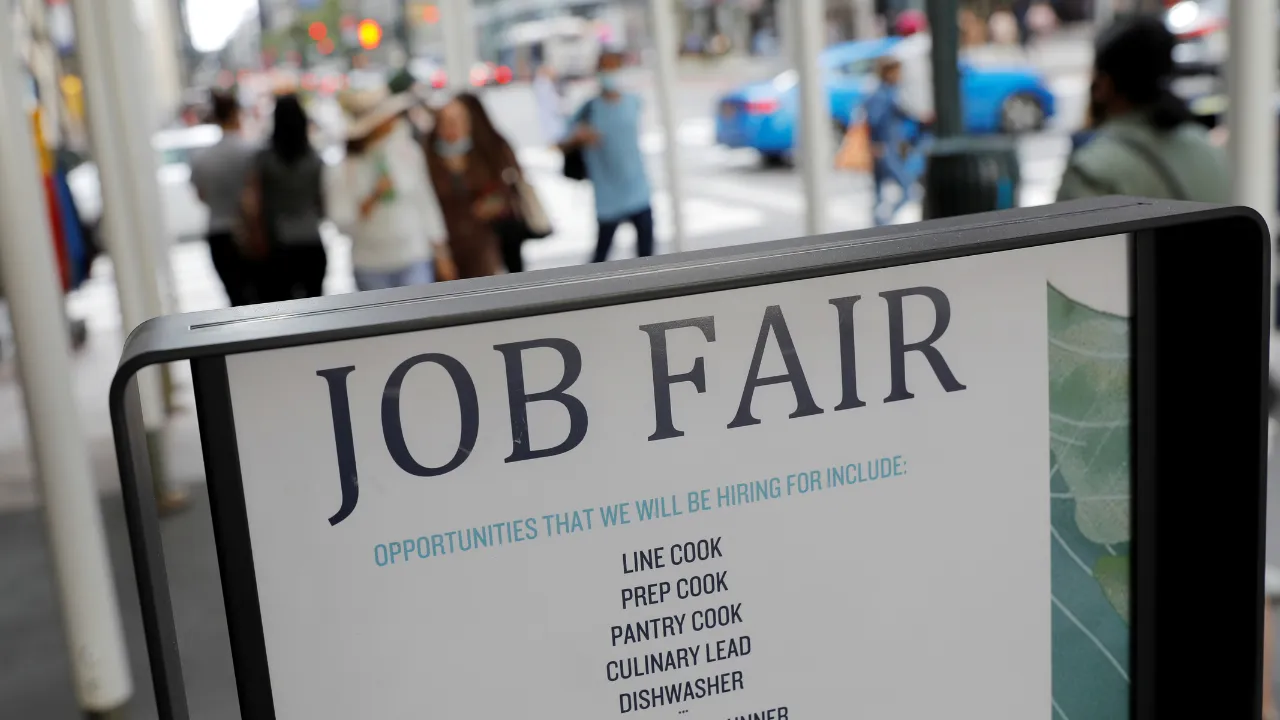
New applications for U.S. unemployment benefits increased moderately last week, showing no signs of labor market deterioration and potentially giving the Federal Reserve room to keep interest rates unchanged as it monitors the economic fallout from the war with Iran.
Headline inflation picked up on a monthly basis in February and economic growth almost braked in the fourth quarter, other data showed on Thursday. Economists expect that price pressures increased further in March as the U.S.-Israel war with Iran drove up the cost of energy and other products. Though President Donald Trump on Tuesday announced a two-week ceasefire on the condition that Tehran reopen the Strait of Hormuz, the truce appeared fragile.

Economists said the war, now in its second month, added another layer of uncertainty for businesses that spent last year trying to navigate a constantly shifting tariffs landscape.
“The war has increased the downside risks to the labor market and we think it’s too soon to assume that the ceasefire announced earlier this week will last and to say those risks have abated,” said Nancy Vanden Houten, lead U.S. economist at Oxford Economics. “But, so far, the claims data indicate that labor market conditions are still stable, with no evidence of an increase in layoffs or a further pullback in hiring.”

Initial claims for state unemployment benefits rose 16,000 to a seasonally adjusted 219,000 for the week ended April 4, the Labor Department said. Economists polled by Reuters had forecast 210,000 claims for the latest week. Low layoffs are anchoring the labor market. A surge in global oil prices has sent the national average gasoline retail price soaring above $4 per gallon for the first time in more than three years and wiped $3.2 trillion from the stock market in March.
Economists are bracing for a jump in inflation in March, with the Consumer Price Index expected to increase about 1.0% on a monthly basis, translating to a year-on-year rise of about 3.3%. The government will release the CPI report for March on Friday.
Inflation already was elevated before the war, largely because of Trump’s broad import duties. A separate report from the Commerce Department’s Bureau of Economic Analysis showed the Personal Consumption Expenditures Price Index increased 0.4% in February after an unrevised 0.3% gain in the prior month. The increase was in line with economists’ expectations.
In the 12 months through February, PCE inflation advanced 2.8%, matching the gain in January. The BEA is still catching up on data releases following delays caused by last year’s U.S. government shutdown.
Excluding the volatile food and energy components, the PCE Price Index increased 0.4% in February for a second straight month. In the 12 months through February, so-called core PCE inflation advanced 3.0% following a 3.1% increase in January. The slowdown in year-on-year core PCE inflation reflected last year’s high readings dropping out of the calculation.
The U.S. central bank tracks the PCE price measures for its 2% inflation target. Economists say monthly PCE inflation needs to increase 0.2% for a sustained period to bring inflation back to target. The release on Wednesday of the minutes of the Fed’s March 17-18 policy meeting showed a growing group of policymakers felt last month that interest rate hikes might be needed to counter inflation.
The minutes also said “participants noted that a prolonged conflict in the Middle East would likely lead to more persistent increases in energy prices and that these higher input costs would be more likely to pass through to core inflation.”
The Fed left its benchmark overnight interest rate in the 3.50%-3.75% range. The odds of a rate cut this year have greatly diminished.
U.S. stocks were trading lower as investors keep a wary eye on the fragile ceasefire in the Middle East. The dollar fell against a basket of currencies. U.S. Treasury yields were mostly higher.
Higher Prices Inflate Consumer Spending
The labor market has been stuck in what economists call a “low-hire, low-fire” state, which they blame on uncertainty stemming from the Trump administration’s aggressive trade policy and mass deportations of migrants.
Though nonfarm payrolls rebounded by 178,000 jobs in March, the median duration of unemployment at 11.4 weeks was the longest in nearly 4-1/2 years.
The number of people receiving unemployment benefits after an initial week of aid, a proxy for hiring, decreased 38,000 to a seasonally adjusted 1.794 million during the week ended March 28, the lowest level since May 2024, the claims report showed.

But part of the decline in the so-called continuing claims was likely because of people exhausting their eligibility for benefits, which is limited to 26 weeks in most states. Some unemployed young adults, who typically have a limited or no work history, are not eligible to file for jobless benefits. They have been the worst affected by the lethargic labor market.
Economists are watching for shifts in consumer spending in the aftermath of the recent stock market selloff and rise in gasoline prices, as these could impact the labor market.
The latest report from the BEA showed consumer spending, which accounts for more than two-thirds of economic activity, rose 0.5% in February after increasing 0.3% in January. Spending, however, was inflated by high prices. When adjusted for inflation, consumer spending edged up 0.1% after being flat in January.
The data suggested consumer spending likely slowed further in the first quarter after a significant slowdown in the October-December quarter. The slow pace of spending contributed to holding back gross domestic product growth to a 0.5% annualized pace in the fourth quarter, a separate report from the BEA showed. The economy grew at a 4.4% rate in the third quarter.
(Reporting by Lucia Mutikani; Editing by Chizu Nomiyama and Paul Simao)