
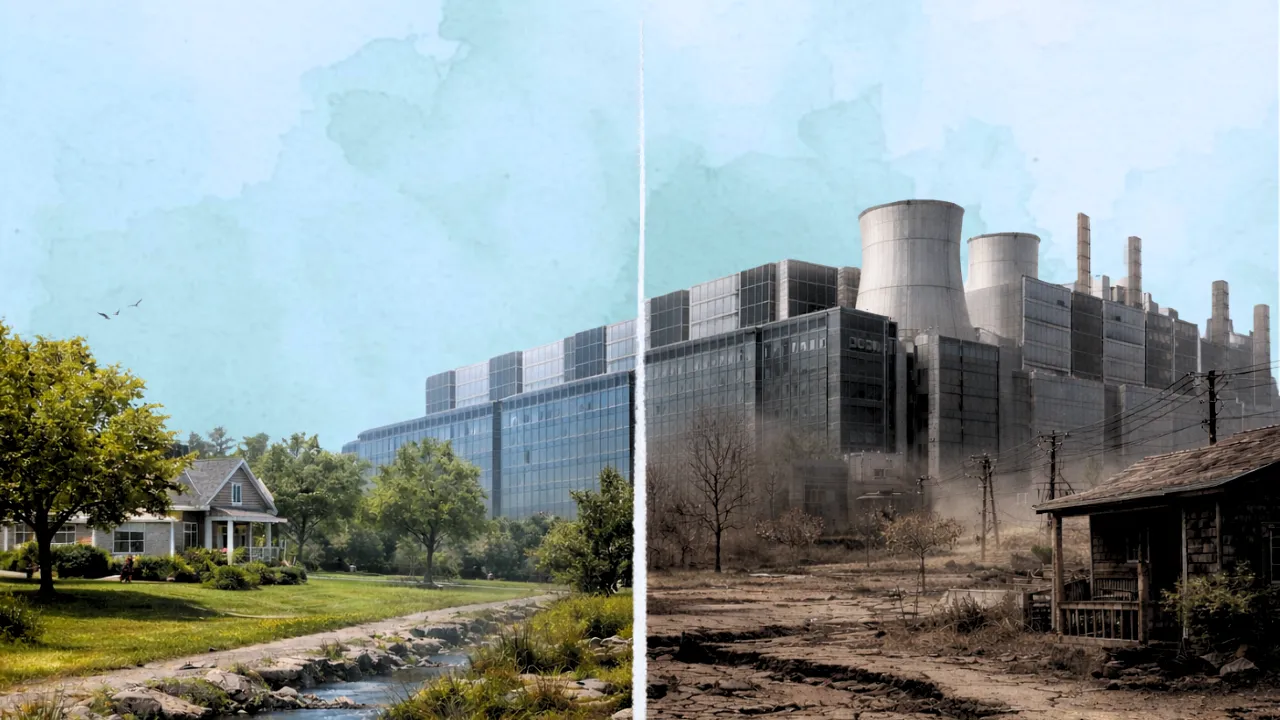
Artificial intelligence is no longer a future investment.
Now, it is an active, accelerating buildout. Behind every model, automation tool, and enterprise AI platform is a physical infrastructure layer that is expanding just as quickly as its daily use: data centers.

The companies leading the AI race — Microsoft, Google, Amazon, Meta, and OpenAI — are investing tens of billions into data center capacity to support large-scale AI systems. These facilities are the backbone of the AI economy. But their exponential expansion is raising a harder question: as the future of work becomes more dependent on AI, who absorbs the cost of powering it?
The Hidden Footprint of AI Growth
AI may feel intangible, but its infrastructure is very measurable.

Data centers require enormous amounts of:
- Electricity to run and cool servers
- Water for cooling systems
- Land for large-scale facilities
In some regions, a single data center can consume as much electricity as a small city. Water usage has become an even more sensitive issue, particularly in drought-prone areas like the American Southwest, where new facilities are being built to take advantage of land availability and tax incentives.
For local communities, this creates tension. The promise of economic development — jobs, investment, and tax revenue — does not always match the long-term reality.
Jobs Created vs. Jobs Displaced
Data centers do create jobs, but not in the way many expect.
- Construction phase: Temporary surge in employment
- Operational phase: Relatively small, highly specialized workforce
Once operational, a large data center may employ only a few dozen to a few hundred people. These roles often require technical expertise, limiting accessibility for the broader local workforce.
At the same time, the AI systems these centers support are actively transforming — and in some cases reducing — roles across industries like customer support, administrative work, entry-level analysis, and content production.
This creates a disconnect. Communities host the infrastructure, but the economic upside is distributed globally, while local labor markets may face disruption.
Environmental Strain Meets Workforce Transformation
The environmental cost compounds the workforce issue. Communities near large data center clusters have raised concerns about:
- Strain on local power grids
- Increased water consumption
- Rising land and housing costs
- Limited long-term job creation
According to a new study by a group of scientists, data centers may even be creating “heat islands,” raising local temperatures by up to 16°F.
Analyzing 20 years of NASA satellite data, researchers found that ambient surface temperatures rose an average of 3.6°F after a data center opened — and in some cases, spikes reached 16.4°F. The heat extended beyond the immediate site, affecting areas more than six miles away.
In regions already dealing with resource scarcity, these pressures can strain local economies. Energy demand can drive up utility costs. Water usage can become politically and socially contentious.
Temporary Boom, Lasting Disruption
The impacts described aren’t hypothetical. In Richland Parish, Louisiana, the construction of Meta’s $10 billion Hyperion data center has brought thousands of temporary workers to a rural town, creating a surge in demand for housing, food, and services.
Local businesses like food trucks and small vendors initially thrived, but many struggled when large contractors brought in out-of-state suppliers. Residents report rising rents, disrupted roads, and nighttime lights and noise transforming the once-quiet community.
Meanwhile, once construction ends, the data center will employ only a few hundred highly specialized workers, leaving local infrastructure strained while most economic benefits flow elsewhere.
Does the Future of Work Require AI Infrastructure?
AI is increasingly embedded in enterprise operations, financial systems, healthcare diagnostics, logistics and supply chains, and knowledge work. Companies are creating systems that are driving up demand for more data center capacity at a rapid rate.
The future of work is being built on systems that rely on continuous computation, real-time data processing, and large-scale model training. All of this depends on physical infrastructure.

But that does not mean the current model is the only path forward.
Rethinking the Trade-Off
The core issue is not whether AI should expand — it already is. The issue is how its infrastructure is integrated into economic and community planning.
A more balanced approach would require:
- Transparent resource usage reporting from companies operating data centers
- Local workforce development programs tied directly to infrastructure investments
- Stronger environmental regulations around water and energy consumption
- Revenue-sharing or tax structures that reflect long-term community impact
Right now, the incentives are often misaligned. Companies optimize for speed and scale. Communities are left negotiating the terms after the fact.
The Workforce Question No One Is Answering
AI is positioned as a productivity multiplier. And in many cases, it is. But productivity gains do not exist in isolation — they redistribute value.
If AI enables companies to operate with fewer people, while data centers expand in regions that see limited employment benefit, the question becomes unavoidable:
Where does the value go, and who is left managing the consequences?
For HR leaders and workforce strategists, this is not an abstract concern. It seriously impacts hiring, reskilling, location strategy, and long-term workforce planning.
A Turning Point for Decision-Makers
The expansion of AI infrastructure is happening faster than the frameworks designed to manage its impact. Companies are being forced to make hard decisions about where to build, how to scale, and what to automate.
But communities are reacting to resource strain, economic changes, potential pollution, heat, and water scarcity, and changing labor demand.
The future of work will depend on AI. But whether that future is broadly beneficial — or unevenly distributed — depends on decisions being made now.
Decisions that will ultimately answer who will carry the brunt of the costs making a future of work centered around AI possible.