
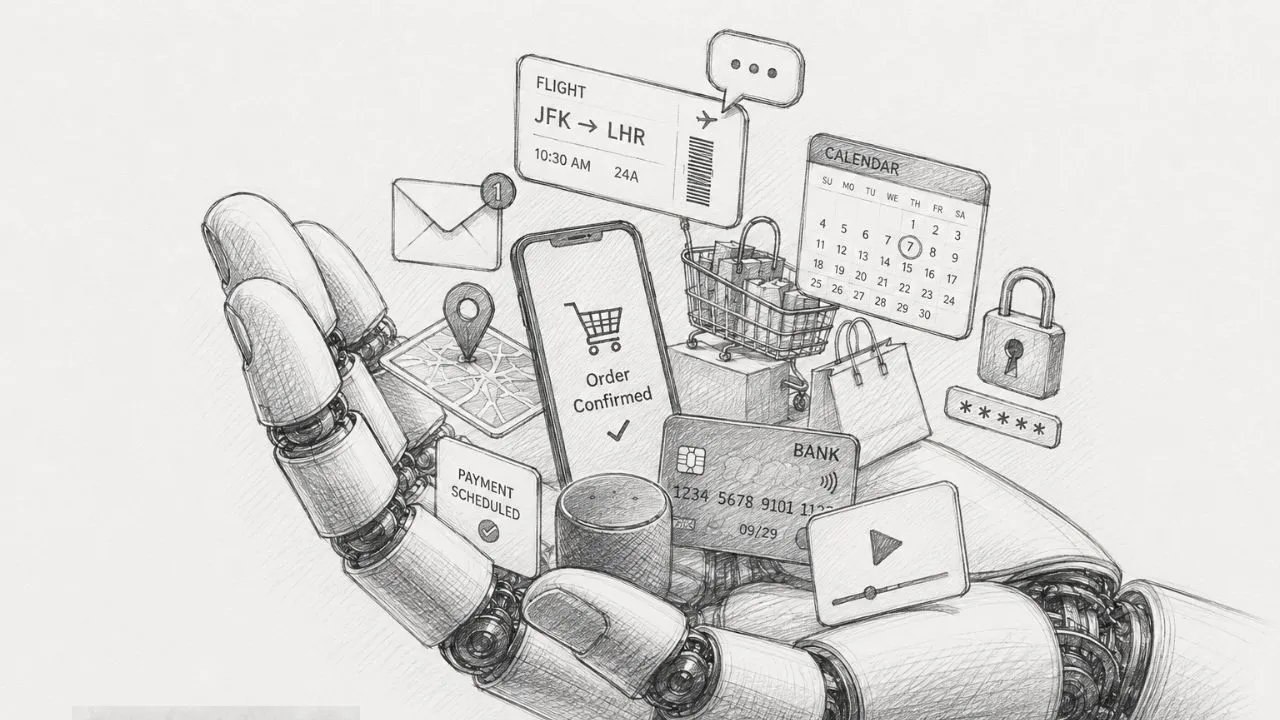
The age of passive AI is ending faster than many leaders expected. Consumers are no longer merely asking chatbots for recipes, travel ideas, or customer-service answers. They are beginning to let software act for them.
That makes autonomous AI trust the next serious business moat because the companies that earn permission to act on a customer’s behalf will sit much closer to decisions, wallets, schedules, and daily routines.

EY’s 2026 AI Sentiment Report found that 84% of respondents across 23 markets used AI in the previous six months, while 16% had already used AI systems that act without human intervention. Those figures should end any comfortable fiction that autonomous AI is a distant boardroom topic.
The delegation economy has already begun. The open question is whether leaders will treat autonomy as a feature to ship or a relationship to earn.

Delegation Is Becoming Everyday Behavior
The most important AI adoption story is not dramatic — it is ordinary. People are growing comfortable with AI through low-stakes interactions such as route planning, recommendations, travel planning, and customer support. That familiarity is quietly preparing them to hand over more consequential tasks. EY reported that 10% of respondents had used AI agents to purchase products on their behalf and 11% allowed AI to refill shopping carts or manage banking tasks.
That is why agentic AI adoption matters beyond the technology sector. McKinsey’s 2025 global survey found that 88% of organizations were regularly using AI in at least one business function, while 23% were scaling an agentic AI system somewhere in the enterprise.
Consumers are delegating at the edge of daily life while companies are experimenting inside workflows. The two trends are converging.
The strongest early markets also reveal where the curve may go next. EY identified India, the Chinese mainland, Brazil, Mexico, Saudi Arabia, the UAE, Hong Kong SAR, and South Korea as “Pioneer” markets, where 94% of respondents reported using AI and nearly one in four had already used autonomous AI. That pattern suggests autonomy will not spread evenly. It will accelerate first where digital habits, mobile commerce, and comfort with platform-mediated services are already high.
For executives, the lesson is blunt. Customers may say they worry about AI, yet still use it when it saves time, reduces friction, or solves a tedious problem. Adoption does not wait for full confidence. It advances through usefulness.
Trust Is Lagging Behind Use
The paradox is that people are delegating before they fully trust the systems receiving that authority. EY found that 66% of respondents worry about AI systems being hacked or breached, 66% say human oversight remains essential, and 73% fear they will no longer be able to distinguish what is real from what is AI-generated. That is a warning about how autonomy must be introduced.
The public mood points in the same direction. Consumer AI trust remains fragile, with Pew Research Center finding that across 25 countries, a median of 34% of adults were more concerned than excited about AI’s increased use — compared with 16% who were more excited than concerned. Stanford’s 2025 AI Index likewise found that global confidence in whether AI companies protect personal data fell from 50% in 2023 to 47% in 2024.
The trust problem grows sharper when AI moves from advice to action. A chatbot that gives a bad dinner suggestion is annoying. An agent that buys the wrong product, mishandles personal data, or follows malicious instructions is a different category of risk.
OpenAI’s release of ChatGPT agent captured both sides of the new era: the promise of tools that can navigate websites, create spreadsheets, and complete multistep work, and the risk that agents handling live data can be manipulated through prompt injection or other adversarial tactics.
That makes AI security risk a board-level issue. IBM’s 2025 Cost of a Data Breach Report warns that AI is outpacing security and governance, with 63% of organizations lacking AI governance policies to manage AI or prevent shadow AI. Autonomy expands the attack surface because agents can connect, click, retrieve, decide, and sometimes transact.
Governance Must Become A Product Feature
The businesses that win the autonomous AI race will not be the ones that shout “fully automated” the loudest. They will be the ones that make control visible, understandable, and reversible. Human oversight AI is part of the user experience. NIST’s AI Risk Management Framework and its Generative AI Profile give organizations a practical language for mapping, measuring, managing, and governing AI risks before they become brand failures.
The same shift is visible in regulation and standards. The AI Governance Strategy conversation has moved from voluntary principles to enforceable expectations, with the European Union’s AI Act entering into force in 2024 to promote responsible AI development and deployment. ISO/IEC 42001 similarly gives organizations a management-system standard for establishing, maintaining, and improving responsible AI practices.
But governance cannot live only in legal, risk, or compliance departments. Autonomous systems require product-level design choices: when the agent asks permission, what it is allowed to do alone, how it explains actions, how users revoke access, how sensitive data is protected, and how failures are corrected. These choices determine whether customers experience autonomy as convenience or loss of control.
That is why responsible AI leadership now belongs in strategy discussions about growth. McKinsey found that AI high performers are more likely to redesign workflows, define when model outputs need human validation, and show senior leadership commitment. In other words, value comes not from sprinkling AI onto existing processes, but from rebuilding work around clear accountability.
Conclusion
Autonomous AI is crossing the line from novelty to infrastructure. It will impact how people shop, bank, schedule, travel, learn, and work. Yet the permission to act on someone’s behalf is more intimate than the permission to answer a question. It demands a higher standard.
The emerging AI trust gap is therefore not a reason to slow down indefinitely, but is a reason to build better. Companies should assume customers will adopt useful autonomous tools before they fully trust them, then design every delegated action to earn more confidence than the last.
Trust will not arrive through grand promises about the future of AI. It will accumulate through secure, transparent, well-governed moments when the machine does the right thing, the human remains in control, and the value is obvious.