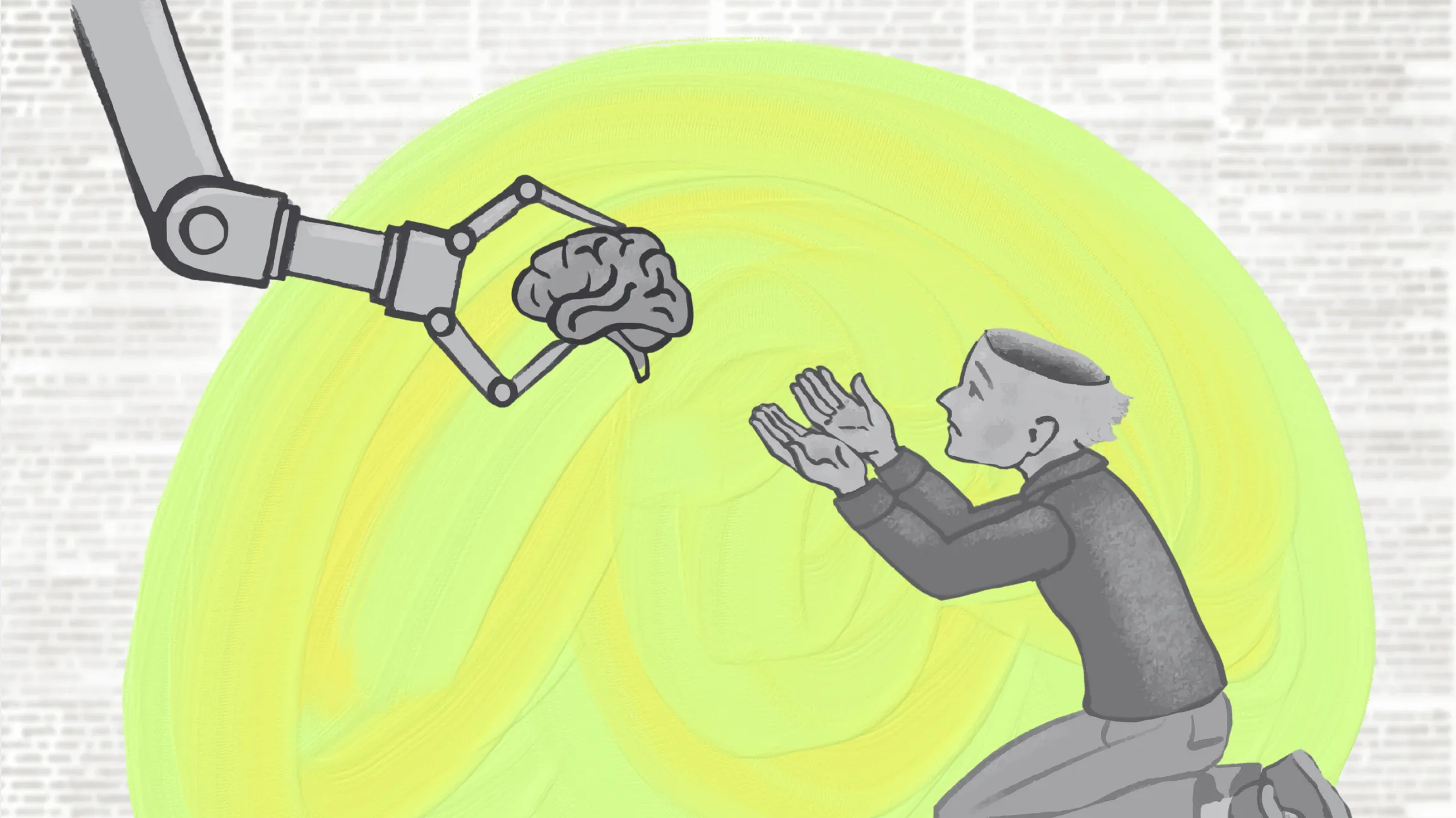
A budget decision lands on a manager’s desk. An AI system has already analyzed the data and generated a recommendation. The output looks polished. The reasoning behind it isn’t visible. The manager signs off.
This is becoming the norm for how decisions get made inside organizations.

We’re still talking about AI mostly in terms of productivity: what can we automate, what can we accelerate, and where can we reduce headcount.
But AI has moved past task-level work; it’s becoming an invisible layer inside organizations — one that influences which decisions get made, how information flows, and where opportunities end up. And when influence shifts from people to systems, the nature of power inside organizations changes too.

Which leads to a question worth asking: if AI is handling the analysis, shaping the options, and generating the recommendations, what exactly are we supposed to be doing?
A recent report, The Future of Being Human in the Age of AI, from the Elon University Imagining the Digital Future Center, collected perspectives from hundreds of experts, including the author, and paints a picture of a systemic shift in how humans operate when AI mediates the environment around them.
What it describes is a gradual handoff, not a single disruption. AI gets woven into systems, services, and decisions, and people start relying on it — without ever identifying the exact point where they stopped making the call themselves.
It feels like progress. It looks like efficiency. But what’s actually happening is that AI is changing how people reason, choose, and own the consequences of their choices.

The deeper risk inside organizations is the slow erosion of human agency. Independent thinking weakens. Judgment atrophies. Accountability blurs. Even shared understanding of what’s real starts to fray.
That is the real impact AI is having on how organizations make decisions — and most of it is invisible.
When Speed Becomes The Standard, Thinking Takes A Back Seat
Nobody builds an AI strategy with the goal of undermining human judgment. Leaders want better decisions, fewer mistakes, and faster execution.
But the design of AI-embedded workflows creates its own behavioral consequences over time.
When a system delivers a confident recommendation, fewer people dig into how it got there — and even fewer push back. When organizations reward speed and output volume above all else, taking time to reflect starts to feel like a liability.
Alf Rehn’s contribution to the report names this dynamic well: cognitive triage. People narrow their focus and default to whatever the system suggests. On the surface it looks like the organization is running smoothly — outputs are flowing, dashboards are green. But underneath, people are giving up their agency without realizing it.
Matthew Agustin takes it further. He warns that the real danger is when people stop being the authors of their own judgment and meaning. Decisions keep getting made. Work keeps getting done. But the thinking behind it becomes hollow — validated rather than questioned.
Roger Spitz captures this with the term “superstupidity” — the opposite of superintelligence. It’s what happens when humans lean on AI more heavily than their own comprehension can support.
The Shift No One Is Talking About In AI-Driven Workplaces
Most of the conversation about AI at work is still about efficiency. But inside organizations, something less visible is unfolding: the way human behavior is changing is also rewiring how decisions actually happen.
Teams are told to use AI tools, but aren’t always expected to understand the reasoning behind what those tools produce. Managers carry accountability for results they didn’t fully shape. Leaders celebrate productivity improvements but don’t track whether their people are still capable of thinking independently.
Gradually, reliance replaces reasoning. It becomes the path of least resistance.
People’s roles shift, but nobody formally redefines them. Employees stop working through decisions and start moving forward on decisions that were made for them.
And when machines take over the predicting and persuading, and no one is left interrogating what they produce, organizations lose something that Barry Chudakov calls their cognitive immune system.
We don’t just hand off tasks to AI — we hand off the ability to ask whether something is right, whether it should be done at all, and what it means. AI can identify and reproduce patterns. But it can’t ask whether those patterns should exist.
If we want humans to remain real participants in the thinking process, that has to be an intentional choice. People need to understand the decisions they’re part of, feel ownership over the outcomes, and have the standing to push back on what they’re given.
Otherwise, organizations get faster but more fragile.
Building Resilience Into How Work Gets Done
Individuals can’t solve this on their own. The old resilience playbook — learn a new skill, adapt to the next wave — doesn’t work when the environment is shifting in ways people can’t see or control. Resilience needs to be designed into organizational systems: governance, decision-making structures, workflow design, incentive models, and accountability frameworks. These have to actively protect human capability instead of taking it for granted.
As AI becomes part of workplace decision-making, leaders must clearly establish the human role. Employees need to know who has final authority, what level of understanding is required before relying on AI recommendations, and when they are expected to challenge AI-generated conclusions.
Some processes shouldn’t be optimized for speed at all. They need built-in pauses — space for people to think, verify, and take ownership. When you strip all the friction out, you may gain short-term efficiency, but you erode the capability that makes organizations resilient over time. Speed can’t come at the cost of judgment.
AI is now embedded in the systems that govern how work gets done. And those same systems are shaping how the people inside them think, decide, and take responsibility.
Each workflow redesign, each new tool deployment, each automated decision model plays a role in that transformation. And the effects aren’t theoretical — they’re already showing up inside companies.
The question is whether any of it is being designed on purpose.