
Flexible workspace is becoming a more established part of corporate real estate strategies, with many of the world’s largest companies expanding their footprints even as the total number of enterprise customers declines.
According to new data from WeWork, 124 Global Fortune 500 companies were using its workspaces as of May 2026. While that is down from 142 a year earlier, the companies that remained increased their average footprint by nearly 21%, from 556 seats to 672. Total seats occupied by Global Fortune 500 members also rose 5.6% year over year to more than 83,000.

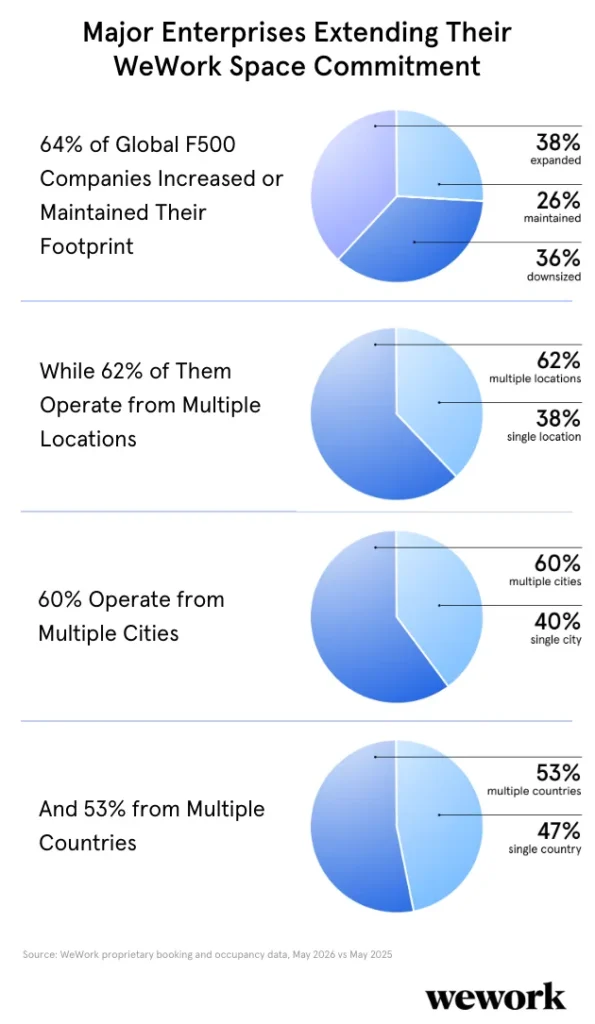
Two-thirds of Fortune 500 members maintained or expanded their WeWork presence during the year, signaling continued demand among large enterprise customers.
 Large Enterprises Double Down on Flex Space
The growth is being driven primarily by large, multi-location companies rather than smaller tenants. Nearly two-thirds of enterprise members operate across multiple WeWork buildings, while more than half use the provider in multiple countries, allowing organizations to standardize workspace across global markets.

Dedicated private offices remain the preferred option, accounting for roughly 90% of enterprise seats. Companies are increasingly pairing long-term headquarters with flexible office space that can expand or contract as business needs change.
The report also notes that technology, finance, consumer, and manufacturing companies make up roughly three-quarters of WeWork’s enterprise customer base.
Speed Becomes a Competitive Advantage
Enterprise customers are also moving into new office space far faster than they would through traditional leasing.
Across more than 1,000 Global Fortune 500 agreements signed since 2023, companies took an average of 95 days from initial inquiry to move-in. Even offices with more than 100 seats were typically operational within about four months, providing businesses with greater flexibility to respond to changing workforce needs.

North America Leads Growth
North America posted the strongest expansion, with Fortune 500 seating increasing more than 24% over the past year. The average footprint per company climbed by one-third, and three-quarters of members either maintained or expanded their space.
Elsewhere, activity remained relatively stable. Enterprise footprints in Europe, the Middle East, and Africa were largely unchanged, while Asia-Pacific maintained steady demand and Latin America recorded one of the highest enterprise retention rates.
The findings add to growing evidence that flexible workspace is becoming a permanent component of enterprise real estate portfolios, particularly among large organizations looking to balance long-term office commitments with greater operational flexibility.