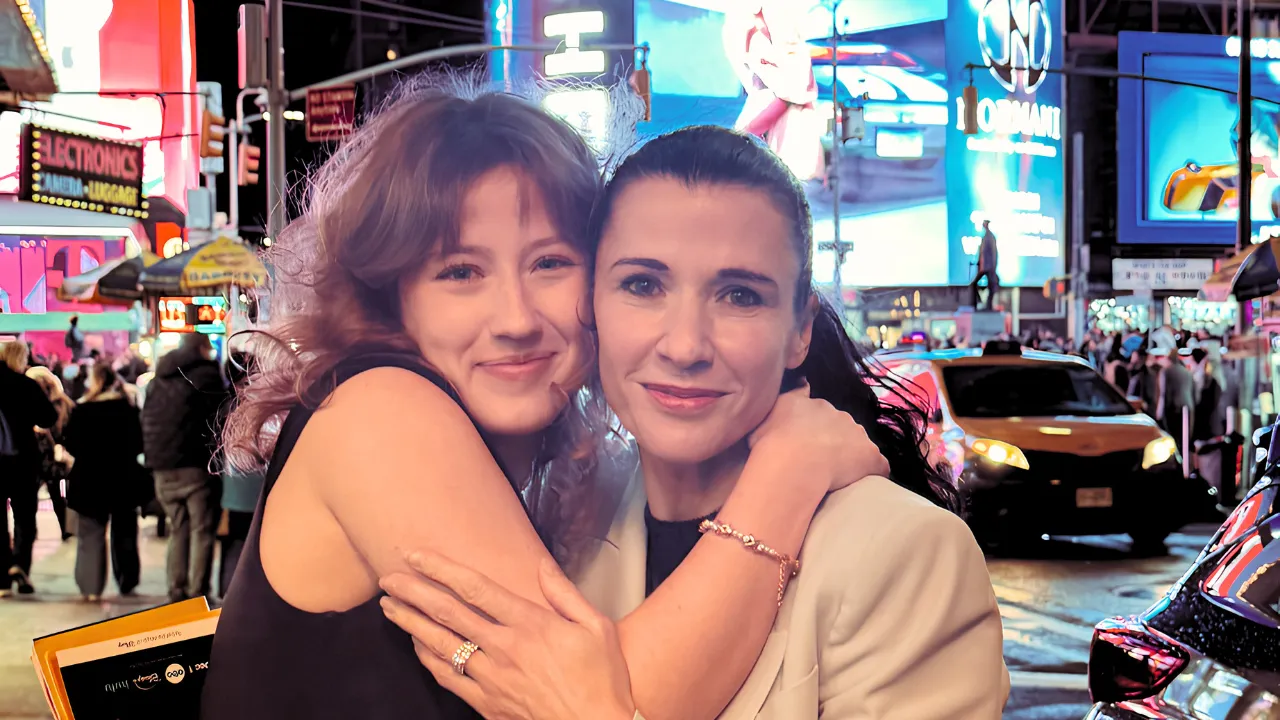
Editor’s note: Maria Colacurcio is the CEO of Syndio, a decision intelligence company focused on pay. Her daughter, Sofia Frei, just completed her first year at Dartmouth College. They wrote these essays independently.
Part One: Three Times the CEO I Was a Year Ago
by Maria Colacurcio, CEO, Syndio

The strange part wasn’t watching the AI do my work. It was reading my own voice come back to me in something I never wrote.
I’d spent the past year building agents to help run my company. Somewhere along the way, they learned to sound like me. Down to the tics. The short sentences. The way I trail off into a comma instead of landing the point. The weird little parentheses I drop where they don’t belong (like this one).

I read a draft one of them had produced and went looking for the seam between what was mine and what was the machine’s, and couldn’t find it.
That’s when I sat back and thought: What have I done?
What scares me isn’t what AI can do. It’s how quickly it becomes indispensable.
I had wanted this: I spent a year taking courses, building agents, and wiring these tools into how I think and run a 140-person company. It was working, faster and better than I thought it would. The thrill and the dread arrived in the same second.

I’m not special in this. Right now millions of people are sitting where I sat, handing a piece of themselves to a machine and quietly deciding how much to trust what comes back.
So let me explain what I actually built, because the fear in that moment is worth understanding before we hand this technology to everyone.
My work is about pay: who gets the raise, the offer, the promotion. For as long as we’ve paid people, those decisions have been made quickly by human beings with their own blind spots. No one writes down why, and the consequences compound over time.
What I build now does something we’ve never been able to do: it captures the why. A person makes the decision. The system preserves the reasoning alongside the outcome. For the first time, we can ask whether our judgment was any good. Decisions that used to vanish now leave a trail. Bias that used to hide behind a confident face becomes something you can see.
The same tools draft and model in an afternoon what used to consume a month. On a good day, I’m three times the CEO I was a year ago.
So I didn’t keep it to myself. I gave my leaders the same charge: learn these tools, build with them, come along quickly, because the distance between the people who do and the people who wait is going to be brutal. I believe that.
I’m all in. But I don’t have everything answered, and I want to be honest about that, because the people selling this rarely are. I built my agents for a purpose I chose, in a company I control. That’s a confined, lucky version of this technology. It’s not the version most people are going to meet.
My daughter may never have that choice. My daughter is about to meet the other one. She’s 19. She didn’t choose this, she didn’t get to set the guardrails, and the AI in her life isn’t a tool she built at a kitchen table. It’s in her search bar, her classroom, her feed, running whether she agrees to it or not.
When I listen to her explain what she’s afraid of, I don’t think she’s wrong. I think she’s describing the same technology I’m building, stripped of protections. That’s what I sit with.
A 2026 Wharton study by Steven Shaw and Gideon Nave found that when participants consulted ChatGPT, they adopted its answer more than 80% of the time even when the AI was wrong. The researchers coined the term “cognitive surrender” to describe the tendency to defer to AI outputs rather than engage in independent reasoning.
I’ve felt that pull myself: the urge to accept the good-enough answer and skip the part where I’d normally check the work. That complacency scares me.
The thing that frightens me isn’t that machines will replace people. It’s that people may quietly stop thinking while the machine keeps going.
Underneath all of this is something I don’t say in board meetings: the power of this technology is intoxicating. And intoxicating is the right word, because it can make you three times as capable — and half as careful at the same time.
That’s the thing I want my daughter to catch me on. It’s the thing I hope her whole generation refuses to let the rest of us forget.
Part Two: I Don’t Want AI to Think for Me
by Sofia Frei
This is my first technological revolution.
I just finished my first year at Dartmouth College. When I was 14, I imagined college as a place where I would disappear into books, write long papers, and spend hours wrestling with ideas that couldn’t be explained in a few sentences. I couldn’t wait for the freedom to study whatever I wanted.
Instead, I arrived on campus just as artificial intelligence arrived everywhere.
My school is launching AI initiatives. Professors are rewriting assignments and grading rubrics. Students are experimenting with ChatGPT and Claude. Every conversation about the future seems to begin with the same assumption: AI is coming, so we’d better adapt. What surprises me is how little confidence anyone seems to have about what exactly we’re adapting to.
My mother, Maria Colacurcio, is the CEO of Syndio and one of the people leaning into this moment — she has spent the past year building AI agents and thinking deeply about how these tools might improve decision-making. I get the appeal. Used thoughtfully, she argues, AI can help us organize information, spot patterns, and even challenge our assumptions.
But I find myself asking a different question. What happens when we stop knowing whose judgment we’re even relying on?
One of the arguments I hear from adults is that AI will make us more productive. It will help us write faster, research faster, learn faster, work faster. If we want jobs after graduation, we’re told, we need to become fluent in it. Take the courses. Earn the certificates. Learn to build agents. And maybe they’re right. But every time I open one of these tools, I feel a pit in my stomach.
Part of it is worry about what it’s doing to the environment. Part of it is concern about the artists, writers, musicians, and creators whose work was used to train these systems. Part of it is whether it’s really me doing the work. And part of it, I’ll admit, may simply be fear of change.
But I think a larger part is something harder to articulate. It feels as though we’re racing to hand over parts of our thinking before we’ve fully understood why those parts mattered in the first place.
I started talking with friends about this. For a project on generational views on AI in a “Systems Reporting” class, I interviewed dozens of students. Almost all of them use AI in some way. Few believe it’s going away. Yet many described the same feeling: if everyone else stopped using it tomorrow, they would too.
It reminded me of something I’ve heard a lot from people my age. “I’d totally get a flip phone if everyone else did.” There’s a strange nostalgia among young people for things we barely experienced ourselves. Maybe that’s because we’ve already seen what happened when social media promised connection and delivered isolation. We’ve grown up inside an experiment that adults didn’t fully understand when they launched it. Now we’re being told to embrace another one.
The question isn’t whether AI will become part of our lives. It already has. The question is whether we’re adopting it because it genuinely improves our lives — or because opting out feels impossible.
What worries me most isn’t that AI will become smarter than humans. It’s that convenience will become more important than struggle. Learning is frustrating. Creativity often begins with boredom. Good relationships require patience, conflict, and misunderstanding. Growth comes from wrestling with uncertainty long enough to form your own conclusions. AI removes that friction. That’s what makes me uneasy. It’s easier to vent to an AI chatbot than to a friend. It’s easier to summarize a book than read it. It’s easier to generate an answer than sit with a difficult question. But inconvenience is often the price of being human.
My mother’s generation is asking how AI can help us make better decisions. My generation is asking something different: how do we make sure we’re still making them?
I’m not anti-AI. If these tools help cure diseases, advance science, or solve problems beyond human capability, that would be extraordinary. But before we rush to automate every conversation, every assignment, every customer interaction, and every corner of daily life, we should ask: what are we gaining, and what are we giving up?
Because if we’re not careful, the risk isn’t just that machines will think for us. It’s that we’ll gradually forget why thinking mattered in the first place.
Written by Maria Colacurcio and Sofia Frei for Fortune as “This CEO became 3x more productive with AI. Then she read what her daughter wrote about it at Dartmouth” and republished with permission.