

For much of modern history, productivity was relatively easy to understand. How much land could be cultivated? How many units could be manufactured? How quickly could they be produced?
As work evolved, the measures evolved with it: headcount, utilization, turnover, absenteeism, revenue per employee, and on and on.

These measures matter. But they overwhelmingly answer one type of question: How many?
In a 1971 speech, researcher Daniel Yankelovich described what he called the “McNamara Fallacy:” the risk of privileging what can be readily quantified while discounting information that is harder to measure. Numbers feel objective. They fit neatly on dashboards and give organizations something concrete to compare.

The trouble starts when we assume that because something is easier to count, it must matter more.
When work changes, the measures have to expand
During much of the industrial era, machines paced humans. Speed and efficiency were built into the system, so measuring them made sense.
As AI-enabled technology takes on more routine and repeatable work, that relationship may reverse. Humans will increasingly pace the machines through judgment, creativity, attention, communication, empathy, orchestration, and the ability to navigate complexity.
If those capabilities matter more, organizations need to better understand the conditions that support them. Stress, autonomy, engagement, connection, wellbeing, and focus begin to look less like peripheral employee-experience measures and more like useful information about the performance system.
Traditional productivity measures still matter. They simply can’t tell the whole story anymore.
Organizations spend considerable time asking whether people are performing. We spend far less time asking whether we’ve provided the conditions they need to perform at their best.
What do people need to perform well?
Self-Determination Theory (SDT), developed by psychologists Edward Deci, Anja Olafsen, and Richard Ryan, offers a useful lens by identifying three basic psychological needs: autonomy, competence, and relatedness.
Autonomy is about experiencing choice and volition. Competence is about feeling capable and effective. Relatedness is about connection and belonging.
These aren’t simply abstract ideas. A 2026 meta-analysis by researchers Martin Hagger and Katie McAnally Star examined 192 workplace studies representing 93,552 participants and found that greater support for employees’ basic psychological needs was associated with greater engagement, job performance, job satisfaction, and wellbeing. As AI changes the division of labor between people and technology, findings like these take on new relevance. If organizations expect more human qualities, the conditions must support them.
Yet workplace design conversations can quickly turn to amenities as the solution. Amenities can support convenience, connection, and restoration, but they rarely address fundamental human needs on their own.
SDT offers a surprisingly straightforward way to get back to the fundamentals. Instead of starting with “What should we put in the workplace?” start with “What do people need to do their best work?”
Performance is a system
Organizations provide resources, expectations, relationships, and physical environments that support what we do. All of which can make work easier or harder.

These aren’t purely individual considerations. Teams also need control, resources, relationships, and shared knowledge. In other words, autonomy can coexist with teamwork, and relatedness doesn’t require constant collaboration.
The role of design shouldn’t be overstated. A great workplace cannot overcome poor management, unreasonable workloads, inadequate tools, or lack of clarity. Space is one part of a larger performance system. But it is still part of the system.
Research by Lynne Armitage and Jihan Nassor Amar on person-environment fit suggests that workplace outcomes depend partly on how well the environment fits people’s needs and the work they do.
SDT doesn’t prescribe a floor plan, but it can help frame useful workplace questions:
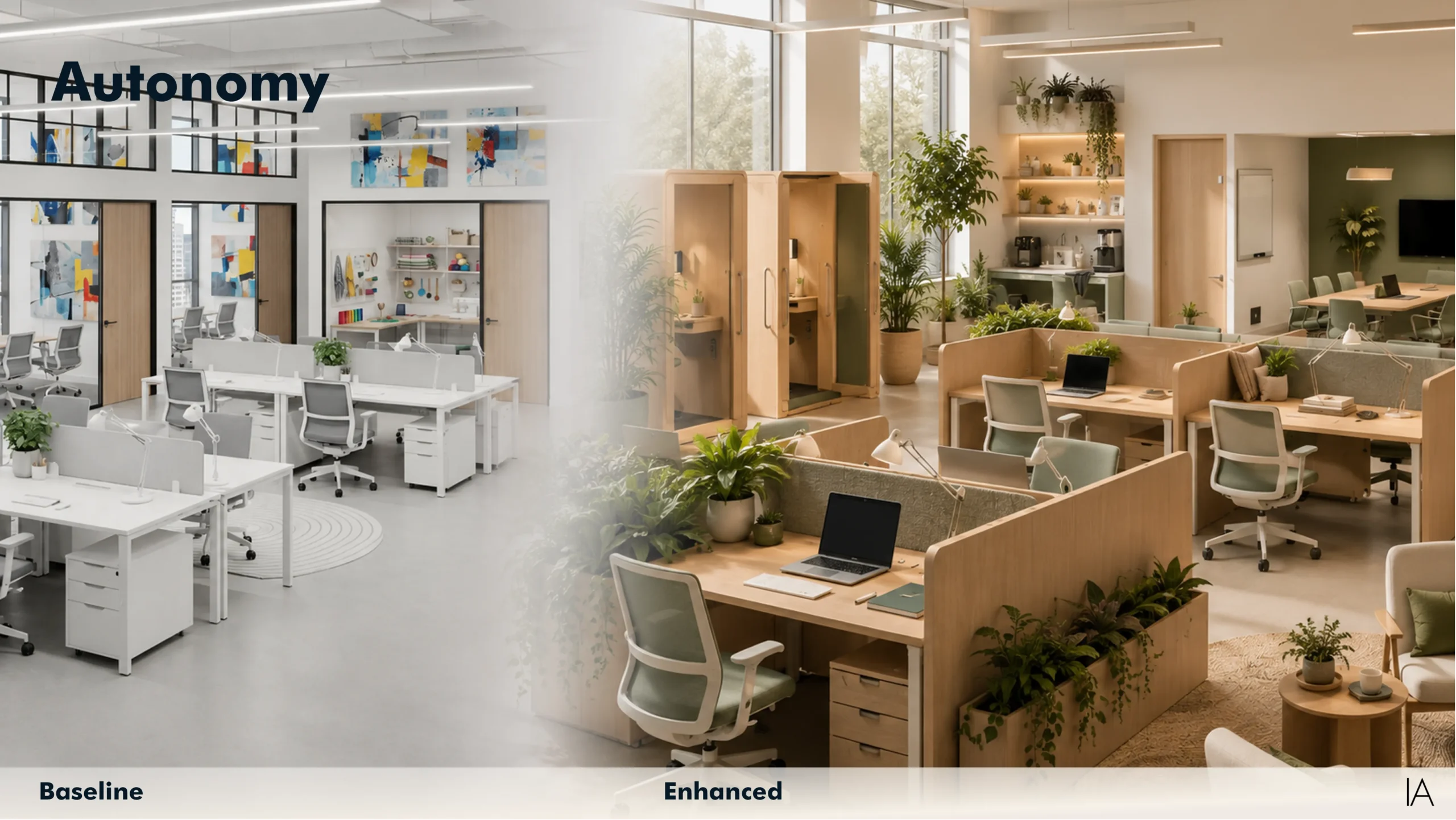
- For autonomy, do people have an appropriate degree of choice in where and how they work
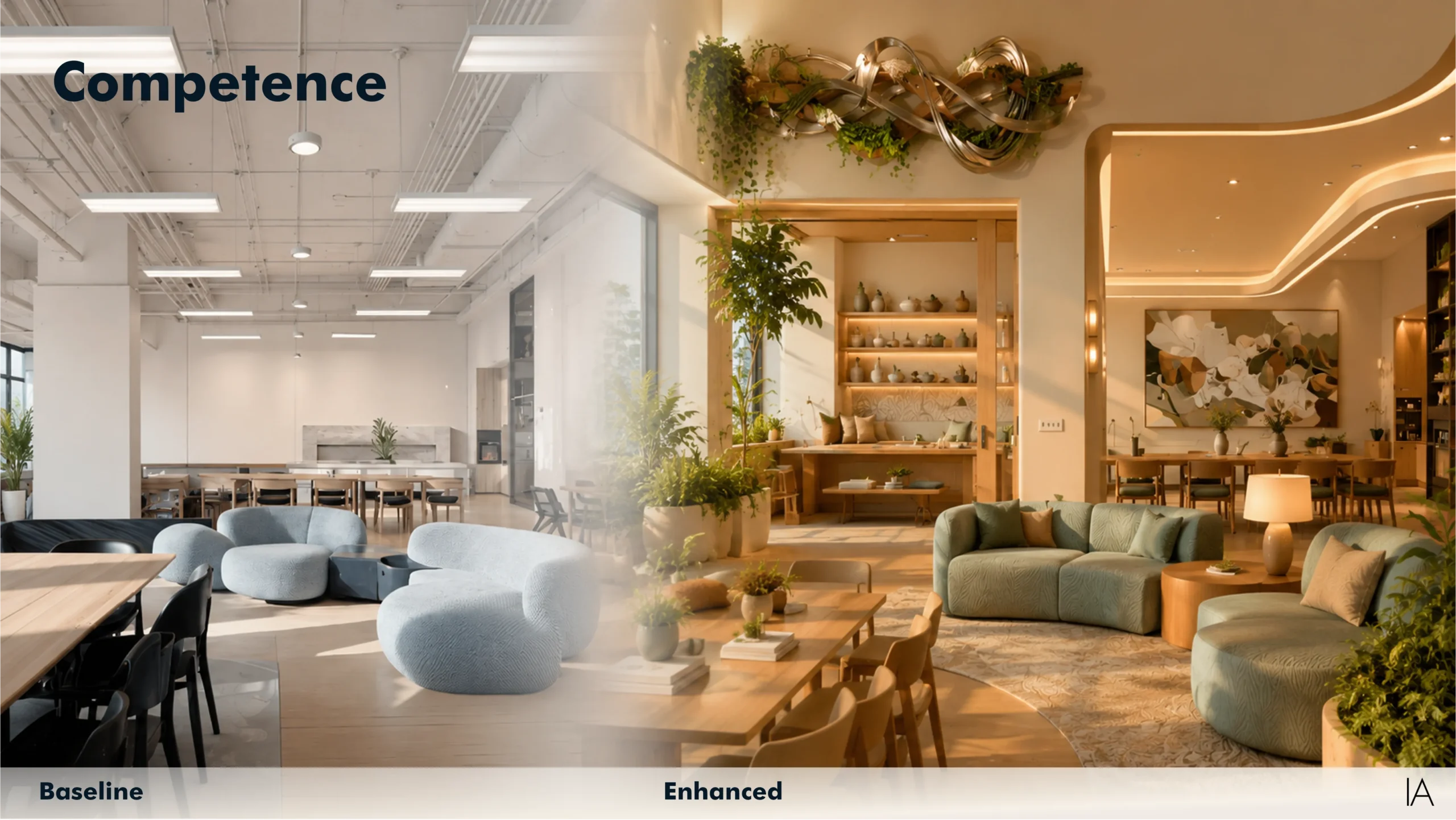
- For competence, does the environment help or hinder demanding work
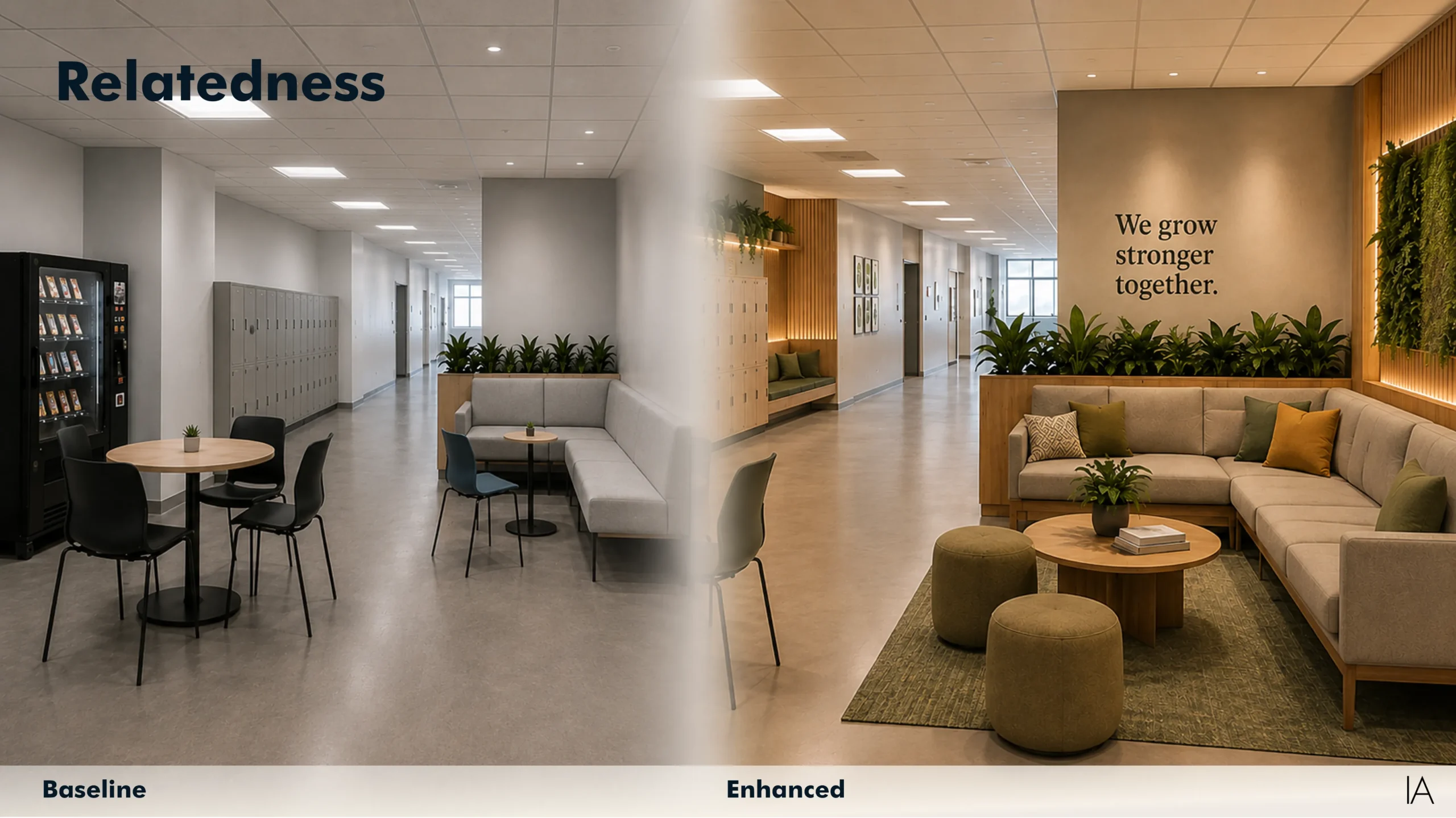
- For relatedness, does it provide conditions in which connection, knowledge exchange, mentorship, and relationships can develop?
Research by Michel O’Neill suggests that appropriate choice and control over where, when, and how people work can support positive individual and organizational outcomes.
These questions expand the focus beyond how efficiently space is used to consider how well it equips people to perform.
How do we measure “how human?”
Qualitative doesn’t mean immeasurable. And measuring human outcomes doesn’t require turning your workplace into a research lab.
Organizations can use surveys, ethnographic data, site assessments, and other appropriate metrics as long as they align with the measures that matter most.
Start with the performance outcome. What does the work actually require from people? If judgment is critical, what helps people think clearly and make good decisions? If collaboration matters, what helps people build relationships and exchange knowledge? If sustained attention matters, what helps people focus and recover?
Then establish a baseline. Identify the human condition connected to that performance outcome and consider what might influence it: design, policy, management, technology, or other organizational supports. Make the change, then measure again using consistent methods.
Context is important here. Nothing operates in isolation. Measuring before and after a change can help organizations understand how the workplace contributes within the larger performance system and whether the outcomes that matter are moving in the intended direction.
Many organizations already track some of the data they need. Engagement, satisfaction, turnover, absenteeism, and employee experience are all pretty common measures. The harder part is knowing which of those measures tell us something meaningful about the performance outcomes we’re trying to understand.
That scrutiny matters even more as AI makes more data available and leaders continue asking for proof of efficiency and performance. Yes, a calendar can tell us how many meetings someone attended while working remotely, for example, but it can’t tell us whether those conversations led to better decisions.
In the end, don’t stop measuring “How Many.” But before asking, “How are our people performing?” organizations should also be able to answer: “How well have we equipped them to perform?”
As human work increasingly depends on judgment, creativity, connection, and navigating complexity, organizations need to become just as rigorous about understanding “How Human.”