





For generations, effective leadership was built on certainty. Leaders were expected to know where the organization was heading, anticipate what was coming, and answer everyone’s questions.
That model is buckling under permanent disruption. AI is not only changing how work gets done; it is changing what employees need from the people leading them. Add economic pressure, geopolitical instability, and new expectations about where and how people work, and uncertainty stops being an interruption and becomes the norm we operate under. Leadership now depends less on having the answers than on supplying clarity, confidence, and direction.

Leading HR strategist and future-of-work thought leader Nirit Cohen examines this tension in her Allwork.Space article Leaders Are Getting The Future Of Work Right. Why Does Work Feel So Wrong? Organizations speak confidently about productivity, AI, and transformation, Cohen argues, while many employees quietly question their value, identity, and future within those same workplaces.
The task for leaders, therefore, is not to eliminate uncertainty, but to help people understand what is changing, what remains unresolved, and how the organization intends to respond.

Uncertainty is Now a Feature of Work, Not a Temporary Phase
Organizations have historically treated uncertainty as temporary and finite, often linking it to events such as mergers, restructuring, or major new technology and systems rollouts that had to be managed until stability returned and employees adjusted to new ways of working.
But how should leaders respond when change is no longer periodic, but continuous? In such an environment, leaders cannot delay communication or decision-making until every uncertainty has been resolved. They need to help teams make sound decisions with incomplete information, set clear priorities, and explain how the organization will respond as circumstances change.
The gap between present-day confidence and future readiness is already becoming visible. Cohen cites research showing that while 87% of workers feel confident in the skills they use today, many are far less certain about their ability to adapt to AI and changing job demands. Her broader point is that organizations cannot focus only on what employees can deliver now; they also need to help people build the skills and confidence they will need for the future.
Communicating Clearly in Uncertain Times
During uncertain periods, leaders may wait until decisions are final before communicating, believing that incomplete information will create confusion. But silence can deepen uncertainty, leaving employees to interpret events for themselves. Persistent uncertainty can make people more risk-averse, narrow their focus, and operate in survival mode. Leaders do not need to communicate every possibility, but they do need to explain what is known, what remains unresolved, and how the situation is being managed.

Research published in the Quarterly Journal of Experimental Psychology suggests that the way leaders communicate uncertainty makes a significant difference. Leaders are generally perceived as more competent when they describe uncertainty as a feature of the situation (the situation is uncertain) rather than as personal doubt (I am uncertain). People expect leaders to acknowledge uncertainty rather than conceal it.
Leaders do not need to project certainty, but they do need to show confidence in how they respond. Rather than simply saying, “We don’t know yet,” they can explain what is known, what remains unresolved, what is currently happening, and when employees can expect an update. In uncertain environments, confidence often comes from knowing that decisions are being made through a credible, transparent process.
Why Transparency is Essential in Uncertain Times
Transparency matters most when employees suspect information is being withheld. A recent LiveCareer survey found a substantial trust gap between employees and leadership. Nearly three-quarters (73%) said they did not trust leaders to be fully honest during periods of financial difficulty.
Among employees who had experienced layoffs or restructuring, 71% believed leaders had either been dishonest or withheld information. The same proportion expected employers to downplay AI’s impact on jobs or remain silent until employees began experiencing the effects themselves.
These findings point to a wider problem: when trust is fragile, limited communication can easily be interpreted as concealment. Leaders may therefore need to communicate earlier, not because they have definitive answers, but because silence can deepen suspicion.
Transparent communication does not mean disclosing every discussion, possibility, or commercially sensitive detail. It means being clear about what has changed, what has not, which questions remain unresolved and, importantly, what criteria will guide the decisions that follow. Explaining how decisions will be made can give employees a greater sense of stability, even when the outcome itself remains uncertain.
According to the CIPD, traditional command-and-control leadership is ill-suited to periods of uncertainty because it assumes leaders have clear answers and employees will follow direction without question. In unfamiliar and fast-changing situations, leaders often have to act without complete information, making trust, open communication, and psychological safety increasingly important to effective leadership.
Psychological Safety Is a Leadership Priority in Uncertain Times
In addition to transparent communication, employees also need to feel able to respond openly. That means being able to say, “I don’t understand this,” “I think there is a problem,” or “I disagree with this approach” without worrying that speaking up will make them appear difficult, resistant, or incapable.
These are the kinds of behaviors psychological safety makes possible. Harvard Business School professor Amy Edmondson, whose research helped establish the concept of psychological safety, describes it as an environment in which people can speak up without fear of interpersonal consequences.
During periods of transition, this is especially important because leaders need honest feedback from the employees dealing with the changes day to day. Employees must feel able to flag emerging problems, question assumptions, and say when a change is creating unintended consequences.
For leaders, this means responding constructively when concerns are raised, resisting the urge to shut down dissent and making it clear that questioning a decision is not the same as resisting change.
Psychological safety does not remove uncertainty. It makes it easier for people to question assumptions, flag problems early, and contribute information that leaders may otherwise miss.
Effective Leaders Help Employees Understand What Comes Next
Leadership during periods of change requires more than explaining where the organization is heading. Employees also need to understand what that future means for them. When leaders announce an AI transformation, restructuring, or new business model, employees often ask a more immediate question: Where do I fit into this?
Leadership expert and founder and CEO of The Grossman Group, David Grossman, argues that strong leaders connect business strategy to employees’ own development and future opportunities. That means explaining how roles may change, which skills will become more valuable, what support or learning will be available, and where new opportunities may emerge.
It also means giving employees clear context for the change itself: why it is happening, what problem it is intended to solve, and what success will look like. Leaders cannot promise that every role will remain unchanged, but they can make change more understandable and less abstract. That clarity can strengthen trust, improve engagement, and help employees respond more constructively to transition.
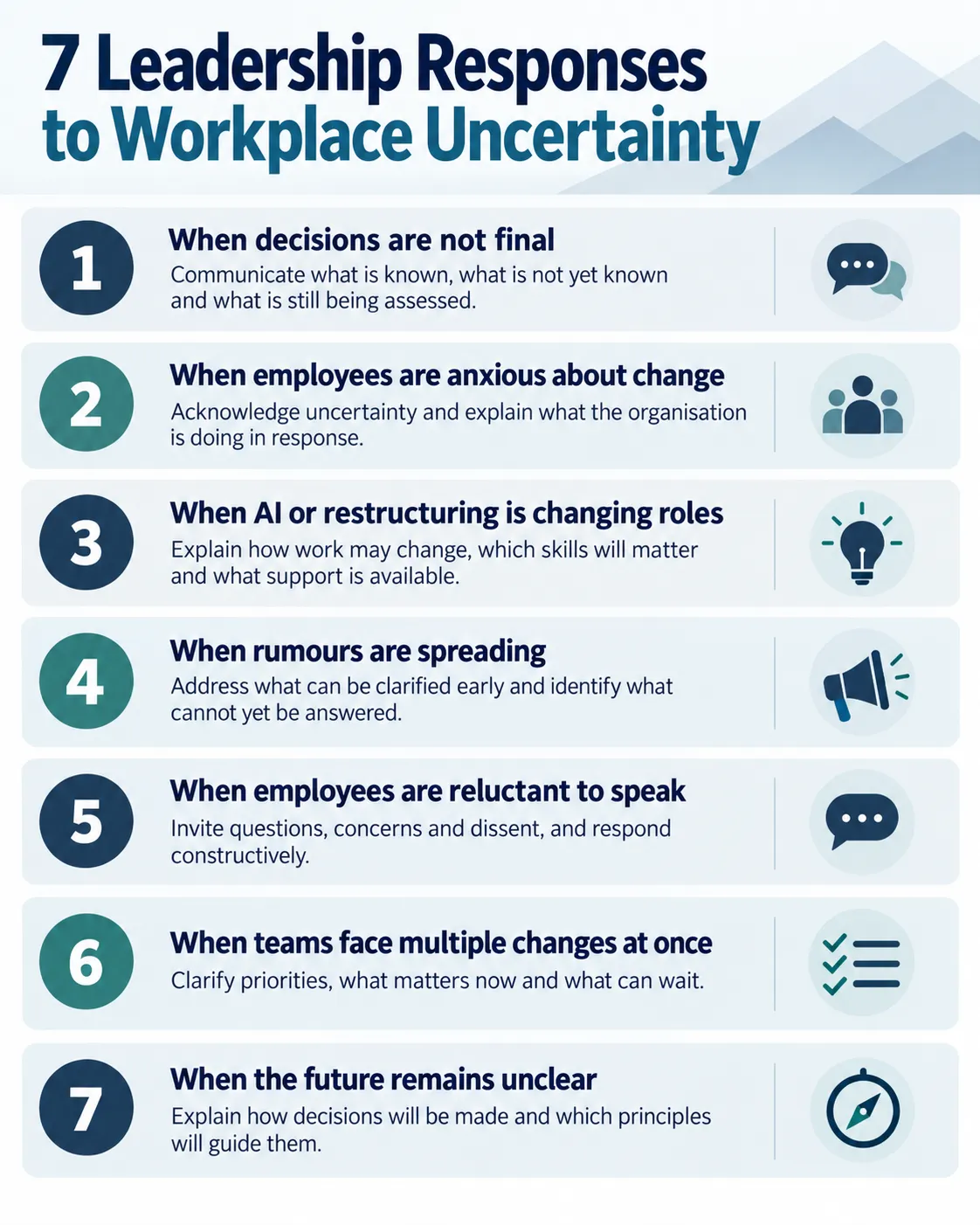
The following seven responses bring those principles into practice:
7 Leadership Responses* to Workplace Uncertainty
The rapid advancement of AI, large-scale workforce transformations, and economic disruption will continue to create situations in which leaders cannot predict what comes next. The most effective leaders will not be those who claim to have every answer, but those who can provide clarity when certainty is unavailable.
Ultimately, leadership under uncertainty is about giving people confidence, not in a guaranteed outcome, but in the decisions and processes that will guide what happens next.
* Sources referenced in 7 Leadership Responses to Workplace Uncertainty:
Your Thought Partner; Workplace Options; Harvard Business Review; iFeel; Workvivo; Forbes Coaches Council; Center for Creative Leadership; Speakers Office.