


Speed has become a badge of honor in business: faster launches, quicker decisions, shorter cycles. Although speed can create a quick, defensible answer, creativity often needs time to notice, wander, and experiment.
Research offers a reason to question a fast pace. A 2025 meta-analysis of experimental studies found that stress reduced creative performance overall, with time pressure particularly detrimental for adults. A 2023 workplace study linked time pressure with lower radical creativity due to reduced exploration of knowledge outside the organization. The practical concern is what urgency leaves out: opportunities to look beyond familiar information and discover something worth pursuing.

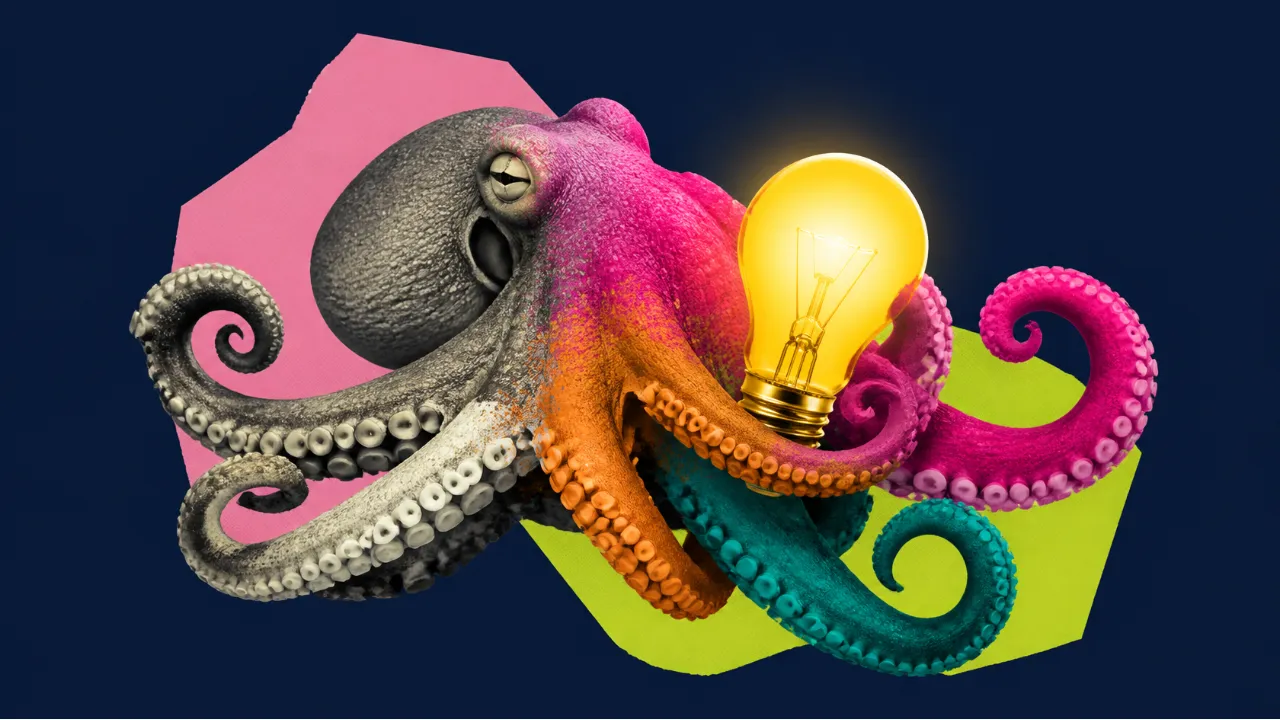
One recent discovery illustrates the value of those opportunities. In January 2026, Stanford researchers reported a flexible material that can change the color and texture of its surface within seconds. Inspired by octopuses and cuttlefish, the researchers combined a water-responsive polymer with a semiconductor manufacturing technique.
An unexpected observation led to the discovery: Instead of creating new samples, a researcher reused samples examined under an electron microscope in an earlier project. Surprisingly, regions of the material previously scanned behaved differently and turned a different color, revealing a way to control the material’s response. Biology supplied the inspiration, manufacturing supplied a method, and an anomaly opened a new possibility.
For an idea to resonate, it must connect with people’s experiences, emotions, or needs. An unexpected connection may open a possibility; understanding who it could serve gives us a reason to pursue it.
Most of us aren’t studying octopuses, but we are acutely aware of our customer and business needs. AI tools can help generate options. However, noticing an anomaly, questioning an assumption, or judging what deserves pursuit still require human attention, time, and rigor. While rigor may seem at odds with creativity, it can help turn unexpected connections into meaningful applications.
Three practices offer a starting point: organized consumption, foresight collisions, and systematic theft. Together, they broaden our intake, explore disruption, and apply what we can transfer.
1. Organized consumption: Look Beyond Familiar Perspectives
In a short-story experiment by Anil Doshi and Oliver Hauser, AI assistance improved creative ratings, but the stories were more similar to one another. Access to AI does not remove the need to seek different perspectives and question what informs our ideas.

Organized consumption means deliberately choosing what information to engage with and how to interpret it. Seek a source beyond your usual field. Read for understanding, then revisit it through a different lens. What assumption does the finding challenge? Whose experience is missing? Which conditions made the result possible?
Prompts help. The Cognilense thinking-hat deck by Monsoonfish offers several and you can build your own from The Decision Lab’s bias resources. As an example, take confirmation bias and ask: What did we accept because it supported our idea, and what did we dismiss because it didn’t?
Assign team members different lenses; then compare findings on a question that matters to their work. Make room for disagreement. An unsettling interpretation may expose a shared assumption.
Picture a team room with movable, cushioned seating, warm lighting, and a shared reading wall. Everyone posts their own interpretation before discussion begins. Then, together they examine the differing readings before choosing a direction.
2. Foresight collisions: Explore Future Possibilities
Once we broaden what we notice, foresight asks under what future conditions might it matter.
Returning to Stanford’s responsive material, if we want future workplaces to support varied sensory needs, could changing surfaces communicate information differently? What problems might they introduce? These are speculative applications requiring investigation, but their purpose is to challenge assumptions and uncover possibilities.
Foresight collision brings a development into contact with a changing need: Under what future conditions could this become valuable?
Using the Futures Wheel from the U.K. Government Office for Science, map immediate consequences and subsequent ripple effects. Map two changes separately, then examine where their consequences intersect, positively or negatively.
Consider a reconfigurable room or simulation where teams rehearse future situations. Change the layout, sensory conditions, or ways people interact. Examine which assumptions hold and what the experience reveals that discussion might miss.
3. Systematic theft: Borrow Principles From Other Fields
When a connection looks promising, systematic theft learns from an underlying principle, crediting its source, and testing it in a new application.
The Stanford team’s combination of biological inspiration and semiconductor patterning makes this tangible. Copying an octopus’s appearance would have produced a different investigation from studying how its surface changes.
Identify the mechanism. Examine the conditions it depends on. Propose how it could work elsewhere, then investigate where the analogy holds or breaks.
The Biomimicry Institute’s AskNature offers a starting point. Using its companion AI, try: “My challenge is helping my team be more creative. Reframe it as a function, then find three documented mechanisms from unrelated fields that perform that function. Explain what might transfer and where each analogy breaks. Link the original sources.”
Or take a team on a “visual safari” to explore the problem you are solving. In a museum, observe how visitors choose between an overview and deeper exploration. Could that principle inform employee onboarding? Borrow the logic, then test its relevance.
Give ideas time to develop
Creativity helps us respond when familiar answers no longer meet people’s needs, and in an uncertain world, that capacity matters more than ever.
Creative thinking involves generating and evaluating ideas, and these three practices support both. The 2023 workplace study mentioned earlier offers practical direction. Its authors suggest avoiding tight deadlines and allowing flexibility when breakthrough ideas are the goal, as well as creating opportunities to exchange knowledge beyond the organization through workshops, conferences, or collaborations.
For offices, that suggests places to encounter outside perspectives, examine ideas together, and work without interruption. Such spaces need schedules and expectations that make using them possible.
Change the lens. Change the conditions. Transfer the principle. Then give the idea enough attention to discover who it could serve and whether it works. The future of innovation depends on what we feed creativity and how much room we give it to grow.