



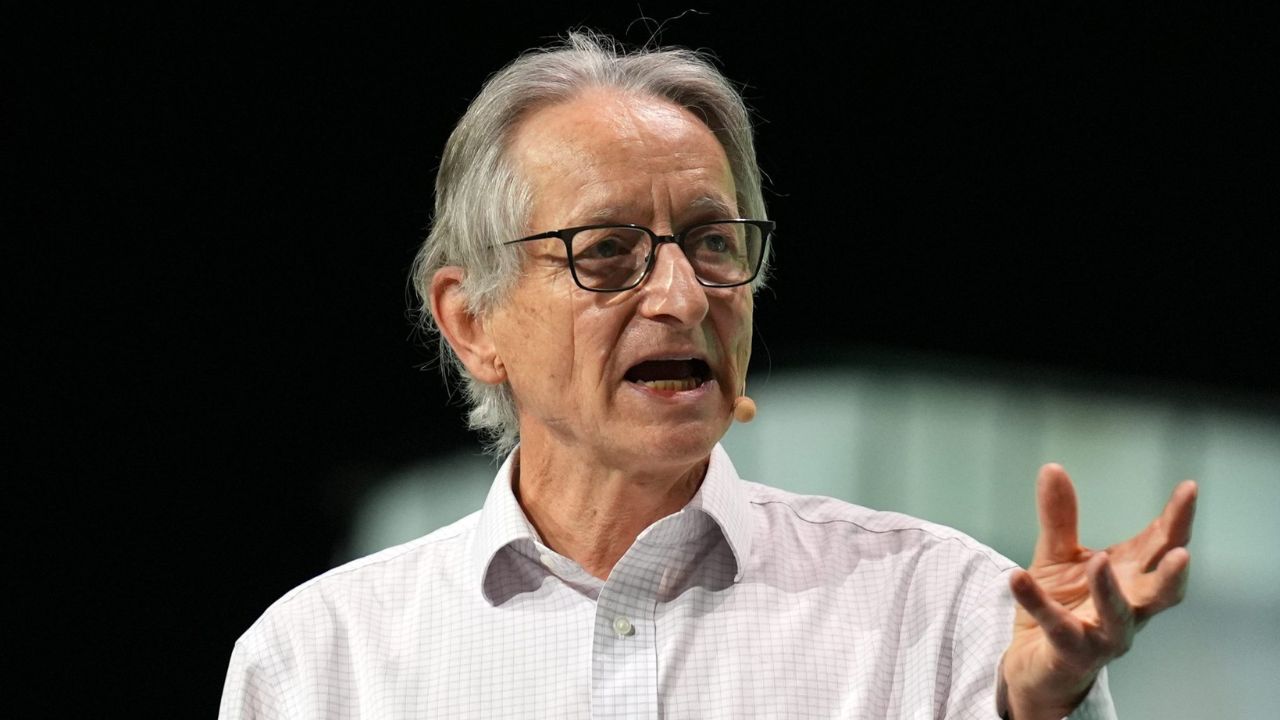
CEOs and experts agree that AI is creating a new world of work, but many are starkly divided on what it’ll look like. As AI agents and robots enter the picture, the pioneering computer scientist dubbed the Godfather of AI, Geoffery Hinton, has predicted one industry will be safe from the potential jobs armageddon: healthcare.
“They’re much more elastic,” Hinton explained yesterday on the Diary of a CEO YouTube series.

“If you could make doctors five times as efficient, we could all have five times as much health care for the same price,” he continued. “There’s almost no limit to how much health care people can absorb—[patients] always want more health care if there’s no cost to it.”
The Nobel Prize–winning scientist is one of many experts who anticipate that health care will be buoyed in this digital transformation—but many others won’t be so lucky.

Hinton believes that jobs that perform mundane tasks will be taken over by AI, as roles like receptionists and customer service representatives are already vulnerable. That, Hinton predicted, will wipe out a high number of roles right off the bat: “You’d have to be very skilled to have a job that it couldn’t just do.”
Most jobs will be replaced by tech, and only the ‘skilled’ will stay employed
Tech leaders with rosy lenses like Jensen Huang contend that humans won’t be replaced by AI, but rather their AI-enabled coworkers will take their jobs. But the Godfather of AI thinks that’s too optimistic.
“There are jobs where you can make a person with an AI assistant much more efficient, and you won’t lead to less people, because you’ll just have much more of that being done,” Hinton said. “But most jobs are not like that.”
He concluded that AI will likely lead to companies needing far fewer workers and that the new technology’s impact can’t be compared to previous technological advances that created an explosion of new jobs.
“This is a very different kind of technology. If it can do all mundane human intellectual labor, then what new jobs is it going to create?” Hinton said. “You’d have to be very skilled to have a job that it couldn’t just do.”
It isn’t just leading scientists, CEOs, and workers ringing the alarm bells—even major consulting firms and banks are projecting a bleak labor market. McKinsey predicted that by 2030, 30% of current U.S. jobs could be automated; Goldman Sachs projected that up to 50% of jobs could be fully automated by 2045, driven by generative AI and robotics.
Other CEOs agree that health care jobs are safe from AI disruption
It’s been estimated by leaders like Anthropic’s CEO that nearly half of entry-level white collar jobs are on the chopping block thanks to AI—and Klarna’s CEO admitted that “a lot of the jobs are going to be threatened.” But many health care roles will be safe and sound.
Health care is a key industry expected to thrive amid the U.S.’s digital workplace disruption, according to a 2024 report from McKinsey. AI still can’t perform a majority of tasks that health care workers can—like sterilizing surgical equipment, or administering at-home aid.
Plus, there’s something much more comforting about a human handling your medical care over a cold, metal robot. Demis Hassabis, the CEO of Google’s AI research lab DeepMind, also echoed Hinton’s prediction that health care workers will be optimized—but not fully replaced—by AI. The tech executive believes the tools will help us cure disease, and create “superhuman” productivity. But people will still be at the heart of medical care.
“There’s a lot of things that we won’t want to do with a machine,” Hassabis told Wired in a recent interview
Written by Emma Burleigh for Fortune as “The ‘Godfather of AI’ says this sector will be safe from being replaced by tech—but even then, only the ‘very skilled’ will hold down a job” and republished with permission.