About This Episode
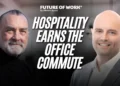
The office space crisis is not just about vacancies — it’s about evolution. In this episode of The Future of Work® Podcast, we welcome Andrea Pirrotti-Dranchak, Head of Real Estate, Americas at infinitSpace and one of the world’s leading authorities in flexible workspace.
With over 25 years of experience driving innovation in real estate across 65+ countries, Andrea joins host Frank Cottle to unpack the growing misalignment between traditional commercial real estate and the needs of today’s occupiers. From shrinking lease terms to hybrid demands, and suburban growth to the economics of amenities, Andrea delivers hard truths, fresh strategies, and a clear-eyed call for a flexible, user-first future of space.

This episode is a must-listen for landlords, brokers, occupiers — and anyone reimagining the workplace.
About Andrea Pirrotti-Dranchak
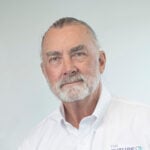
Globally recognized as a leading authority in flexible workspace, Andrea Pirrotti-Dranchak has 25+ years of experience driving expansion and innovation across 65+ countries. As Head of Real Estate, Americas at infinitSpace, she leverages the flexible workspace model to unlock asset value and transform how real estate performs. A trusted voice in the future of work, she advises, writes, and speaks on strategies that define and scale this fast-moving industry.

What You’ll Learn
- Why product–market fit is failing in commercial real estate
- The data behind reduced space demand and shorter leases
- Why landlords must learn from other industries to adapt quickly
- How flexible workspace partnerships can future-proof assets
- The hidden financial friction keeping cities and buildings stuck
- Why converting office buildings to live-work hubs may be key
- How historical city planning shows us the future of work-life design
- The cultural and economic forces driving suburban flex growth
Transcript
Andrea Pirrotti-Dranchack[ 00:00:00 ]Used to be that less than 1% of knowledge workers could make a workspace-related decision. That fact has changed. Every single person who reports to the office has the ability to make a workspace-related decision as to where they’re going to go. And regardless of whether there’s a return to office mandate, if going into an office is not compelling, it’s not going to happen. They’re going to leave and they’re going to go work somewhere else.
Frank Cottle[ 00:00:26 ] Andrea, welcome to the Future Work podcast. Gosh, it’s great to have you back. Really enjoyed chatting with you last time.
Frank Cottle
[ 00:00:34 ] What background do you have? You’ve worked with every major, not every major, but a lot of the major flexible workplace companies across the industry throughout your almost 30 years of experience.
Frank Cottle
[ 00:00:48 ] You’re rolling your eyes like I shouldn’t have said 30 years.
Frank Cottle
[ 00:00:53 ] But I’m really interested. You and I have discussed in the past, and I think there’s a disconnect between the product that property companies, building owners are building.
Frank Cottle
[ 00:01:07 ] and the needs of the tenants, whether they’re flexible workspace operators or tenants in general.
Frank Cottle
[ 00:01:14 ] What is your thoughts on that?

Andrea Pirrotti-Dranchack
[ 00:01:18 ] Yes, and you know, Frank, and I love riffing with you, and especially you, I always say that you ignite my brain on many different levels, and I’m expecting some probing questions from you today. This one is a good one. No question. I’m a marketer at heart, right? And so when I think about where we are at this point, 20 years ago, I said that the current logic of real estate is dead. And it was probably a concept. before it’s time.
Andrea Pirrotti-Dranchack
[ 00:01:53 ] But there is no question that the product from a commercial real estate standpoint, from an office standpoint, the product that is on the market is incongruent and not necessarily serving the needs of the consumer. The consumer being enterprise customers who are grappling with the fact that their long-term leases that they were banking on are hurting their business because only 40% of their people are.
Frank Cottle
[ 00:02:31 ] showing up and so literally it’s draining millions of dollars a year for a large user well it creates a lot of debt on their balance sheet too that’s not necessary and that restricts their growth overall as a company which in case a point challenges the security of the very employees that are there
Frank Cottle
[ 00:02:52 ] Well, it does.
Andrea Pirrotti-Dranchack
[ 00:02:53 ] And in no world do you have a portfolio that is filled with fixed long-term commitments.
Andrea Pirrotti-Dranchack
[ 00:03:08 ] There is no way that an enterprise customer, even a small to midsize customer, or even a solopreneur can forecast out with an appropriate degree of certainty how much space.
Andrea Pirrotti-Dranchack
[ 00:03:23 ] they’re going to need. And we all know that facilities is the second largest fixed line item for any company behind people. And when that decision is flawed or wrong, you put a stranglehold on the business. And we’ve seen this through ebbs and flows over the last.
Andrea Pirrotti-Dranchack
[ 00:03:46 ] two and a half decades that I’ve been in this category.
Frank Cottle
[ 00:03:48 ] Over the last two and a half thousand years. I mean, the concept of a landlord, it comes probably from the Middle Ages when the Lord owned the land and everybody had to deal with. That person in that situation, uh, so I think the whole structure is a bit anachronistic. Uh, overall, but so we’re talking not just about design and amenities, facility changes, things that people want may or may not be willing to pay for, but we’re also talking about the structure of transactions between the two parties. We’ve seen a reduction in terms of lease in most markets over the last 25 or 30 years. It’s slowly, but some markets like Hong Kong, you know, you have a five-year lease, a three-year lease sometimes. The tenant, though, is required to do all the improvements on the space.
Frank Cottle
[ 00:04:51 ] So the tenant is actually at risk for the short-term lease. there so that’s a where it’s gone too far balance wise in one one area uh then in places in europe you have still have 10 and 15 year leases where the tenant’s 100 responsible for all the maintenance on the building and it might be a 200 year old building So things are out of balance right now a little bit. How do we correct that? What have you done?
Andrea Pirrotti-Dranchack
[ 00:05:17 ] Yeah, well, occupiers or the consumers of this product are pushing back. And we’re seeing, to your point, that lease terms have reduced from, on average, 10 years to seven years. And we’re also seeing that the amount of space that they’re taking. overall has reduced by 33%. And so there is a pushback and there is some response by… the product suppliers, if you will, or the landlords who are adapting their spaces and including spec suites, for example, that enable smaller term space and enable shorter term agreements. And that’s interesting. You know, I’m not going to touch flex space right now because that’s a whole different beast. But I think that there is some response and some recognition. On the flip side, in markets like San Francisco and other markets that are similar, where there are soaring.
Andrea Pirrotti-Dranchack
[ 00:06:22 ] Vacancy rates and you hear from brokers that their clients are the landlords are still holding out and are bullish on holding out for traditional long-term leases. And it doesn’t make sense.
Frank Cottle
[ 00:06:36 ] If the property company leases the space at a new lower rate, then their building is devalued. If they sit on the empty space and say it’s worth X, then the building isn’t revalued. And the difference is that they don’t have to come up with the capital covenant on the revaluation if the space is empty. So in many cases, they’re better off holding the space empty for a while, trying to get that fantasy lease. And in some cases, they actually get it, of course, because that building doesn’t get revalued.
Andrea Pirrotti-Dranchack
[ 00:07:10 ] Well, you always follow the money, right? You always follow the money as to why there’s a stagnation in the evolution of…
Andrea Pirrotti-Dranchack
[ 00:07:20 ] in real estate. And that is exactly why. One of the core reasons. Layering onto that is that you have decision-makers on the side of ownership who are fearful of recommending or, you know, suggesting an alternative solution to the long-term lease. And of course, you have brokers who are wondering how this is going to affect their livelihood and will they get a market commission for an alternative solution.
Frank Cottle
[ 00:07:58 ] Damn brokers. No, yeah. No, a broker makes a 70% commission on a 70-year lease that they get on a 10-year lease. So actually, they’re going to oftentimes suggest that the landlord hold out for the longer lease. It impacts them overall.
Frank Cottle
[ 00:08:18 ] The challenge, I guess, is how, when somebody builds a building— let’s say it’s a large building in a central business district of a major market— let’s say it’s a million square foot building— and their tenants are reducing the space.
Frank Cottle
[ 00:08:35 ] That they’re taking because of changes in the workplace, hybrid officing, remote work, flex officing, all the things that have been occurring pre and now post pandemic have been accelerating.
Frank Cottle
[ 00:08:48 ] So they have the same number of tenants, but the tenants are taking smaller space. Who fills that gap so that the building can economically make adjustments to the structure? Or is it a trap that they just can’t do anything about?
Andrea Pirrotti-Dranchack
[ 00:09:05 ] Well, I think that they have to. The writing is on the wall that they have to do something about it. Because if you look at all the classical drivers of change, if you look at technology, which is enabling people to work everywhere and anywhere, if you look at government rules and regulations that are opening up because of COVID. And because people were working remotely, that enable tax relief, if you will, or adjustments to taxes for people to work out of state. If you look at social norms, it used to be, my gosh, when I was at Ernst & Young. You were ranked by how close you were to the window and the size of your office and whether you had an office, right? So those social norms are changing.
Frank Cottle
[ 00:09:47 ] I want to point out, when I was at Deloitte, I had a corner.
Andrea Pirrotti-Dranchack
[ 00:09:51 ] Did you? I was there early on in my career. And because I was going for my MBA, I got to sit in a partner office shared closer to the window. That’s how nuanced I got.
Frank Cottle
[ 00:10:05 ] They have to change.
Andrea Pirrotti-Dranchack
[ 00:10:07 ] True.
Frank Cottle
[ 00:10:08 ] And it’s funny.
Frank Cottle
[ 00:10:11 ] I think that one of the things that people have to look at when they consider property is employment structures and look at how many companies are hiring.
Frank Cottle
[ 00:10:26 ] Entry-level personnel to do entry-level jobs, Gen Z to do entry-level jobs, versus hiring an AI bot. Okay, and I’ve never seen a bot sitting at a desk.
Andrea Pirrotti-Dranchack
[ 00:10:41 ] No.
Frank Cottle
[ 00:10:41 ] Okay. So when we look at the replacement of employees, not just the remote work or hybrid work of employees, but the actual emplacement of employees, then we also have to rethink of the building designs and building this and that utilization density.
Frank Cottle
[ 00:11:00 ] And if density drops, revenues drop. If revenues drop, it’s harder and harder to support the amenities that so many people are crying out for within large buildings and do it economically. Somebody’s got to pay for that. So how do you rectify those two things?
Andrea Pirrotti-Dranchack
[ 00:11:22 ] Well, I just want to double down on what you just said, because it just occurred to me, is that from an AI standpoint, and as AI replaces those lower-level entry jobs, to your point, they those are the people who have to show up to the office every day, and they’re not anymore. So the knowledge workers—right, the senior-level people— are the ones who are working remotely anyway, and so all of a sudden, your total addressable market for these landlords has really significantly diminished. And so to your point, that’s a really incredible point. So the addressable market has changed. The product that occupiers or the buyers want has changed. And so, how do you cost-effectively and efficiently evolve this? And so, I always look to categories that have already been established, right? Why reinvent the wheel? And so, landlords are already engaging with gyms, restaurants, to add amenity, to add vibrancy, to add nuance, or points of differentiation to their…
Andrea Pirrotti-Dranchack
[ 00:12:35 ] their building or to their asset, to accommodate their occupiers. So, you know, just draw upon that. And how do you extend that to to other ways to welcome and support all different product needs into your building?
Frank Cottle
[ 00:12:55 ] Well, I think that works in a high-density central. That’s mid-Manhattan thinking, central London thinking, downtown Chicago thinking. What about when you’re in Chicago, you go out to Naperville? What about you go out to Geneva? You go into the smaller suburban markets where the people, an awful lot of the people that are commuting into these larger markets live and aren’t working anymore. Where the buildings are smaller, 25, 50, 100, 200 ,000 square feet instead of a million square feet. And those buildings don’t have the capacity to add a restaurant as a tenant, because that’s what the larger property is. They’re not doing it for free. They’re adding them as a tenant. They’re adding the gym as a tenant. It still becomes an amenity to the building.
Frank Cottle
[ 00:13:47 ] That doesn’t exist, and about 70% of all commercial office space is not in central business districts.
Frank Cottle
[ 00:13:55 ] So how do you balance that out as a total program?
Andrea Pirrotti-Dranchack
[ 00:14:01 ] this just a downtown central business district cure and then we’ll let everything else we’ll worry about everything else later well i think that there are different um i think there is a cure right for downtown i think that’s absolutely right um i always love to refer to 22 bishopsgate where they have know the core building and then they have the they’ve created a vertical village and an ecosystem and they’ve um done that through management that’s in london you’re referring and that’s in london it’s actually the tallest occupied building in all of Europe, I believe. The shard beats it because of the sphere.
Andrea Pirrotti-Dranchack
[ 00:14:37 ] And they’ve done that incredibly well, and it’s a very vibrant environment.
Frank Cottle
[ 00:14:44 ] How many square feet? What’s the square footage, or what’s the square measure? It’s, it’s, I can’t, it’s very large, it’s about a two and a half million square foot project, it’s very large, so when you so, how do you adapt that, literally, if I can, can interrupt it, literally, has as much square footage of that one building as a lot of mid-sized, smaller cities have.
Andrea Pirrotti-Dranchack
[ 00:15:06 ] Yes. And so, what if you were, again, I’m just re-imagining this and I’m thinking on the fly right now. First of all, there was a building that I’m looking at in suburban Atlanta, and they have re-imagined this asset, and they in suburbia have put in a restaurant and a gym. And it is just, it is a go-to destination. But that’s to your point. It’s not, it’s not, it’s not that’s not commonplace. And so, you don’t want to, the idea of adding these amenities is to increase NOI, right? To increase the value of the asset, not to take away from the space that could be monetized in a different way that may bring greater value to the building. And so. Maybe there’s ways of partnerships so that you’re extending your offering beyond the four walls of the asset. Or maybe there’s ways to, again, bring in through retail type or management type agreements or franchising, quite frankly.
Andrea Pirrotti-Dranchack
[ 00:16:14 ] these smaller companies into the building to provide a greater variety of vibrancy or resources or amenities.
Frank Cottle
[ 00:16:28 ] You know, at one time, IBM joint ventured with a lot of property companies. This is in the late 80s, if I’m remembering correctly. They would take a major chunk of a major building along with equity in the building. Um and caused the building itself to have all of the corporate amenities they wanted as if they were building their own campus. But those amenities were open to the entire building because they had a piece of the building they had a vested interest in doing that. If property companies were to work closely with their anchor tenants and reaffect that type of structure, I think that would have an impact on the types of amenities that and the types of offerings they could make. But it would take a big commitment a capital commitment on the part of the partner, the corporate partner, which they may or may not be willing to make. That didn’t work out well for IBM, by the way, because the market changed and all of a sudden the asset on their balance sheet turned to a liability and they had to get rid of the space.
Frank Cottle
[ 00:17:38 ] So because of the change in the real estate market that had nothing to do with their business.
Frank Cottle
[ 00:17:43 ] Um uh, so this is a risk that an occupier in that structure that that situation has to consider. But do you think property companies should look more at the campuses and the structures that their major tenants are building for themselves? Look at the amenities they put in for their employees there and try and replicate that within their buildings. How do you think that should happen?
Andrea Pirrotti-Dranchack
[ 00:18:10 ] I think that’s right. I think that there’s what occupiers are— how they are constructing their workplace to meet and adapt to the needs of their team members— is important. We always say that it should work. Where you work should enable work, but it would in an ideal world, it would enhance work. So you would hope that these enterprise companies have the resources and the wherewithal to create environments that enhance work. And so, for landlords to look to their occupier partners, to look to these enterprise customers, and to inform the evolution of their asset based on what they feel will enhance the work of their people is important.
Andrea Pirrotti-Dranchack
[ 00:19:12 ] You want to have purpose-filled space. You want to have spaces that enable people to…
Andrea Pirrotti-Dranchack
[ 00:19:20 ] connect that’s meaningful, that gives purpose to coming into the office. And really, it doesn’t require a complete revolution of the space. I think that there are opportunities to evolve the offering.
Andrea Pirrotti-Dranchack
[ 00:19:39 ] Because when you look at these, ultimately, we’ve got these fixed assets. They’re brick, they’re mortar, they’re sturdy, they’re solid, they’re fixed. And so how do you evolve the offering within these fixed assets? You can’t revolutionize the offering.
Frank Cottle
[ 00:19:58 ] I disagree with you, by the way. I think it has to be revolutionary.
Frank Cottle
[ 00:20:04 ] We need to build cities within cities.
Frank Cottle
[ 00:20:12 ] So villages within cities, in my opinion. And let’s take putting a gym in a building as an amenity.
Frank Cottle
[ 00:20:23 ] Most of the gyms that I know, their biggest occupancy hours are between 5:30 and 7:30 in the morning and 5:30 and 8 o’clock at night. Those are not working hours when people want to be in their office buildings still.
Frank Cottle
[ 00:20:39 ] Most restaurants I know of that are successful serve lunch and dinner or breakfast, lunch and dinner. Nobody wants to go to dinner in their office building. And without that.
Frank Cottle
[ 00:20:50 ] category of income, a restaurant in itself is really just a lunch deli. And so a lot of the amenities that we talk about putting in are amenities where it requires a resident population.
Frank Cottle
[ 00:21:08 ] So I’m much more in favor of saying a building that is only able to achieve economic occupancy of 60 or 70 percent of its space at a good value for office building use should take that other 30 or 40 percent and convert it to residential. that has 24-hour occupancy as opposed to eight or nine-hour occupancy. And that is a trend that revitalizes all the businesses and the amenities, or excuse me, all the businesses and the neighborhood within which the building sits. I’m a big fan of… converting cities, not just amenitizing buildings. So if you look at Hudson in New York. The reason its office buildings are successful is because all the residential that’s been built in and around it also.
Frank Cottle
[ 00:22:07 ] If we want to stop commutes, we have to, or reduce commutes and have people work and live in the same place, we have to be thinking that way. And I think that if you look at London, central London is… The biggest problem in London is a reduction of office space as a result of it was economically more effective to convert it to residential.
Frank Cottle
[ 00:22:30 ] So there’s all these things going on, not just in space design and terms, but in city design.
Frank Cottle
[ 00:22:38 ] that is going to impact the way we work in the future and i think that has to be considered carefully as well so that’s that’s my story i’m sticking to it i’ve been saying it for 10 years and how the property companies react to that though How do they recapitalize, restructure themselves? And it’s usually not the developer. The developer is usually crazy, happy to do anything that’s cool. It’s usually the financial institution that capitalized the developer is where the stagnation is. It’s the insurance company that gave the property company the money to build the building. The property company is hamstrung. I can’t do these changes because of the structure of their own capital. All you can do is nod at that. I know I went on a little rant.
Frank Cottle
[ 00:23:31 ] I really think this is the issue. I really think this is the issue.
Andrea Pirrotti-Dranchack
[ 00:23:35 ] No, it’s true. Well, I think, I know, listen, I think, yeah, you’re 100% correct. And I actually, you know, as far as I’ve been doing this, right, we tried. Two and a half decades ago, we embarked on a joint venture with a long-term stay company to make an effort to combine people who travel with work, with their workplace.
Andrea Pirrotti-Dranchack
[ 00:24:06 ] I did a deal with a new build that has coworking and apartments within the one building. And I do wonder.
Andrea Pirrotti-Dranchack
[ 00:24:22 ] I have to question that because I would not personally, and I’m just going to take my personal, it’s all about me. I’m going to take my personal preference.
Andrea Pirrotti-Dranchack
[ 00:24:31 ] Well, everything that you said makes a lot of sense. The dinner, I’m not going to go back to my office building to have dinner. I might stay late to have a business dinner, but I’m not going to bring my family there. I’m not going to, if I’m going out.
Frank Cottle
[ 00:24:43 ] The restaurant can’t survive on lunch alone.
Andrea Pirrotti-Dranchack
[ 00:24:46 ] No, the restaurant can’t survive on lunch alone. But the thing is.
Andrea Pirrotti-Dranchack
[ 00:24:51 ] Is that, do we want a harder line between work and personal? Do I want to wake up, take an elevator to… you know, to my office and take an elevator to where I’m going to go to dinner and then go down to the gym.
Frank Cottle
[ 00:25:09 ] It doesn’t necessarily have to be the same building, by the way. And if you look at London, New York, Chicago, people live downtown and walk six blocks to their office or 10 blocks to their office. That’s right. cycle to their office, things of that nature. So you don’t have to live, work, eat, shop in your one building.
Frank Cottle
[ 00:25:32 ] Buildings that offer that capability overall revitalize the city and reduce the…
Frank Cottle
[ 00:25:44 ] 8-hour, 12-hour city syndrome of commuters overall. And that means there are more amenities, more services within the city itself. They’re more vibrant. That makes the city more desirable and makes the workplace more desirable also.
Frank Cottle
[ 00:26:00 ] Most people would like to be able to cycle, walk, or take very short public transportation to their workplace.
Andrea Pirrotti-Dranchack
[ 00:26:12 ] Well, and I think that, this, really doubles down with all work. I did an article with the headline of: ‘Are the CEOs who are mandating return to office actually the good guys or the good people?’
Andrea Pirrotti-Dranchack
[ 00:26:32 ] And so the idea, though, is that when you have these cities that are actually so reliant upon the office.
Andrea Pirrotti-Dranchack
[ 00:26:44 ] the office real estate to bring that vibrancy, to bring that footfall, to fuel the local restaurants and flower shops and tailors or dry cleaners. When those people aren’t showing up to work, we are seeing the results.
Frank Cottle
[ 00:27:02 ] Exactly. It’s devastating.
Andrea Pirrotti-Dranchack
[ 00:27:05 ] And so I think you’re right. Having that more holistic mix of live, work, play, if you will, within a certain radius makes a whole bunch of sense. a more vibrant community.
Frank Cottle
[ 00:27:24 ] Well, that’s the way cities developed originally.
Andrea Pirrotti-Dranchack
[ 00:27:26 ] Of course.
Frank Cottle
[ 00:27:28 ] You know, live work started with a shop on the bottom floor on the street level and an apartment above.
Frank Cottle
[ 00:27:39 ] a trades person of some sort. Before that, you lived above the cows that lived down on the first floor. So live work has always been around and that’s how cities were built.
Frank Cottle
[ 00:27:52 ] So I don’t think that’s going to change. But I guess that how do we get the needs of the occupiers?
Frank Cottle
[ 00:28:05 ] Translated through the property companies that have massive investments from financial institutions, how do we affect change in a manner that can impact an entire city or an entire way that we work, fast enough to not have big holes in the whole process?
Andrea Pirrotti-Dranchack
[ 00:28:29 ] Yeah, and certainly that’s what I grapple with because when I think of the writing on the wall with all the classical change drivers that are compelling this change, right? Compelling. You know, in terms of where, when, how people work, who’s going to work, all of that stuff. But then I think of all the friction that’s on the other side of enabling and supporting this change.
Andrea Pirrotti-Dranchack
[ 00:29:00 ] It’s very challenging, which is why I say that this has to be, number one, we have to be informed by other categories, right? When you look at the evolution of Blockbuster and then to Netflix home delivery and then to Netflix streaming, or if you look at the evolution of the record industry, where it used to be the record companies had complete control over the content that was being distributed. And then you have Napster that ultimately went out or it’s having revitalization. And then you had music going, streaming music going directly to the end user, putting the power in the hands of the end user. Our category is the same. It used to be that less than 1% of knowledge workers could make a workspace-related decision. That fact has changed. Every single person who reports to the office has the ability to make a workspace-related decision as to where they’re going to go. And regardless of whether there’s that return to office mandate, If going into an office is not compelling, it’s not going to happen.
Andrea Pirrotti-Dranchack
[ 00:30:03 ] And they’re going to leave and they’re going to go work someplace else. And so there are so many change forces driving this change. But how do we get, to your point, the capital markets? How do we get? The landlords, how do we get all these brokers aligned to support, enable that change, which is why I say a revolution is required. I agree with you, but I don’t think that a revolution will be enabled. I think it has to be slow and methodical changes. I also think, I’ll end with this, is that it has to be moved off of the pages of the property publications and it has to be moved into the general business discussion.
Andrea Pirrotti-Dranchack
[ 00:30:52 ] This is a general business discussion. It has to be moved from the commercial real estate, head of commercial real estate into the overall general business and be addressed by, has to be addressed by HR, it has to be addressed by the CFO, the COO, the head of technology, the head of property. The silos of this decision-making process have to be broken down in order to affect this change as well.
Frank Cottle
[ 00:31:16 ] The CEO of a major company, any company, any industry, one of their primary goals is we always want to have the best people.
Frank Cottle
[ 00:31:29 ] We have to have the best people in order to compete and in order to win in our industry, whatever the industry is. So the battle for talent is the massive driver.
Frank Cottle
[ 00:31:42 ] Randstad, who is the largest human resources management company in the world, would tell us that they do tell us, that they get a five times return on applications when they include the word ‘remote,’ ‘hybrid,’ ‘flexible work,’ et cetera, in the job description.
Frank Cottle
[ 00:32:01 ] So five times as many people are seeking one of those things or all of those things in their new employment structure. And that says downtown is dead.
Frank Cottle
[ 00:32:15 ] Okay. So downtown has to redevelop itself, which means cities have to allow for this. Government has to allow for this. Tax structures have to be reconsidered for this, et cetera, et cetera. It’s not just the property companies and the investors behind them. It’s a holistic approach to the redevelopment of the way we work and live.
Frank Cottle
[ 00:32:42 ] And if that’s going to occur, it’s going to take more than a revolution. It’s going to take almost a complete DNA gene pool change. We’re going to go through a full Darwinistic adjustment of those that are adaptable will survive and those that are not adaptable will not survive. And I think that’ll be true of cities as well. If you go back through history, thousands of years, certain cities evolved. famous cities famous cities go go back thousands of years and then disappeared for some reason the water changed the people changed the trade route changed the some something happened and that that city just stopped existing will that occur today probably not because of the densities we have but the desirability of the cities and the economics of all that has to work together and it really comes down to the economics ultimately can people is it worth investing in buildings of this nature in downtown central business districts today.
Frank Cottle
[ 00:33:48 ] And you and I know that the flexible workspace industry, which is considered to be one of the major tenants now in the world, has moved to the suburbs.
Frank Cottle
[ 00:34:00 ] Know the most of the growth is in the secondary and tertiary markets and that tells us that’s where people want to be. That’s where people are, etc. So cities are going to have quite a challenge if they don’t meet this amenity-rich environment, culturally. I want to live in Manhattan because of the culture. It’s kind of a scary thought when you think about it, but at least to me.
Frank Cottle
[ 00:34:25 ] I like the pizza though.
Frank Cottle
[ 00:34:29 ] But these things all have to be considered.
Frank Cottle
[ 00:34:34 ] I’d like to say I have a solution or have an idea of the solution, but I really don’t.
Andrea Pirrotti-Dranchack
[ 00:34:38 ] Yes, I don’t either. My only solution is to chip away with it a little bit at a time.
Andrea Pirrotti-Dranchack
[ 00:34:45 ] And, you know, the writing is on the wall, though. When you look at 40 percent. Footfall, 40% of the people are showing up, there is going to be this extraordinary rippling effect that’s going to happen.
Andrea Pirrotti-Dranchack
[ 00:35:01 ] If you take, if you just take, you know, some of the top occupiers who have a million people who are showing up to offices every day and they start to rebalance their portfolio and they start to include flexible workspace solutions into their portfolio.
Andrea Pirrotti-Dranchack
[ 00:35:22 ] There will not be enough flex around the world to support that demand. And there is a product market fit issue because landlords are not going to be able to satisfy that demand.
Frank Cottle
[ 00:35:36 ] Agreed. Agreed completely.
Andrea Pirrotti-Dranchack
[ 00:35:37 ] And their buildings are going to sit empty. And these leases are just going— you know, the sublet, the shadow space, all that stuff— it’s just going to, you know.
Frank Cottle
[ 00:35:52 ] Let’s leave this to next time. And I’m going to make a bold statement. It’s a solution to empty office space in conventional commercial buildings that were previously occupied by conventional tenants, particularly large institutional tenants. The solution to that occupancy is to replace that space with flexible workspace. Flexible workspace meaning business centers, co-working centers, serviced offices, etc. And to allow that type of enterprise to replace the… I don’t know whether people will buy off on that or not, but I think that’s a contribution to the solution that we all need to consider.
Andrea Pirrotti-Dranchack
[ 00:36:45 ] Well, it very clearly is, and I’ll just end with this, is that over the course of time, when you look at these assets, they have outsourced. their restaurants, they have outsourced their gyms, they have outsourced the cafe and all the other amenities because it is not their core competency. It’s not what they have done. And they’re trying to find the solution for short term. and smaller spaces through spec suites. But when you do the numbers, the spec suites don’t pencil out for the asset owner. They don’t pencil out for the landlord. And so the idea of bringing in a flex partner— and doing it in a partnership way— makes sense. And even though, when you map it out in the performer, when you build the business case and the economics are over the top compelling, there remains resistance because of all this friction that’s getting in the way.
Frank Cottle
[ 00:37:43 ] block the change and so that is something that i would very much look forward to speaking with you again uh in the future about is how do you overcome that friction in order to in order to progress the evolution of these assets that friction comes from the financial institutions not from the property companies So that’s where as an industry, as a flexible workspace industry, we need to start working, I think, to cause the economic conversion to occur. Andrea, thank you very, very much. It’s a pleasure speaking with you as always. Look forward to exploring these and other thoughts in the future again sometime. And I’m very grateful to you for all that you’ve done for the flexible workspace industry. And we’ll look forward to it.
Andrea Pirrotti-Dranchack
[ 00:38:34 ] Thank you, Frank. It’s a pleasure.
Frank Cottle
[ 00:38:37 ] If it’s impacting the future of work, it’s in the Future of Work podcast by allwork .space.