

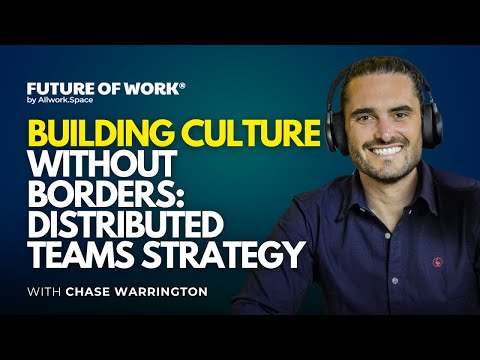
In a recent episode of The Future of Work® Podcast, Allwork.Space spoke with Chase Warrington, Head of Operations at Doist — the company behind popular productivity tools Todoist and Twist. With over 15 years of experience scaling remote operations across six continents, Chase shared how Doist built and continues to evolve a high-performing, location-independent team spanning 35+ countries.
From their approach to asynchronous work and flat hierarchies to their methodical planning systems and global retreats, Warrington outlined a comprehensive model for managing distributed teams that runs counter to many return-to-office narratives.

From Remote-First to Culture-First
Doist has been fully remote since its founding in 2012. What stands out, however, is not simply that they operate without a central office, but that the entire organization was designed from the beginning around that structure.
Warrington emphasized that distributed work was never treated as a temporary workaround. Instead, the company used it as a foundation to develop culture, define communication norms, and rethink what team autonomy could look like.

Their team now spans every time zone, with employees working asynchronously by default.
This structure, Warrington explained, doesn’t eliminate the need for culture, but rather reshapes how culture is created and sustained.
Flat Hierarchies and Distributed Decision-Making
One defining aspect of Doist’s operating model is its flat hierarchy. Inspired in part by the company’s Danish roots, decision-making is pushed down to teams, not held at the top.
New hires, Warrington said, are often surprised to find that asking for permission is discouraged. Instead, individuals are expected to take initiative and act without waiting for approval. The system is built around the idea that distributed work requires logistical planning as well as trust, clarity, and shared context.

Doist structures its work in small, cross-functional “squads,” typically consisting of four to six people. These squads work within quarterly cycles toward specific goals, largely autonomously. Company-wide direction is set by leadership, but execution is decentralized.
Rethinking Communication Norms in a Distributed World
A recurring theme in the podcast conversation was the critical role of communication. At Doist, remote communication is treated not as an afterthought, but as a core competency.
Each employee is introduced on day one to a set of communication principles: assume responsibility, share context, document decisions, and move quickly. These guidelines help mitigate common distributed work challenges — such as silos, slow responses, or duplicated efforts.
Intentional communication, Warrington noted, is about designing systems where transparency and information flow are defaults — not exceptions.
Strategic Planning Without Offices
Warrington also shared how Doist handles strategic planning across global teams. The company developed its own internal system, dubbed the “Do System,” to coordinate projects from idea to execution.
Each quarter, leadership defines broad objectives. Small squads then set their own goals that ladder up to those objectives, working in short “cycles.” Accountability is measured through outcomes, not presence.
This approach allows the company to maintain both alignment and flexibility — two elements often seen as mutually exclusive in traditional management.
Learning at Work, Not Outside of It
Another facet of Doist’s model is its approach to professional development. Rather than viewing learning as something that happens outside of work, the company builds it into regular operations.
Employees are given time during their workweek to develop skills and explore new tools, including how artificial intelligence can support their roles. Internal knowledge-sharing helps keep learning collective, not siloed.
This model encourages skill growth as well as recognizes that competitive advantage comes from the pace at which a team learns, not just what it already knows.
In-Person Moments, Crowdsourced Strategy
Despite being fully remote, Doist still incorporates in-person interaction through leadership retreats and occasional team gatherings. But these are structured intentionally.
Last year, the company’s leadership team gathered in Paris to map out strategic goals — but only after crowdsourcing ideas from every employee. That input was distilled and integrated into the planning process, increasing buy-in across the organization.
Rather than asking how to replicate the office in digital spaces, Doist designs in-person experiences as focused, high-impact events.
Why This Model Matters Now
Warrington’s insights arrive at a time when many organizations are still navigating tensions around remote and hybrid work. The case of Doist is a signal that multiple models are viable.
What stands out is not that Doist has the “best” approach — but that its operating model is deliberate, tested, and evolving. Rather than clinging to legacy systems, the company continues to experiment with new workflows, adapt rituals, and simplify complexity.
As more companies rethink their relationship with location, culture, and flexibility, the tools and tactics used at companies like Doist offer useful insights. They point to a future where leadership is decentralized, work is asynchronous, and learning is built into the job — not added on top of it.