



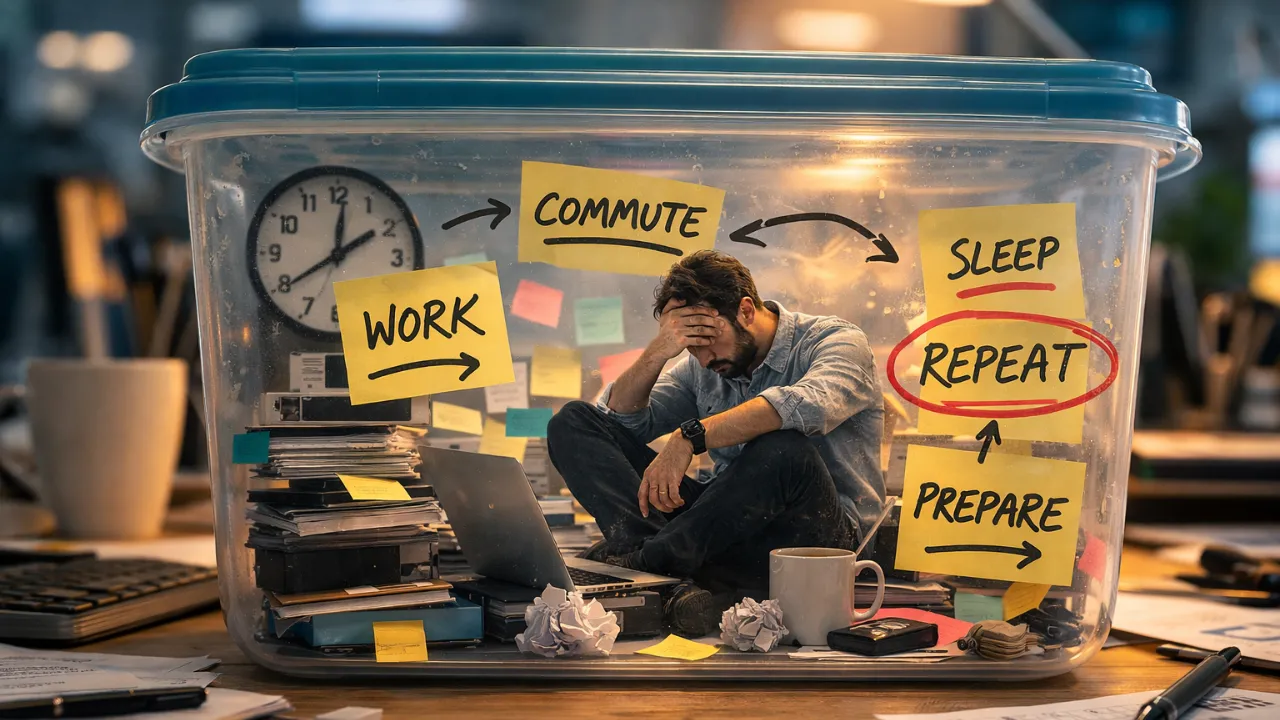
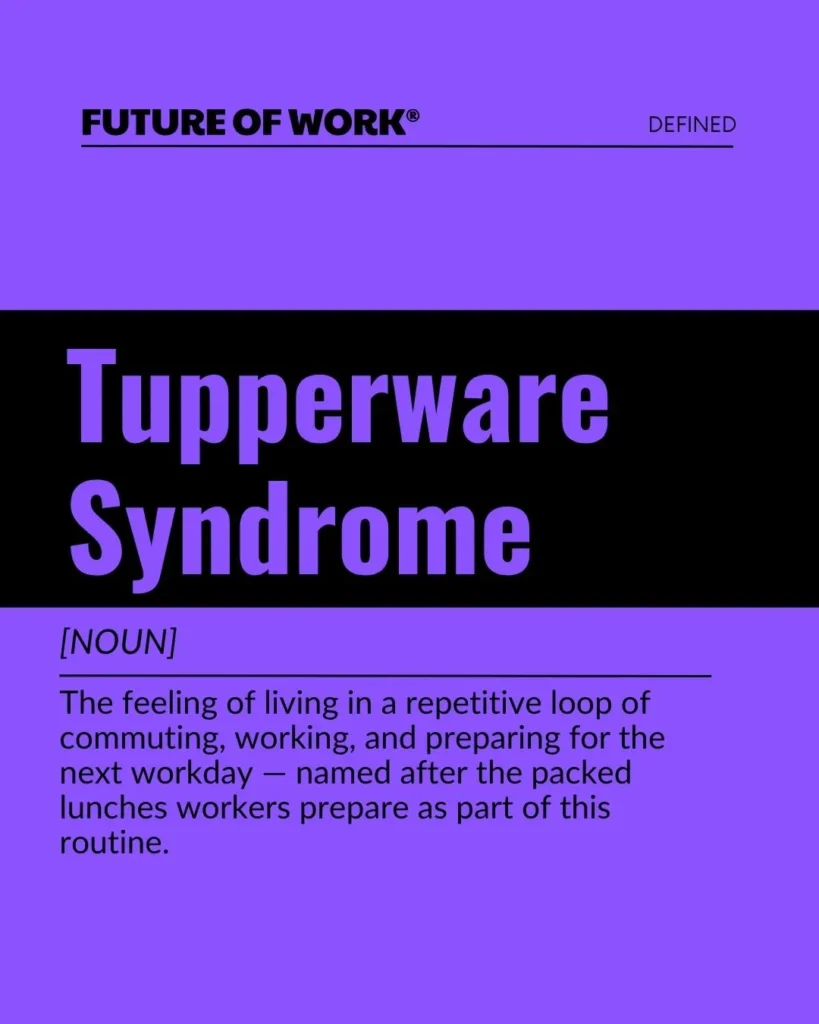
A new phrase has begun circulating widely in Spain: “Tupperware Syndrome.”
At first glance, it sounds almost humorous. But behind it lies something far more serious — a growing sense among workers that their lives have been reduced to an exhausting loop of work, commuting, and preparation for the next workday.

The idea resonates because it indicates a change already underway. What was once a structured workday is increasingly dissolving into what researchers now call the “infinite workday” — a reality where work begins earlier, ends later, and quietly expands into personal time.
According to Microsoft’s Work Trend Index:

- 40% of employees are already online by 6 a.m.
- a third are still checking emails at 10 p.m.
- 1 in 5 works on weekends
This erosion of boundaries is not happening by design, but rather emerging as a side effect of flexibility itself. As Allwork.Space previously explored, “flexible work was the dream, but the infinite workday is the reality,” where the absence of clear limits has stretched work across the entire day.
Within that context, the “Tupperware Syndrome” becomes easier to understand.
The term gained traction following a widely shared letter in El País, where a worker described a routine many instantly recognized: waking up early, commuting, working long hours, returning home exhausted, and preparing a tupper (packed lunch) for the next day.
The question posed was simple but unsettling:

“Is this really what we expected from life?”
But the “Tupperware Syndrome” isn’t really about food.
It’s about the structure of modern work, and the growing feeling that it no longer works for people.
 A Routine That Feels Endless, And Isn’t Just Perception
The daily loop described by workers (commute, work, recover, prepare, repeat) is increasingly backed by data.
Nearly 1 in 3 employees report feeling burned out, while close to half of workers globally experience chronic stress.
In Europe alone, 29% of workers report experiencing stress, depression, or anxiety linked to their jobs, according to EU workplace safety data.
This suggests that what’s being labeled as a “syndrome” is part of a broader pattern.
Modern work is increasingly defined by a reinforcing cycle I’ve reported on before: imposter syndrome leads to overwork, overwork accelerates burnout, and burnout fragments attention, making it harder to keep up and pushing workers deeper into the same routine they’re trying to escape.

The Hidden Drivers: Time Pressure, Long Hours, And Commutes
What makes the “Tupperware Syndrome” particularly resonant is how closely it reflects measurable workplace conditions.
More than 40% of European workers report working under constant time pressure, a key factor in creating repetitive, high-intensity routines.
At the same time, long working hours continue to carry real risks. Research by the World Health Organization shows that working 55+ hours per week increases the risk of stroke by 35% and heart disease by 17%.
Even the commute (often dismissed as a minor inconvenience) plays a measurable role. Studies indicate that every additional 10 minutes of commuting increases the likelihood of depression by approximately 1.1%.
Put together, these factors create exactly the kind of loop workers are now naming and sharing.
The Bigger Issue: A System Out Of Sync With Reality
What makes this trend particularly important for the future of work is that it points to a deeper structural issue.
It’s not just that people feel tired.
It’s that the way work is organized may no longer align with how people live.
Some estimates suggest that up to 30% of roles in modern economies are structurally misaligned with current work patterns, showcasing a gap between traditional job design and today’s realities.
In countries like Spain, this tension is especially visible, where productivity challenges persist despite long working hours and effort — highlighting a mismatch between time spent working and actual outcomes.
This misalignment is increasingly showing up in how workers describe their careers. Many now feel caught in what Allwork.Space has called the “Great Job Situationship Era,” which is a frozen labor market turning careers into gray-area commitments workers can’t easily exit; remaining in roles that no longer fulfill them.
This state of professional limbo mirrors the repetitive loop behind “Tupperware Syndrome” and is backed by shocking data:
- 93% of workers admitted to staying in jobs they didn’t love purely for stability
- 63% described their relationship with work as “complicated” or said they were “ready to break up”
- 74% of workers said they believe it is not possible to love any job in 2026
Particularly in the U.S., millions experience what has been described as “ghost growth,” which is the illusion of career advancement without raises, promotions, or real authority while facing heavier workloads with little to no compensation, leading to frustration and burnout.
The result is a growing perception among workers that they are not just working hard — they are stuck in systems that no longer make sense.
From Viral Phrase To Global Signal
The rise of “Tupperware Syndrome” makes sense in the context of other recent workplace trends — from quiet quitting to burnout culture — all pointing to the same underlying shift:
Workers are no longer just asking where they work; they are questioning how much of their lives work should consume.
This is a problem that hits the whole economy, not just the workers.
According to Gallup, low engagement and “quiet quitting” are costing the global economy an estimated $8.8 trillion in lost productivity, while actively disengaged employees alone account for roughly $438 billion in annual losses.
In that context, trends like “Tupperware Syndrome” are not just cultural expressions — they are early warning signals of systemic inefficiency, where rigid work structures are eroding both human energy and economic output.
This is already influencing real-world change.
Studies on the four-day workweek indicate its viability, with 92% of participating companies choosing to continue the model after trials. These companies reported benefits such as reduced stress, lower absenteeism, and sustained or higher productivity.
While some businesses hesitate to embrace this, the data suggests this trend is unavoidable: the working hours of full-time employees are consistently declining across various sectors, roles, and demographics, a pattern most pronounced among younger generations.
These experiments suggest that the issue isn’t a lack of productivity, but rather how work is structured.
The Real Question Behind The Trend
The “Tupperware Syndrome” may have started as a cultural observation in Spain.
But its rapid spread points to something larger: When a simple object — a lunch container — becomes a symbol of exhaustion, repetition, and lack of time, it signals that workers are not just tired.
They are re-evaluating the role of work in their lives.
And that raises a more fundamental question for the future of work: If work is meant to support life, why does it feel like life is being built around work instead?