

Independent coworking operators are gaining traction across the U.S. as more remote workers, freelancers, and startups look for flexible workspaces with stronger local identity and community ties.
A new Coworking Cafe analysis of 73 U.S. cities with populations above 200,000 found that smaller, locally owned coworking brands are expanding fastest in parts of the Midwest and South, even as major operators still control nearly 60% of the overall market.

Smaller Operators Find An Opening
The report defined independent coworking providers as companies operating fewer than four locations within a single city. Researchers ranked cities based on the share of coworking spaces operated by those local providers.
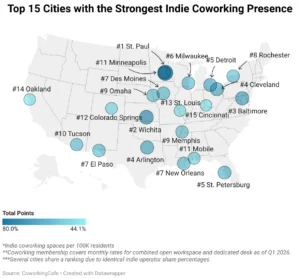
St. Paul, Minnesota, and Wichita, Kansas, tied for first place, while Jacksonville, Florida, ranked second and Tucson, Arizona, ranked third.

The Midwest accounted for eight of the top 15 cities in the ranking, the largest regional concentration of independent coworking markets in the study.
Cities including Milwaukee, Des Moines, Omaha, St. Louis, Detroit, and Cleveland posted strong independent coworking presence, helping establish the Midwest as the country’s strongest region for locally owned coworking brands.
Remote Work Continues To Fuel Demand
The findings show how deeply flexible work has become embedded in local labor markets. In roughly 75% of the cities analyzed, remote work rates exceeded the national average of 13.3%.
Many of the highest-ranked cities combined above-average remote work rates with strong self-employment activity, creating steady demand for flexible workspace from freelancers, entrepreneurs, and distributed workers.

Researchers noted that many independent coworking operators are building spaces tailored to specific local communities, industries, or worker groups rather than offering standardized national-brand experiences.
Big Cities Aren’t Dominating The Trend
Unlike earlier coworking booms centered around major metros, many of the strongest indie coworking markets are mid-sized cities with lower operating costs and less saturation from national chains.
Nine of the top 15 cities had populations under 500,000.
The report suggests that smaller cities may offer a stronger environment for locally rooted workspace brands because they combine growing remote-work populations with lower real estate costs and tighter community networks.
Coworking Becomes Part Of Local Work Infrastructure
Rather than treating coworking as a temporary alternative to traditional offices, many workers now view flexible workspaces as part of their long-term professional routine.
The report also found that independent operators increasingly position themselves as neighborhood-focused work hubs tied to local business ecosystems, startup communities, and remote worker networks.
As hybrid work remains widespread, the findings suggest flexible workspace demand is no longer limited to large corporate operators or major coastal cities.