

In many workplaces, the most disruptive behavior is not immediately visible. It does not look like conflict or overt misconduct, and it often comes from individuals who are also among the highest performers.
A pattern often begins to emerge. A senior employee consistently delivers strong results, but colleagues quietly adjust their behavior around them—becoming more cautious in meetings, less willing to challenge ideas, and increasingly selective about what they say due to repeated, subtle undermining behavior that is difficult to name in isolation. Over time, the team begins to function differently, even in the absence of any formal complaint.

In some cases, managers may overlook these signals, particularly when the individual is also delivering strong results. As a result, concerns remain unaddressed until the impact on team morale is already deeply embedded and far more difficult to reverse.
When Performance Masks Problematic Behavior
If output is the primary measure of an employee’s value, it creates a blind spot in evaluating their overall contribution to the organization. Strong results can overshadow behavior, even when that behavior damages team dynamics. Over time, this can create a “too valuable to lose” mindset, where high performers are treated as indispensable despite concerns about intimidation, poor communication, or fear-based interactions. In these environments, disruptive behavior is often ignored or downplayed, with the individual instead described as intense or overly ambitious.

In a recent article, Is Your Highest Performer A Bully, Joyce Odidison, a conflict analyst and certified coach, explains that organizations respond differently to behavioral concerns depending on performance level. Concerns involving lower performers are typically addressed through standard processes. However, when similar concerns arise with high performers, responses tend to be more cautious, and the behavior is more likely to be reframed as miscommunication or personality differences. When performance is rewarded without equal attention to conduct, it creates a form of protection that allows harmful patterns to persist.
This often plays out in subtle ways. Early warning signs—such as disengagement, reduced participation or quiet turnover—are present but are frequently overlooked because performance data remains strong. Complaints may be minimized, investigations may conclude that evidence is inconclusive, or concerns may be reframed as interpersonal issues rather than behavioral problems. Meanwhile, the individual continues to be rewarded for results, reinforcing the pattern.
What This Behavior Looks Like in Practice
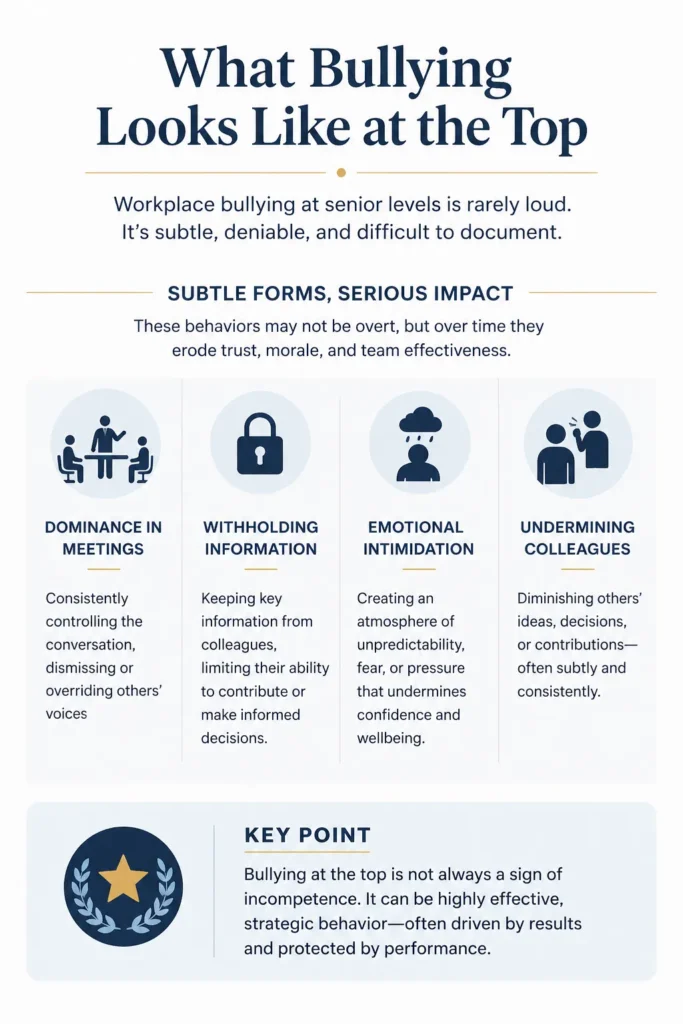
Bullying by high performers is often less visible than expected. It rarely appears as overt misconduct, but instead emerges through consistent patterns that are difficult to identify yet clearly felt within teams. In some cases, high-performing bullies are deliberate in how they manage their behavior, maintaining strong upward relationships while directing negative behavior toward peers or junior colleagues, making it harder to challenge.
According to Odidison, this can include dominating conversations, controlling decision-making, and marginalizing other voices. It may also involve withholding information, excluding colleagues, or applying pressure that gradually undermines confidence. For example, a team member may consistently dismiss ideas in meetings, question colleagues’ competence in front of others, or exclude individuals under the justification of “efficiency” or “standards.” No single incident is severe enough to trigger formal action, yet over time, colleagues begin to disengage, avoid speaking up, or work around that individual. While each instance may seem minor in isolation, the cumulative effect disrupts team functioning.

Odidison notes that this behavior is rarely rooted in deliberate harm. Instead, it is shaped by pressure, mindset, and sustained stress, which can gradually reduce empathy and self-awareness. As attention narrows toward outcomes, awareness of interpersonal impact declines, and strong results begin to overshadow concerns about behavior.
High performers in this pattern are typically driven and highly focused on results. However, this focus can come at the expense of self-awareness, emotional regulation, and interpersonal skills. Because organizations reward measurable outcomes, these individuals may prioritize technical capability and career development while giving less attention to how they work with others.
As a result, they often do not perceive their behavior as problematic. When concerns are raised, they may believe they are simply pushing for higher standards while viewing others as underperforming. Behaviors such as public criticism, dismissive feedback, or intimidation are therefore framed as being direct or performance-focused, even when they create fear and reduce morale within teams.
 The Cost of Looking Away
The impact of this pattern rarely stays contained, and gradually infiltrates team behavior, shaping how people interact, communicate, and contribute. Over time, the repercussions spread across the organization. Levels of morale, engagement, and collaboration all drop off, psychological safety erodes, and employees become less willing to speak up or contribute openly. As a result, innovation and problem-solving also decline.
This environment also drives higher turnover. Employees disengage or leave without raising concerns, resulting in a steady loss of talent and capability. The remaining team members may still deliver results in the short term, but under increasing amounts of pressure and strain.
As Odidison highlights, the long-term cost is significant. What appears efficient on the surface often conceals more serious damage to how teams function and sustain performance. Even when performance metrics remain strong, organizations can experience reduced trust, weaker cohesion, and a gradual breakdown in culture. The issue then becomes not whether organizations can afford to hold top performers accountable, but how much damage caused by their behavior they can afford to ignore.
Organizations Cannot Continue to Shield Top Performers
The issue is not limited to individual behavior. It reflects how systems and incentives shape what organizations choose to notice and what they choose to ignore. When performance is prioritized above all else, harmful behavior can be overlooked in favor of results.
When organizations reward outcomes without equal accountability for how those outcomes are achieved, they create conditions where results are seen as justification for behavior. This can discourage concerns from being raised and allow problematic conduct to persist.
Odidison emphasizes that evaluating performance solely through results reinforces this imbalance. When leaders rely heavily on metrics and avoid challenging top contributors, accountability becomes inconsistent, and any misconduct is less likely to be addressed.
The challenge is even greater in hybrid and distributed work environments, where visibility is reduced. Behaviors such as exclusion or intimidation are harder to detect, making early warning signs more important. Disengagement, reduced participation, and quiet turnover often signal deeper issues but can be missed when attention is fixed on output.
Addressing this requires shifting focus from who delivers results to how those results are achieved and what impact they have on others. Participation patterns, complaint data, and informal conversations all offer insight into workplace culture, often revealing concerns that do not surface through formal processes.
At some point, this is no longer a subtle pattern but a clear failure of organizational accountability. Leaders who prioritize long-term performance must hold all employees to the same standard, regardless of output. This requires aligning reward systems with behavioral accountability, rather than allowing results alone to define value. Only then are high-performing bullies more likely to recognize the impact of their behavior and take steps to change it.