

Hybrid work has evolved from being the biggest conversation in the office to the acceptance that flexibility is table stakes for today’s workforce. What is not widely understood are the costly impacts of scheduling variabilities.
While most decision makers know how many square feet they own or lease, the cost per square foot, energy costs, and occupancy rates, many don’t have a handle on how the building is actually used.
A recent Wakefield Research survey of 400 workplace decision makers found 62% do not know how office space is used without directly asking employees or using privacy-compromising technologies to observe employees. Neither of those scenarios are likely to generate genuine insight. Workforce surveys tell leadership what they want to hear. Monitoring tools can undermine trust, potentially leading to performative behavior.
The challenge is that much of the workplace data organizations collect lacks insight on how humans use the office.
The Cost of Not Knowing How Offices Are Used
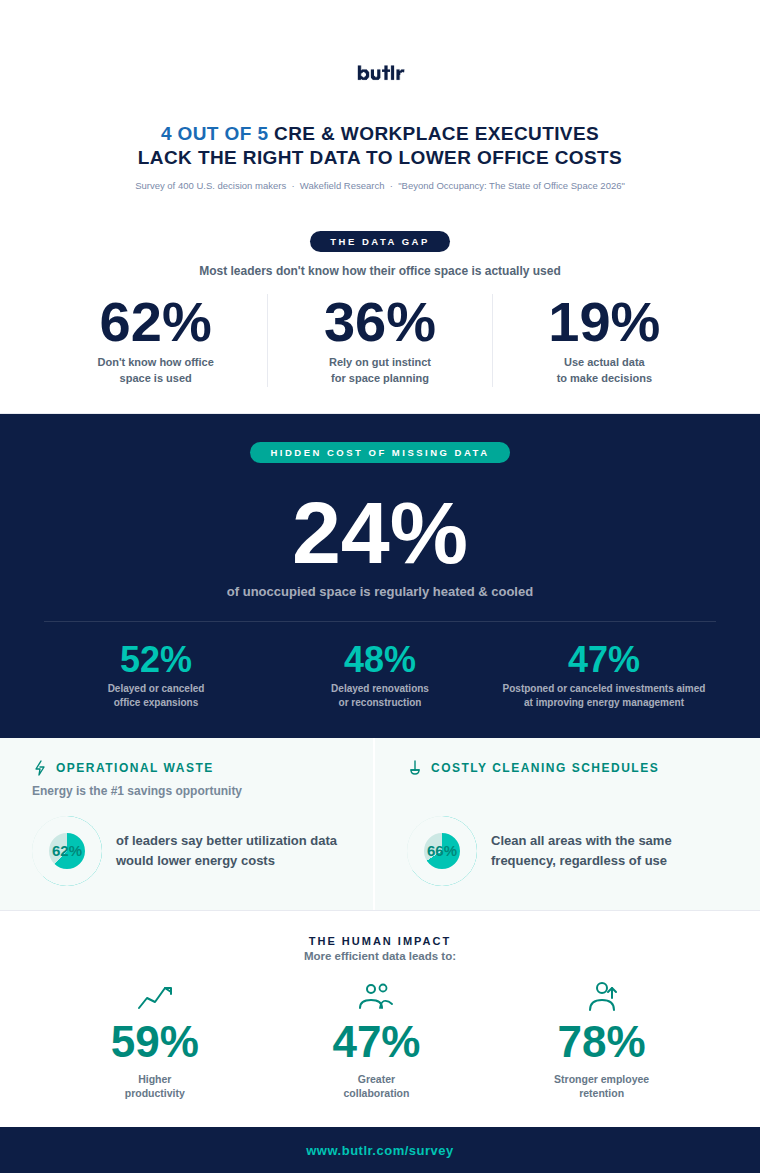
As a result, 36% rely on gut instinct to make critical decisions about the office including investments in amenities, redesign, and the amount of space leased. Assumption-based planning explains why 76% are concerned the current office layout is not delivering the most productive use of space.
From a workforce comfort and facilities management perspective, the lack of genuine insight is why 24% of under- or unoccupied office space is regularly heated and cooled.
The related costs add up in productivity losses, employee retention, energy costs, and capital expenses. This is happening at the precise time employers are investing in office renovations while fit-out costs are rising.
JLL’s latest Future of Work data reports 59% of organizations are increasing their investments in office fit-outs. Their Global Office Fit-Out Costs Guide puts renovation costs at 2%-6% higher globally, with North America being the highest at a range of $230-$375 per square foot.
It can be an expensive learning lesson when workplaces don’t know how the office is used but invest in transforming layouts and adding amenities they assume will be useful. The delta between knowing how the office is used and what the workforce prefers and needs is known as the spatial intelligence gap.
Closing the Spatial Intelligence Gap
A variety of technology solutions exist to close the spatial intelligence gap. One popular strategy is to stitch together various data sources from occupancy counters, badge swipes, and room reservation systems. To get the big picture, a dashboard shows the integrated data sets and validates assumptions about office usage.
The inadvertent blind spot this creates is a lack of information about how the workforce uses the office throughout the day. Just as seasons change, so does workforce behavior. Vacations create an obvious lull in occupancy, but less obvious factors can also change how people use a workplace.
Depending on the location and structure of an office building, for example, sun glare may distract employees, elevate heat, force cooling systems to work overtime, and disrupt employees working on computers. This can prompt them to move to other areas of the building or leave for the day.
These everyday actions may not seem like a big deal, but their operational costs add up. The Wakefield survey shows 62% believe building energy costs are a top area where better utilization insights could deliver measurable savings. Further, 60% believe data on cleaning costs could yield measurable savings.
Instead of piecing together data based primarily on who is in the building and for how long, decision makers can be more effective if they have an accurate understanding of anonymous insights based on real human behavior.
Thermal Sensors Emerge for Anonymous Insights
Getting this additional insight is critical to office planning. Yet cameras cannot be and should not be everywhere. This has led to the rise in thermal sensing technology for the workplace. Thermal technology is inherently unable to capture images because it relies on body heat, not cameras, to depict what is happening in a space.
When those thermal data sets are mapped to the office layout, decision makers can spot trends in human behavior. This is how one employer discovered they didn’t have enough conference rooms and private work areas and reconfigured the office to boost productivity. Another company saves $1,400 per restroom per year through smarter resource planning.
Having accurate, granular, and anonymized thermal data on human behavior in the office can lead to smarter layouts and schedules that reflect the needs of the workforce and culture of the company.
Making the Data Useful
Capturing office usage data quickly leads to millions of frames that need to be analyzed just to get to a narrative. The key is understanding what is happening and what is likely to happen in the future. This is where AI supported by quality data can be effective.
For example, looking at a dashboard and asking AI to present trend data on the busiest days and hours of the week along with written and visual recommendations for layout and desk assignments. Or exploring various scheduling models based on consistent spikes in calls to the support desk and the impact on employees, maintenance, and facilities management.
Anecdotally, office building parking lots are full. Desks are occupied. Buildings are seeing a steady flow of foot traffic. CRE executives, property managers, and tenants are investing in the workplace. Making the most of those investments requires insight into occupancy, usage, and anonymized human behavior. With offices representing one of the largest capital expenses for an organization, experimentation and creative ideas for optimizing the space must be rooted in real data.