



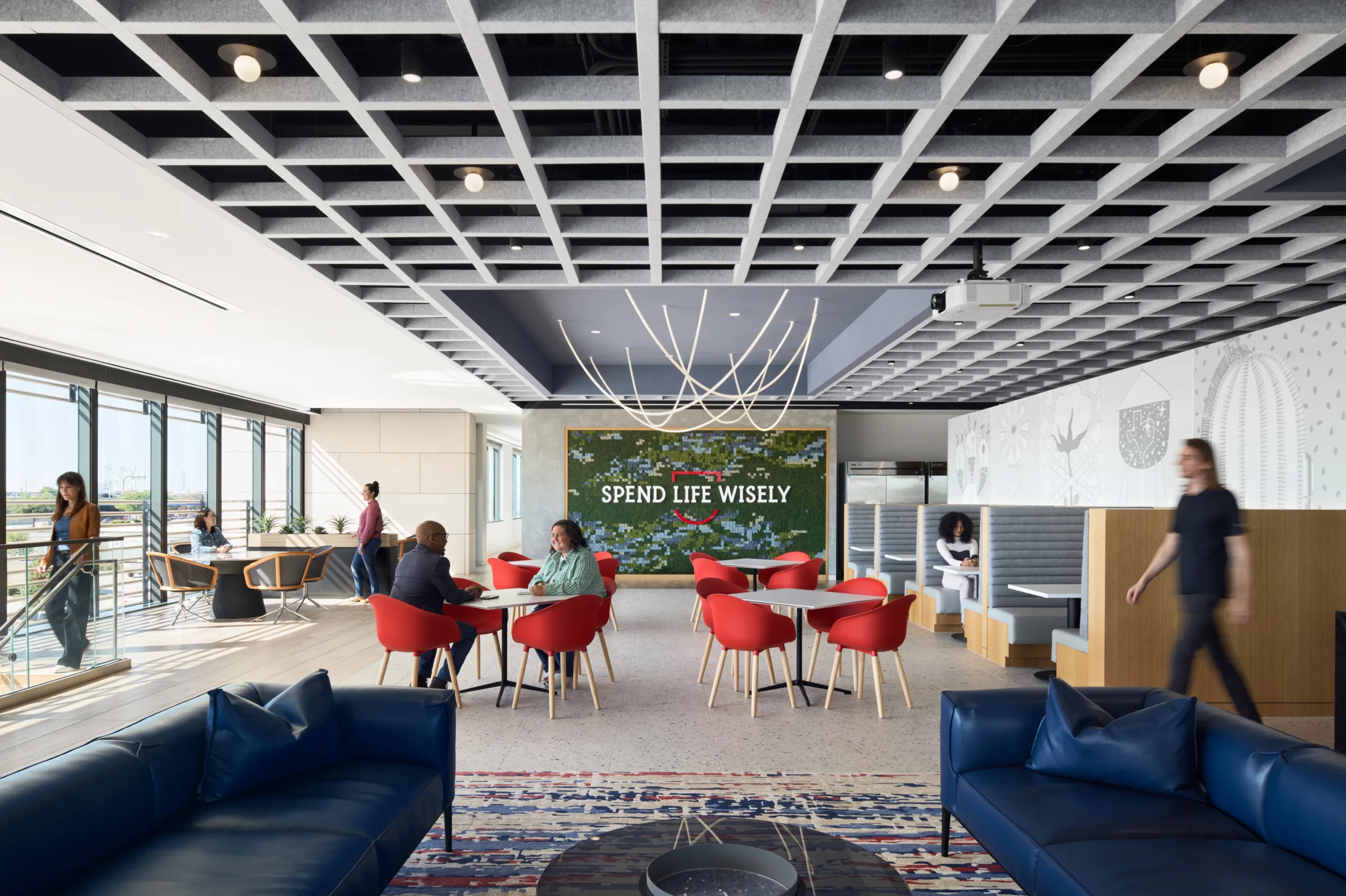
Recent coverage of the Dallas financial services market has frequently referenced the term “Y’all Street.”
More than a catchy regional slogan, the term reflects a significant change in the financial services industry as major firms expand beyond New York to establish a stronger presence in Texas.

As organizations invest in new markets, an important challenge arises for clients and workplace designers: How does a legacy brand from New York gain a foothold in the Dallas marketplace while preserving the trust and culture that made it successful in the first place?
For workplace designers, this requires intentional strategy. The challenge is to embed brand into the workplace, so it becomes more than an application over a reception desk, it becomes a clear expression of what the company stands for.

Beyond the Logo
Many organizations associate workplace brand expression with graphics, colors, signage, or logos displayed throughout a space. While those elements play a role, they only express the surface of a much deeper story.
A strong brand communicates trust, discretion, support, and shared purpose.
The most successful financial institutions have spent decades building their reputations around these values. The physical workplace should reinforce those same qualities. To communicate trust and discretion, for example, workplace designers often include easily accessible consultation rooms for clients, while maintaining privacy through elements like frosted glass. The number of rooms like these can also signal that client support is a high priority.
A workplace succeeds when people experience the organization’s values, not simply its visual identity.

Trust and Innovation Can Coexist
Financial services firms have historically built their environments around security, stability, and discretion. Those values remain critical today. Yet organizations must also communicate something else: innovation.
The future workplace must support a workforce that is technologically adaptive, forward-thinking, growth-oriented, and efficiency-driven.
Balancing security with innovation can be challenging. For workplace designers, this balance can take shape through secure collaboration zones, dedicated environments for cybersecurity teams, and adaptable infrastructure that allows companies to integrate emerging technologies as business needs evolve.
When designers shape the workplace experience thoughtfully, they reinforce confidence in the company’s legacy while creating momentum for its future.
Can Workplace Design Shape Company Culture?
A recent discussion about the growth of the financial services industry in Dallas included a conversation with an executive who had recently changed employers. She had spent years with one of the industry’s most respected firms before joining a direct competitor.
Both organizations were successful. Both had strong reputations, financial stability, and recognizable brands. The motivating factor behind the change was not immediately obvious.
The deciding factor was culture.
While her previous organization offered professional support and opportunities, she felt something was missing. She was searching for a stronger sense of belonging and connection to the people around her.
That conversation reinforced an important lesson. Employees rarely make career decisions based on visual identity alone; they respond to whether an organization’s values are evident in the daily workplace experience. Whether those values include reliability, security, employee wellness, or innovation, design must communicate them strategically and meaningfully.
Culture is often the deciding factor in attracting talent and retaining it.
Human Connection Is the Real Brand Experience
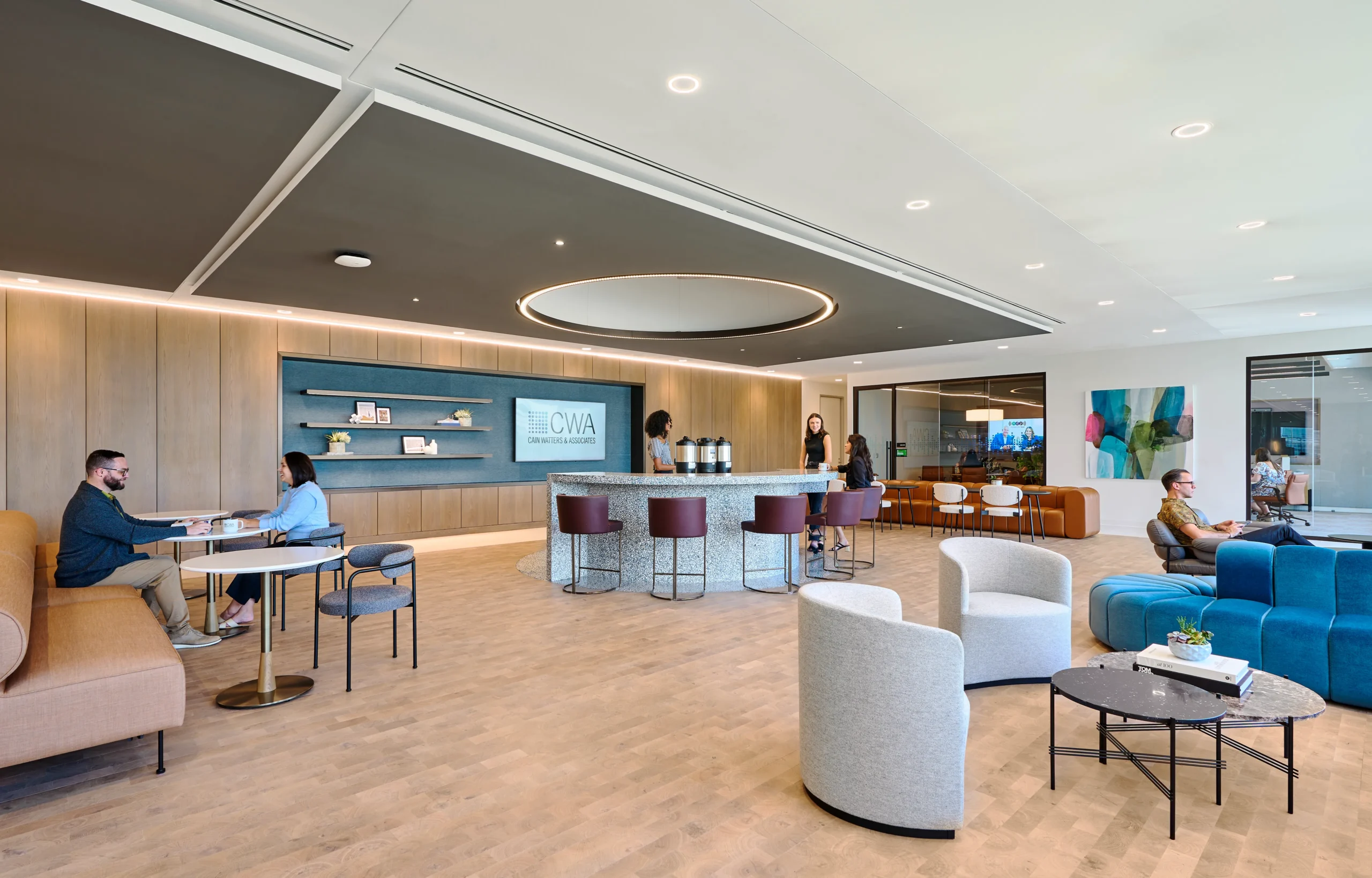
At its core, culture is about human connection.
Workplace strategists can no longer focus solely on where people work. Instead, they must focus on why people come together. A talented workforce is naturally driven to produce at a high level, but work is no longer their sole motivation.
Today, the most effective workplaces create intentional opportunities for collaboration, informal interaction, mentorship, knowledge sharing, and community building. Because professional relationships shape how people engage with their work, spaces that invite meaningful encounters can help build teams that are more cohesive, connected, and committed to one another.
A workplace that strengthens human relationships strengthens the brand itself.
How Workplace Design Can Create A Stronger Sense Of Belonging
One recent headquarters project highlighted this challenge perfectly.
The client was reducing its overall real estate footprint while trying to strengthen both employee culture and client experience. Like many organizations, they were moving toward a more efficient workplace model that meant smaller workstations and fewer enclosed offices.
In practice, those changes raised understandable concerns among employees. Employees worried they were losing personal space and established ways of working. The organization needed a way to ensure the transition felt like an investment rather than a reduction.
The solution was not simply to offset reduced square footage, but to create a stronger sense of belonging and shared ownership.
By creating neighborhood-based planning, collaborative destinations, hospitality-focused environments, and shared client spaces, the workplace evolved from a collection of individual offices into a connected community.
More importantly, the design blurred the distinction between “employee space” and “client space.” Every area became part of a unified brand experience.
The result was a more efficient workplace that reinforced trust, strengthened culture, and supported the company’s future vision.
The Future of Brand Integration
As financial services firms continue expanding into markets like Dallas, workplace designers have a critical role in helping organizations translate brand values into the everyday workplace experience.
The most successful organizations will recognize that brand is not something applied to a space after the design is complete. It is embedded in the culture, relationships, and experiences that the environment creates.
When designers thoughtfully integrate trust, support, innovation, and human connection into the workplace, they create something far more powerful than a branded office. They create a destination where people feel connected to their organization, their colleagues, and a shared purpose.
In a market defined by growth, competition, and rising expectations for the employee experience, that sense of belonging may be the strongest message a company can deliver.