- If society’s goal in the future is to replace cars—or at least some of them, that requires offering more choices to commuters.
- If UBM was a location selection criterion for a coworking center’s location, or starting a new company, or locating a branch office, the 15-minute city could become a reality.
- As gas prices continue to skyrocket, and global warming becomes more of a threat, finding travel alternatives is becoming increasingly necessary.
Since the inception of the car, the physical landscape has evolved around it, resulting in substantial auto-dependence.
Interest in vehicle alternatives is clearly increasing, which is part of a broader trend toward greener transportation.

If society’s goal in the future is to replace cars—or at least some of them, that requires offering more choices to commuters.
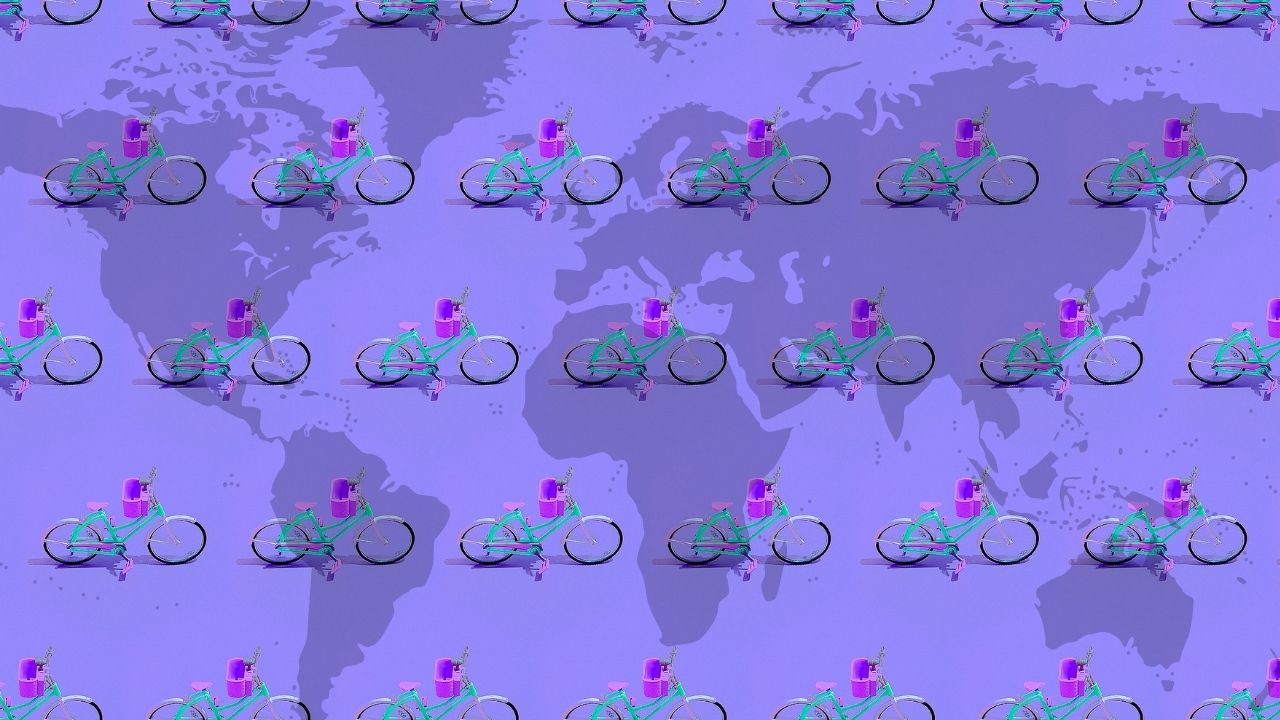
The early entrants in this field, like bikes and scooters, have been global phenomena for decades. Amsterdam has a long history of residents owning more bicycles than cars, and San Francisco is considered the best biking city in the United States.

But micromobility takes these smaller means of transportation in a new direction with the concept of sharing.
What is micromobility?
Docked bicycles for rent first showed up in the U.S. in 2008, and by 2017, fleets of e-scooters were deployed across the country.
Association of City Transportation Officials data found that shared bikes, e-bikes, and scooters accounted for 136 million trips in America in 2019 – a whopping 60% increase from 2018.
This type of micromobility is gaining popularity. In January of this year, Oakland, California, became the latest U.S. city to debut a Universal Basic Mobility (UBM) pilot — a combination of policies, funding, and partnerships that aim to provide all members of society with a basic level of access to mobility.

The best argument for implementing micromobility is that it would improve accessibility and reduce both congestion and emissions.
What would UBM’s impact be on the future of work?
Firstly, Universal Basic Mobility is a concept that aims to make a range of transportation options available to residents, as well as cut down on commuting time/sitting in traffic.
Similar to the idea of the 15 minute city, which describes an ideal geography in which most human needs and desires can be met within a radius of 15 minutes without using a car, UBM contains the idea that the location of goods, services, and workplaces is determined by how long it takes to walk or cycle there.
If UBM was a location selection criterion for a coworking center’s location, or starting a new company, or locating a branch office, the 15 minute city could become a reality. Live-work-play communities could also gain massive popularity, and their creation would skyrocket.
Many believe that transportation is a right. If so, then how does UBM impact the future of work and the selection of jobs and workplaces in the future?
Well, if peoples’ workplaces were accessible by bike, skateboard, or scooter, not only would this have extremely positive implications for the environment, but it would mean that commuting by car or bus wouldn’t be necessary anymore.
According to a survey from the Bureau of Labor Statistics, transportation is Americans’ second biggest expense after housing, costing roughly 10% of annual income on average, while lower income households spend 30%.
With UBM structures in place, no longer would this expense exist to this degree – if at all. Commuting to work is a serious time-eater, not to mention very costly.
Workplaces should be accessible to all, and getting to them shouldn’t be a struggle.
Over the past few decades, increasingly expensive cities have forced many lower income residents to the suburbs. These areas are rarely served by frequent and reliable transit, and often lack the density of residents to prompt additional services. People who can’t afford a car can be caught by the mismatch between where jobs and services are, and where they can afford to live, according to The Mobilist.
“In the US, there is a narrative that if people work hard, then they can get out of poverty, but we’ve built cities that make this narrative impossible. For households making less than $20,000 per year, reliable cars are a pipe dream: a huge expense that they can’t afford. Without adequate transit, they will remain stuck in place,” according to ITDP’s Joe Chestnut,
Transportation equity is not a discrete problem. It poses a barrier to accessing everything that constitutes good quality of life, like healthcare, fresh food, public Wi-Fi, education, and jobs.
Imagine if everything was brought within a 5, 10, or 15 minute radius: Car ownership would become unnecessary, and the major issue of proximity (which creates transportation inequity in the first place) would disappear, and cities would become implicitly inclusive.
Implementing UBM will face some challenges
This new technology will face a number of obstacles, including concerns about sharing roads with cars and pathways with pedestrians.
Micromobility experts say that closer collaboration with cities can help improve safety. Among the measures they recommend are dedicated infrastructure for scooter parking, such as corralled areas, and expanded bicycle lanes that can also be used by e-scooters.
In a car-centric society, the shift away from automobiles is a massive culture shock, and will be met with apprehension as well as resistance.
As gas prices continue to skyrocket, and global warming becomes more of a threat, finding travel alternatives will be increasingly necessary.
Universal Basic Mobility is an encouraging acknowledgment of the role that transportation plays in creating opportunity.