
With 63% of companies now offering hybrid work arrangements to employees, the challenges of making this flexibility work efficiently, fairly, and sustainably are growing.
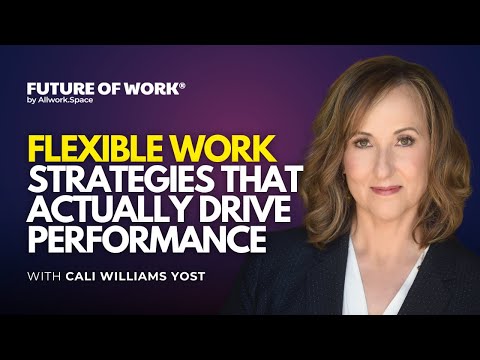
In a recent episode of The Future of Work® Podcast, we were joined by CEO of the Flex+Strategy Group Cali Williams Yost, who has nearly 30 years of experience helping Fortune 500 companies create flexible, high-performing work strategies. Yost brings clarity to the confusion surrounding hybrid work.

Her view is clear: simply allowing remote or hybrid options is not enough. What matters is how you design flexibility so that it fuels performance, creativity, and well‑being.
Execution Is Everything
Many organizations claim to be flexible — hybrid schedules, remote options, third-space allowances — but few are maximizing the potential benefits. According to Yost, that’s because they haven’t clearly defined the why behind each element of their model.

People are showing up to offices without knowing what they’re supposed to accomplish together. Others are remote without clear coordination frameworks in place. The result? Inefficiency, frustration, and underperformance.
In one randomized study Yost referenced, productivity remained static across in-person and hybrid groups. But turnover improved significantly among the hybrid group. The insight was that hybrid models can provide real business value, but only if executed with thought and strategy.
“If that hybrid had been executed in a way where those employees step back and said, okay, what are we going to do when we’re in person? How are we going to really make the best of that time together? And then what are we going to do when we’re not in person…You’re going to get even more benefit from that process,” Yost explained.
What a Real Strategy Looks Like
So what separates performative flexibility from meaningful transformation?

For starters, Yost says the process has to be owned at the top. A respected senior business-line leader must act as sponsor, giving the process visibility, budget, and time. It can’t be relegated to just IT or HR.
This leader must bring together a cross-functional team — including workplace strategy, technology, risk, and people teams — to align every component of the flexible model: physical space, communication tools, talent development, and contingency planning.
This is not a quick fix. It starts with an assessment of where the organization is now, what’s working, and where the friction lies. From there, a shared vision emerges — and then, piece by piece, the organization begins aligning people, tools, and expectations around it.
Even training needs a reset. Yost points to Gallup data showing only 44% of managers globally receive training on how to lead a flexible team. That gap alone undermines everything a flexible model tries to achieve.
Flexible Doesn’t Mean Untethered
The work model has to account for where, when, and how work happens. That includes defining what kinds of tasks should happen in the office, at home, and in third places, and then backing that up with the right infrastructure, equipment, and scheduling.
For example, teams often still want a “neighborhood” in the office, which is a dedicated spot where they can collaborate in person. At home, workers need proper desks, chairs, and connectivity, and in many cases, companies are investing to help make that happen. Third places (coworking centers, satellite hubs, and even cafés) are part of the model too, especially when commutes or life situations make daily office visits impractical.
And all of this needs to be stress-tested for continuity. When transit strikes or natural disasters hit, does your organization know how to instantly switch into remote mode without a productivity hit? One of Yost’s clients did, and it came down to planning and coordination, not luck.
Why Labor Market Realities Demand Flexibility
Organizations that ignore flexible models are resisting change as well as actively falling behind in talent acquisition and retention.
Demographic trends show a shrinking labor pool by 2030. Talent scarcity is already evident across industries, and that’s without considering the massive reskilling needed to make AI implementations successful. The organizations that will thrive are the ones that build intentional models to attract and retain diverse talent across generations, locations, and work preferences.
That’s especially critical when integrating AI. While companies have invested billions into generative AI, most of those investments aren’t yielding returns. Yost argues that’s largely because the implementation has been siloed and people haven’t been trained or involved properly.
Technology can’t drive performance on its own; humans still need to lead.
“This ultimately becomes about the work model, and how, when, and where we’re going to work,” she said during the podcast conversation. “AI is a component of this, but we’re too siloed in how we’re looking at all of these things.”
Designing a Model for the Workforce You Actually Have
The labor force today is not the same as it was even a decade ago. Many baby boomers want to stay in the workforce but need flexibility to do so. Mid-career professionals are facing rising caregiving responsibilities and expect their work lives to accommodate that. And younger generations enter the workforce with an intuitive grasp of remote work tools and digital collaboration — but they still need mentorship, training, and opportunities for in-person learning.
Yost notes that flexible models done right unite the workforce, not fragment it.
She shared a powerful moment of cross-generational collaboration: a younger worker teaching a senior leader how to use Slack more effectively, while the senior leader provides coaching through client meetings. When structured thoughtfully, flexibility can drive intergenerational learning and business value simultaneously.
The flexible work conversation needs to center on designing systems that work — systems that enhance productivity, retain talent, enable business continuity, and support a healthy, high-performing workforce.
It requires leadership, cross-functional collaboration, clarity of purpose, and a deep understanding of how work actually gets done. Organizations that embrace this level of strategy and commitment are the ones that will be ready — not just for 2025, but for the workforce realities of 2030 and beyond.
“We first have to recognize the labor market is really different than it was. And I’ve seen HR people everywhere saying it’s nearly impossible to find people with the skill sets that you want. So you do have to start training people.”
Success will come to organizations that design flexible work with purpose, precision, and a commitment to people.