




This article is based on the Allwork.Space Future of Work Podcast episode “Workplace Strategy Is Becoming A Consumer Experience, Not A Real Estate Decision with Sue Asprey Price.” Click here to watch or listen to the full episode.
For years, the debate around the workplace has been framed as a simple question: office or remote. But for many organizations, that framing is becoming less relevant.

Instead, companies are now asking a more complex question: how can physical space improve both talent outcomes and business performance?
This shift is changing how leaders think about real estate, workplace design, and the purpose of the office itself.
Workplace and real estate strategist Sue Asprey Price recently joined The Allwork.Space Future of Work Podcast to discuss how organizations are moving beyond the “office versus remote” debate. Drawing on her work leading JLL’s Work Dynamics divison, she explained that workplace decisions are increasingly strategic, linking real estate planning to talent outcomes, employee experience, productivity, and long-term business performance.
From Workplace Policies to Workforce Experience
Organizations today are managing a workforce shaped by multiple generations, changing expectations, and exponential technological change. In this environment, workplace strategy is increasingly focused on how companies connect with employees and what kind of experience they provide.
For some companies, the office reinforces brand identity. For others, it plays a role in talent attraction and retention. But the larger goal is improving how effectively employees work.
That has led to a more personalized approach to workplace design. Instead of treating employees as a uniform group, organizations are beginning to think about workplace experience in ways that resemble consumer-facing services.
Flexibility is central to that shift, though flexibility does not necessarily mean fully remote work. Research from JLL suggests that many younger workers still want access to offices.
In the firm’s employee barometer, more than 75% of Gen Z respondents said they prefer having an office environment available.
In practice, that means organizations are designing workplaces that support flexibility while still encouraging people to gather when it matters.
The Office as a Hub for Connection
One of the most visible patterns in workplace data is how office usage fluctuates throughout the week. Many organizations see the highest attendance between Tuesday and Thursday.
Some companies are adapting by using quieter days differently. For example, offices may host clients, training sessions, or brand events on Mondays and Fridays. The goal is not just to increase occupancy but to maintain the sense of activity and connection that draws people into shared spaces.
Price says that human interaction remains one of the primary reasons employees come to the office. Even in a digital workplace, people value the chance to collaborate, meet colleagues in person, and step away from constant online communication.
Interestingly, some younger workers report coming into the office partly as a break from digital overload. In that sense, the workplace can function as a space for both collaboration and mental reset.
Making Real Estate Decisions More Data-Driven
Workplace strategy has also become more analytical. Leaders want to understand exactly how their real estate investments support business performance.
According to Price, executives are increasingly focused on how office space contributes directly to business outcomes.
For executives, the key question is return on investment. They want evidence that every dollar spent on office space serves a clear purpose. As Price explained on the podcast, leadership teams are asking more detailed questions about how space usage connects to productivity, collaboration, and employee engagement.
Technology is beginning to make that possible. AI tools are helping organizations analyze how space is actually used, from meeting rooms to collaboration areas. Instead of relying on assumptions about workplace behavior, companies can evaluate usage patterns in real time.
This allows workplace planners to design offices with multiple purposes. A collaboration space, for example, might host internal meetings one day and client workshops the next. When a single area serves several functions, organizations can justify the investment more easily.
Why Amenities Matter More Than Ever
As companies rethink the role of the office, amenities are playing a larger role in attracting employees back into shared environments.
Price emphasized that simple elements can have a surprisingly large impact. Food, for example, consistently emerges as a major driver of workplace satisfaction. Shared dining areas, coffee stations, and casual gathering spaces often become informal hubs for interaction.
These moments matter because they create spontaneous conversations between employees who might not otherwise meet. Even small interactions, such as chatting while waiting in line for coffee, can strengthen workplace relationships.
Many modern office buildings now emphasize these types of shared amenities. Fitness facilities, wellness spaces, and diverse food offerings are increasingly common in large urban developments, something Price said she is seeing frequently in projects across JLL’s portfolio.
Designing for Neurodiversity
Another growing focus in workplace design is neurodiversity. This concept recognizes that people process information and respond to environments in different ways.
Price noted that while offices have long addressed physical accessibility, organizations are now beginning to consider how lighting, colors, and sound affect cognitive comfort and productivity.
For some individuals, bright lighting or highly stimulating design can reduce focus. Others may need quiet spaces where they can work without interruptions.
As a result, workplace design is becoming more varied. Offices increasingly include concentration rooms, quiet zones, and adaptable environments that support different working styles throughout the day.
Companies that incorporate these elements often report stronger satisfaction scores from employees using the space, a trend Price said is gaining attention among workplace strategists.
The Rise of the “Vertical Campus”
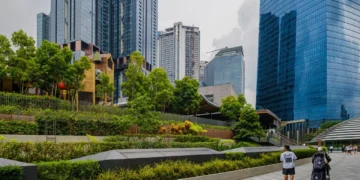
In major cities, another trend is shaping the future of offices: highly amenitized buildings designed to function as ecosystems.
These large, multi-tenant properties offer shared facilities such as gyms, restaurants, event spaces, and cultural amenities. These types of buildings allow companies to access experiences and amenities that would be difficult or expensive to provide on their own.
For smaller companies, these buildings provide access to experiences they could not offer independently. Even large organizations sometimes lease smaller spaces within these environments because the surrounding amenities enhance the workplace experience.
The result is a model where companies rely partly on the building itself to deliver the workplace environment employees expect.
Why AI May Strengthen the Role of the Office
Artificial intelligence is also influencing workplace planning in unexpected ways.
While AI may change how certain tasks are performed, it also gives organizations better tools for understanding how offices support collaboration and productivity.
As Price noted during our conversation, companies can now test designs virtually, analyze usage patterns, and refine layouts before investing heavily in construction or renovation.
Instead of guessing how spaces will function, companies can experiment with data and simulations. In that sense, AI is less a replacement for the office and more a tool that helps companies design workplaces more effectively.
The Office Is Becoming a Strategic Asset
As organizations rethink how work happens, the office is taking on a more deliberate role.
Rather than serving simply as a location for desks, it is becoming a place designed to strengthen culture, support collaboration, and reinforce a company’s brand.
For leaders, the question is no longer just how much space they need. The real challenge is how to create environments that help employees perform at their best while supporting the broader goals of the business.