




Disagreements at work are inevitable, but what if conflict could become a catalyst for productivity rather than tension? Most of us collaborate closely with others, so conflict is unavoidable. The question is: must it always be so disruptive (and costly)?
Healthy conflict is now recognized as a driver of growth, innovation, and stronger teams.

Effectively managed conflict pushes teams to challenge assumptions and tackle complex problems, driving deeper understanding and often leading to more creative solutions. Ignoring or avoiding it may feel safer in the short term, but organizations that fail to address disagreements will eventually stagnate.
Conflict should not always be seen as simply a failure of organizational culture—it often shows that people genuinely care about outcomes. The real failure is not giving employees the tools to handle it constructively. When approached wisely, conflict becomes an opportunity to strengthen teams and help them thrive together.
The High Cost of Unresolved Conflict
In fast-paced business environments where efficient teamwork and decision-making are essential, unresolved conflict is a costly risk that organizations often overlook.
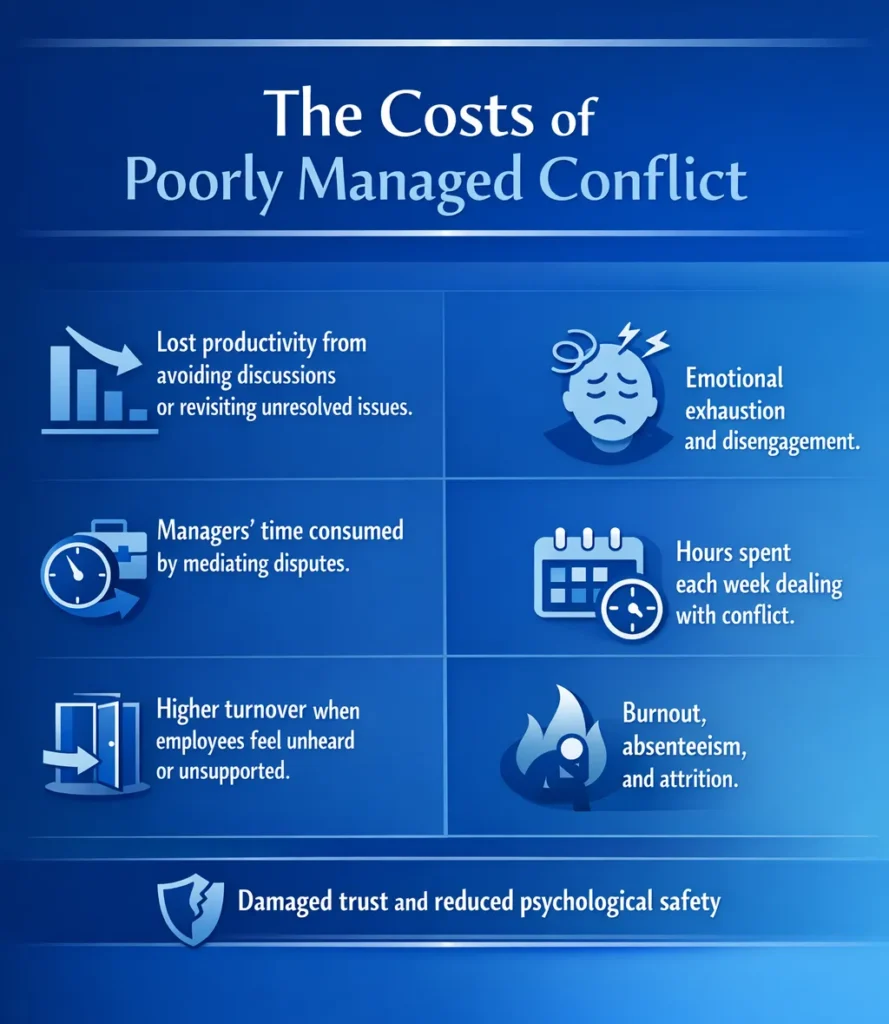
In the U.K., the financial toll of workplace conflict is a staggering £28.5 billion annually (around £1,000 per employee). Those costs take multiple forms: turnover, disciplinary processes, stress-related absenteeism, and significant time spent on grievance procedures. When conflicts escalate, the costs also accelerate. A single resignation tied to unresolved conflict can cost an organization more than £31,000, and cases that reach formal tribunals can exceed £44,000.
An estimated 10 million people in the U.K. experience workplace conflict each year. Conflict has real consequences: when teams see disagreements ignored or mishandled, morale declines, trust erodes, and employees stop raising concerns or challenging ideas. Unresolved, persistent tension leaves one in three U.K. professionals burnt out, and leads to lost earnings, stalled careers, lower pension contributions, and higher stress-related healthcare costs. According to the CIPD, employees involved in conflict are also twice as likely to consider leaving within the year.
In the U.S., workplace conflict affects around 85% of employees, who spend an average of 2.8 hours per week on disputes. This amounts to a substantial loss of real time and productivity across entire workforces.

Dr. Kimberley Best, RN, MA, mediator, conflict management expert, and founder of Best Conflict Solutions, LLC, has seen it all firsthand. She told Allwork.Space, “Workplace conflict costs U.S. employers an estimated $359 billion annually in lost productivity. Add to that increased turnover, absenteeism, disability claims, litigation, and reputational damage. Beyond the financial toll, there’s the human one: anxiety, disengagement, talented people walking away, and teams fractured by unresolved tension.”
A key driver of these losses is a lack of preparation, as indicated by the fact that 60% of workers have never received basic conflict-resolution training. Unmanaged conflict drains time, energy, and performance. Addressing disagreements early and equipping employees with the skills to handle them is, therefore, crucial for business success.
 Conflict Management: The Skill Organizations Keep Ignoring
Conflict mitigation is one of the most critical workplace skills, yet many organizations continue to overlook or underdevelop it. This often stems from a persistent bias favoring technical over relational abilities, leaving professionals ill-equipped to manage disagreements constructively. While workplaces continue to invest heavily in technology, they rarely train people to handle conflict—despite evidence that effective conflict resolution reveals gaps in understanding, initiates creative problem-solving, and ultimately strengthens working relationships.
Dr. Best emphasized that in 2025, broader social and political tensions were directly affecting workplace dynamics, making conflict resolution skills essential rather than optional:
“Political polarization, social division, and heightened tensions didn’t stay outside the office door. They walked right in. Incivility in the workplace increased. So did aggression, hostility, and in some cases, violence. Many organizations discovered that their teams lack the fundamental skills to navigate disagreement, change, and difficult conversations, and the cost has been staggering.”
Dr. Best notes that whether conflict arises from AI adoption, DEI debates, return-to-office policies, or broader cultural tensions, the underlying issue is often the same: employees lack the skills to navigate disagreement constructively. Leaders frequently make the mistake of ignoring conflict or treating it as a “people problem” rather than addressing it as a skills gap. Unaddressed tension does not disappear—it festers, escalates, and can drive people away, even when most employees genuinely want to collaborate.
Why Developing Conflict Management Skills Matters
Knowing the cost of unresolved conflict is one thing; building the capacity to handle it effectively is another. Conflict competence (the ability to disagree constructively, repair relationships, and prevent tension from compounding) is strategically important to the future of work. Many organizations, however, still consider it an innate trait rather than a skill that can be developed.
Dr. Best emphasizes that organizations in 2026 must prioritize teaching employees how to manage and engage productively in conflict. Tension is a natural part of growth and change, but without the skills to handle it, even the best tools and strategies fail when tensions rise.

Dr. Best highlights five reasons why building conflict competency—helping people manage and navigate disagreements productively—should be a strategic priority:
- Retention improves when employees feel equipped to address issues directly rather than suffering in silence or resigning.
- Innovation requires disagreement. Teams that can challenge ideas without damaging relationships produce better solutions.
- DEI efforts stall without these skills. Inclusion means working through genuine differences in perspective, experience, and values. That takes practice.
- AI adoption creates uncertainty (and uncertainty breeds conflict). Leaders need teams that voice concerns and problem-solve together.
- Trust is built through repair, not perfection. When people know how to work through ruptures, psychological safety increases. Manager effectiveness depends on it.
Dr. Best is unequivocal that organizations that pair their investment in digital tools with an equal focus on communication and conflict skills will be far better prepared for the demands of the future workplace.
Empowering Teams to Disagree Well at Work
Effective conflict management relies on communication skills that can be taught throughout any organization. It begins with active listening and the discipline to pause and reflect before replying, which minimizes misunderstandings and demonstrates respect. Recognizing different communication styles can also reduce unnecessary tension. Equally important is accountability: healthy teams acknowledge mistakes promptly, and leaders who model repair after conflict demonstrate that relationships can endure disagreement. Underpinning all of this is psychological safety—a condition that exists only when organizations actively welcome dissent rather than reward quiet consensus.
Traditional approaches, such as role-plays or HR-led interventions, often fall short, while emerging AI tools help bridge this gap by enabling employees to practice difficult conversations in simulated scenarios (developing the empathy and emotional intelligence required in real situations).
Dr. Best emphasizes that the biggest skill gap in leaders is recognizing that they work with people, not “widgits.” She believes effective management requires understanding conflict, listening actively, fostering accountability, facilitating difficult conversations, and practicing servant leadership. To address this, she developed the Best Conflict Conversation Cards—a 50-card, evidence-based tool to strengthen conflict resolution skills. Twenty Story Cards present realistic workplace scenarios to explore triggers and perspectives, while thirty Skills Cards teach strategies for clear communication, emotional regulation, and de-escalation. Organizations use the deck in leadership programs, team meetings, onboarding, and mediation preparation, turning difficult conversations into practical skill-building opportunities.
Organizations that wait for conflict to reach a crisis point often incur unnecessary costs. Early intervention is therefore one of the most effective strategies, and action should be taken before tension becomes entrenched. Mediation is most effective when available as a standing resource rather than a last resort, providing a structured, neutral space to address disagreements before they escalate.
| What Effective Teams Do | What It Leads To |
| Challenge assumptions and actively invite diverse perspectives | More innovative, well-rounded solutions and reduced groupthink |
| Create psychological safety so people can speak openly without fear | Honest dialogue, stronger idea generation, and higher engagement |
| Focus discussions on ideas rather than individuals | Higher-quality decisions with less interpersonal friction |
| Encourage respectful challenge and structured debate | Faster problem-solving and more robust, tested outcomes |
| Practice mindfulness and emotional regulation during disagreements | More thoughtful responses and fewer reactive escalations |
| Adopt a collaboration-oriented mindset | Solutions that balance different needs and perspectives |
| Reframe conflict as an opportunity to learn and improve | Greater engagement, continuous learning, and stronger dialogue |
Conflict as a Catalyst, Not a Crisis
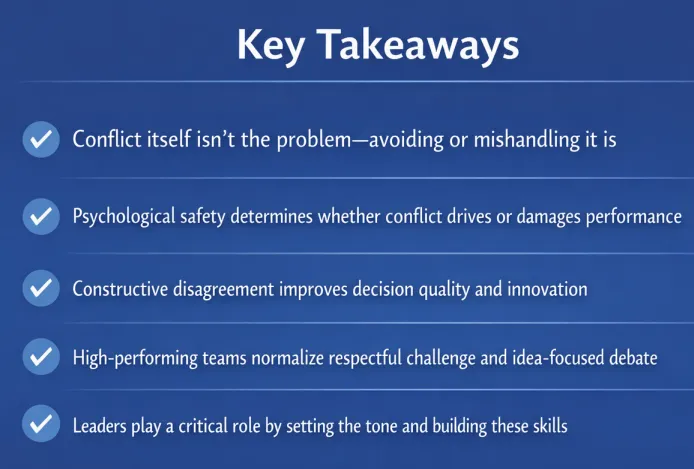
No one welcomes conflict, but the problem is not disagreement itself. High-performing teams leverage it as a tool for learning and improvement. Leaders enable this by framing disagreement as a signal that something meaningful is at stake.
When employees trust that their ideas will be heard, conflict becomes productive. Teams test assumptions, uncover blind spots, and refine proposals. Constructive, idea-focused debate improves decision-making, drives faster innovation, and strengthens the integration of diverse perspectives. In practice, this means encouraging respectful challenge, focusing on ideas rather than personalities, and creating structures that normalize healthy debate.
Handled well, conflict signals engagement—it shows people care enough to challenge one another and pursue better results. As Dr. Best notes, “Conflict is inevitable. Dysfunction is optional.”